Axios Seattle

February 19, 2026

It's Thursday. Good morning to everyone who checked three weather apps before deciding on a jacket.
⛅ Today's weather: Partly sunny, with a high of 42 and a low of 29.
🎂 Happy birthday to our Axios Seattle members Ken Glass, Mark Dyce, and Sherrill Hooke!
Today's newsletter is 979 words, a 3.5-minute read.
1 big thing: 👀 State eyes plate data limits

Washington state lawmakers are advancing a bill that would set the state's first ground rules for regulating automated license plate readers (ALPR).
Why it matters: Washington has positioned itself as a safe haven for immigrants, abortion patients and those seeking gender-affirming care, but privacy advocates warn these protections and others can ring hollow when surveillance data is tapped by federal or out-of-state agencies.
License plate readers don't just capture information on stolen cars — they create searchable databases of where vehicles travel, according to Tee Sannon of the ACLU Washington.
- Once pooled into regional or national networks, those scans can be used to reconstruct daily routines, clinic visits or political activity.
- Without a statewide law, a patchwork of local policies leaves the door open to informal sharing, subpoenas or misuse, critics say.
Driving the news: Senate Bill 6002 passed the Senate 40-9 in a bipartisan vote Feb. 4 and received a public hearing in the House this week.
By the numbers: Under the current version of the bill, agencies must delete ALPR data within 21 days.
- Specialized data would also be purged on strict timelines: four hours for commercial vehicle enforcement, 12 hours for parking and 30 days for traffic studies.
What they're saying: "This is not a partisan issue. This is not a police issue. This is about being a private citizen in the state of Washington," Sen. Jeff Holy (R-Cheney), the bill's co-sponsor, said during a public hearing.
- Holy said people have a reasonable expectation of privacy in their daily movements — from dropping kids off at school to attending religious services or visiting a doctor.
- "These cameras vacuum up all data, regardless of whether there's criminal wrongdoing," he said.
The initial draft proposed a 72-hour limit for ALPR retention, but it was amended to 21 days following feedback from law enforcement.
The big picture: The debate comes amid growing national scrutiny of surveillance technology — from police camera networks to doorbell systems.
- Privacy advocates argue that the longer data exists, the greater the risk it could be accessed or shared beyond its original purpose.
What we're watching: Whether the House Civil Rights & Judiciary Committee moves the bill forward before a key deadline next week.
2. 💰 Hawks for sale
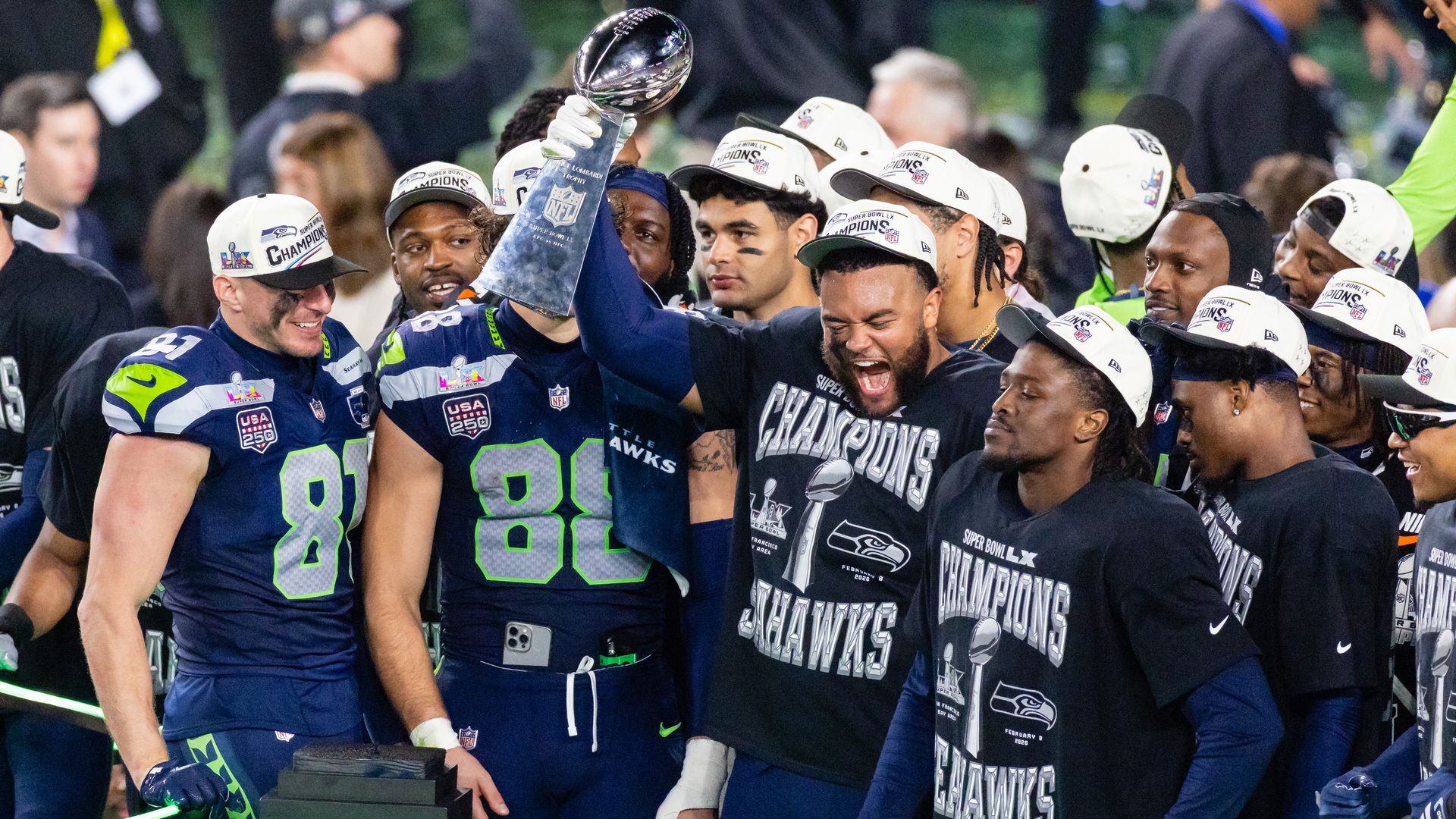
Fresh off a Super Bowl victory, the Seattle Seahawks are being put up for sale, the team announced Wednesday.
The big picture: Selling the team aligns with directions laid out by late Seahawks owner Paul Allen, whose estate continues to own the team, the Seahawks said in Wednesday's announcement.
- Allen's instructions were "to eventually sell his sports holdings and direct all Estate proceeds to philanthropy," the team said.
What they're saying: "This is the first time a team that won the Super Bowl has been put up for sale in the same year," writes Bob Condotta of The Seattle Times.
Flashback: Allen, Microsoft's co-founder, agreed to buy the Seahawks in 1997 and was a controlling owner until his death in 2018, The Athletic reported.
Yes, but: NFL rules state that a team's controlling owner must be an individual, per The Seattle Times — not an entity like the Paul G. Allen Trust.
What's next: The sale process is expected to continue through the 2026 offseason, per the team's announcement.
- NFL owners must ratify a final purchase agreement, the team said.
3. Morning Buzz: 🐓 Big chicken debut
🍗 Seattle's first Raising Cane's opened in the U-District Tuesday, drawing overnight lines as eager customers camped out ahead of the debut. (KING 5)
⚡️A former Microsoft energy executive is helping lead an AI infrastructure startup that's drawing takeover interest as it locks down massive power deals for data centers. (Axios)
✈️ Alaska Airlines has opened a 660,000-square-foot training center in Renton for Alaska and Hawaiian Airlines employees, consolidating operations previously spread across SeaTac. (MyNorthwest)
4. 🤰 Charted: Rise of solo moms


More new moms are having kids solo in their 40s, a trend that is reshaping how families are built in the Evergreen State.
🧮 By the numbers: In Washington, 1.1% of babies were born to unmarried women 40 and older in 2024 — more than twice the roughly 0.42% in 2007.
- Nationally, 40% of babies were born to unmarried women in 2023 and more than 1% of babies were born to unmarried women 40 and older in 2024.
Yes, but: "Unmarried women" can include cohabitating couples.
What they're saying: "The majority of our members are having children via fertility [treatments]" and are in their "30s and 40-plus," said Kat Curtin, director of the international Single Mothers by Choice support group.
- Members typically have "dated, come into their career, come into their life" and are ready to start a family, she said.
- "You don't go down this path and be confident that you can raise a child by yourself unless you have a level of independence and resiliency."

5. 🥺 Cute cub cam
Seattle's newest royalty boasts fur, fangs and ridiculously adorable faces.
Woodland Park Zoo recently released a video of the two female African lion cubs who were born last month to first-time mom Ilanga and dad Tandie.
- One month in, they're bigger, brighter-eyed and already showing off their playful streak.
The cubs will remain off-view with Ilanga while they grow stronger and wait for outdoor temps to hit 50° before making their public debut, per the zoo.
🦮 Melissa is happy that her dog, Eddie, got a clean bill of health at the vet yesterday. Not bad for a 10-year-old guy!
⛺️ Clarridge is decking out her car for camping.
This newsletter was edited by Geoff Ziezulewicz.
Sign up for Axios Seattle