Axios Seattle

December 16, 2024

It's Monday. Hope you had a good weekend.
🌧️ Today's weather: Rain likely. High near 47.
🎂 Happy birthday to our Axios Seattle member Tameem Ansari!
Today's newsletter is 750 words, a 3-minute read.
1 big thing: 🛒 Hunger on edge
Food bank visits in Western Washington jumped 25% this year, officials say, driven by stagnant wages, rising costs, and more families living on the financial edge.
Why it matters: The surge in food bank visits across Western Washington is part of a larger national trend, highlighting the precarious financial footing of millions of Americans.
The big picture: Hunger relief organizations anticipated a surge in need during the pandemic but have been surprised to see it continue rising, said Food Lifeline spokesperson Mark Coleman.
By the numbers: Visits to more than 500 food banks and meal programs across 17 Western Washington counties climbed from 8 million in 2023 to 10 million this year, Food Lifeline spokesperson Mark Coleman told Axios.
- Before the pandemic, Food Lifeline served about 800,000 people annually.
- During the pandemic, that number rose to 1.1 million and has continued increasing, reaching 1.5 million in 2023 and 1.7 million in 2024, Coleman said.
Zoom in: Since 2021, food costs in Western Washington have risen by 20%, making Seattle's food expenses the fourth highest in the nation, according to Food Lifeline.
- That, combined with a rising cost of living and stagnant wage growth among low to middle income workers has put people in a difficult position, Coleman said.
Between the lines: Food insecurity is no longer limited to areas historically tied to need, like the Central District and Chinatown-International District, Coleman said.
- The West Seattle Food Bank has experienced a 30% increase in demand every year since 2020, development director Robbin Peterson told KING 5.
- "You think West Seattle and you think 'view homes', but some of our busiest locations are places you might not expect, like the Ballard Food Bank, Edmonds Food Bank, and Eastside areas like Bellevue, Kirkland, and Redmond."
What's next: Food Lifeline has the goal of providing enough food for local food banks to create 164,000 meals daily for people next year while addressing the root causes of hunger, per Coleman.
What to do: Volunteer or donate to either Food Lifeline or your local food banks, said Coleman, and sign up for advocacy alerts on issues affecting food security.
Give back
We're so thankful to our members for their support of our work through their contribution to our newsroom.
If you join as an Axios Seattle member, you'll get insider notes from the team, birthday shoutouts in the newsletter and other perks.
- Plus, you'll be part of our growth and ensure that our news is always free and accessible to the community.
We're grateful for your trust and continued readership.
2. 📌 Office rebound
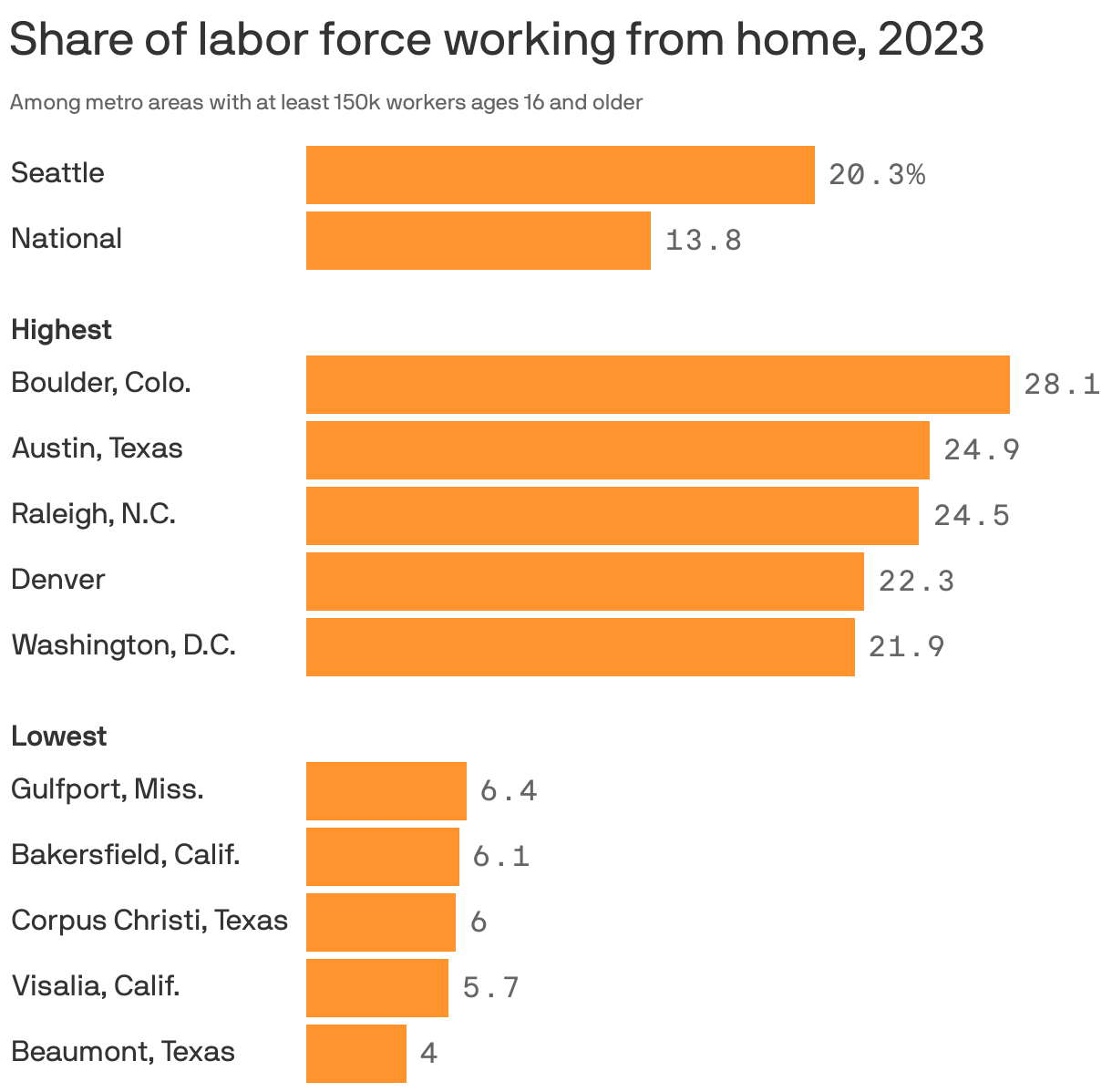
Just over 1 in 5 workers in the Seattle metro were still clocking in from home as of 2023, per the latest census data, down from nearly 50% three years ago.
Why it matters: The debate over remote and hybrid work is reshaping downtowns, office parks, suburbs, and the businesses and services that depend on them even as it continues to evolve.
By the numbers: 20.3% of the Seattle metro area's 2.1 million workers aged 16 and over were working from home in 2023, per Census Bureau data.
- That's the 10th highest percentage nationally after Boulder (28%), Denver (22%) and Portland (21%), among others.
Flashback: The share of workers in Seattle who said they primarily worked from home in 2021 — 46.8% — was almost triple the national average of 17.9%.
The big picture: The trend over the last few months has been a slow but steady return to the land of cubicles, watercooler chitchat, and harsh fluorescent light.
- The return-to-office push is a sign that employers are gaining more leverage over workers, Axios' Emily Peck writes.
- Amazon workers have been told to return to the office five days a week starting Jan. 2. City and county employees are also facing new return policies in the new year.
What's next: The incoming Trump administration is likely to push the country's federal workforce back into the office — largely as a way to trim headcount.
3. Morning Buzz: 🎯 Prime time politics

🎁 Amazon confirmed a $1 million cash donation and $1 million in-kind support to broadcast President-elect Trump's inauguration on Prime Video, as Trump signals warmer ties with Big Tech, including a planned meeting with Amazon founder Jeff Bezos this week. (Axios)
🚨 The Seattle City Council is considering a proposal to repeal restrictions on police use of "less lethal" weapons, allowing officers to use tear gas, blast balls, and other weapons for crowd control. (PubliCola)
💡 High winds knocked out power to over 78,000 Puget Sound residents on Saturday. (Seattle Times)
4. 🏈 Seahawks stumble
The Packers dominated the Seahawks last night, holding Seattle to 208 yards and knocking QB Geno Smith out with a knee injury.
Why it matters: The Seahawks and Rams are tied at 8-6 atop the NFC West, but the Rams hold the advantage thanks to their head-to-head win over Seattle earlier this season.
What's next: The Hawks take on the Vikings at Lumen Field Sunday at 1:05pm.
🎁 Melissa is taking a few days off.
🐾 Clarridge is trying to resist her sister's offer of a red border collie puppy.
This newsletter was edited by Rachel La Corte.
Sign up for Axios Seattle


/2024/12/13/1734113196159.gif?w=3840)