Axios Seattle

November 26, 2024

It's Tuesday!
🌥️ Today's weather: Mostly cloudy. High near 47.
📚 Situational awareness: Seattle Public Schools superintendent Brent Jones is withdrawing his recommendation to close four elementary schools, KUOW reports.
- "It is clear there is no longer a pathway for this approach for the 2025-26 school year," Jones wrote in a letter to families yesterday.
🦃 We are thankful for our Axios Seattle members this holiday season, consider joining them today.
🎂 Happy birthday to our Axios Seattle member Bill Henneger!
Today's newsletter is 902 words, a 3.5-minute read.
1 big thing: Windstorm havoc
Last week's bomb cyclone was among the region's most destructive windstorms in the last six decades, according to the National Weather Service in Seattle.
Why it matters: Last Tuesday's storm brought hurricane-force winds to parts of the Puget Sound area, killed two people and cut power to over half a million customers, some of whom still did not have electricity Monday.
- Though not as powerful or destructive, a second windstorm last Friday downed more trees and slowed cleanup, NWS meteorologist Steve Reedy tells Axios.
By the numbers: In most of King County, top wind speeds were around 40 to 50 mph, but Enumclaw and Mount Rainier saw gusts of 74 and 77 mph, respectively, Reedy says.
Flashback: The 1962 Columbus Day storm is the most powerful recorded windstorm to hit the Pacific Northwest, Weather Service meteorologist Dana Felton tells Axios.
- The storm, which began as a typhoon, brought winds over 100 mph to the Washington coast and killed more than 50 people between Vancouver, B.C., and San Francisco, including nine in Washington.
- The Hanukkah Eve storm of 2006 claimed the lives of 14, including eight from carbon monoxide poisoning, and left around 1.5 million people without power for up to 11 days, per HistoryLink.
- The Inaugural Day storm of January 1993, which brought 94 mph winds to Puget Sound, left six dead and over 600,000 without power.
What happened: Last Tuesday's storm was a rare example of a mountain wave in Washington, a phenomenon more commonly seen in places like Colorado, says Felton.
- A mountain wave occurs when strong winds flow over a mountain, creating turbulent gusts with the wind going in different directions as it descends, Felton says.
- Additionally, the winds came from the east, hitting trees that have adapted to withstand winds that typically come from the southwest, he says.
What's next: The storms appear to be behind us for now, says Reedy, with the weather disturbances forecast to head south in the next few days.
- "That's going to take most of the wet weather with it and give us a dry holiday," he says.
2. Mapped: Our STI rate
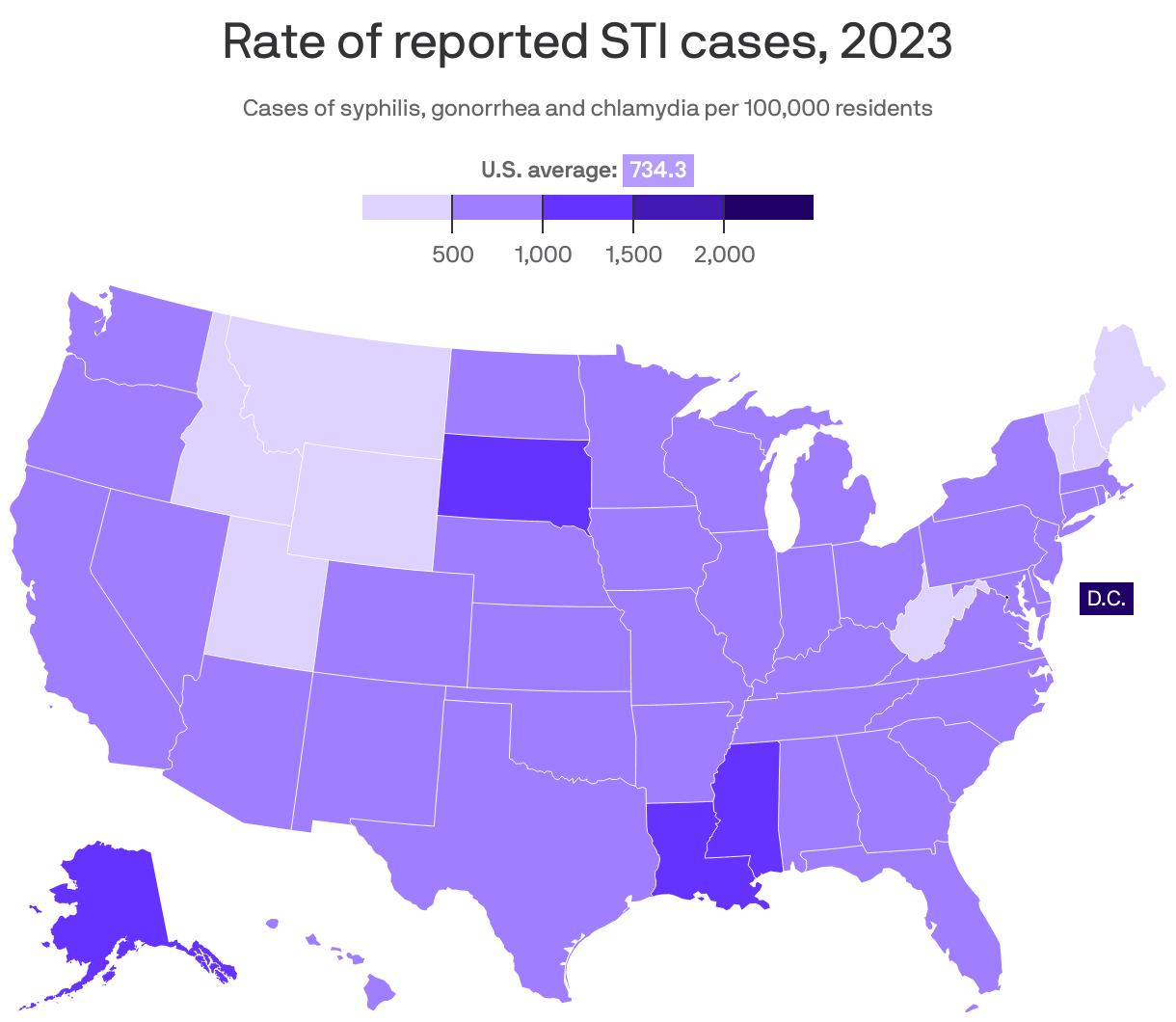
Washington's rate of sexually transmitted infections remains lower than the national average, despite a statewide rise in syphilis cases last year, per CDC data released this month.
Why it matters: Left untreated, syphilis can cause brain damage, blindness and heart problems, while chlamydia and gonorrhea can lead to pain and infertility.
By the numbers: Combined, Washington had roughly 541 cases of those three types of sexually transmitted infections per 100,000 residents last year, according to the CDC.
- Nationwide, the rate was about 734 cases per 100,000 residents.
Zoom in: Washington saw a slight rise in total syphilis cases from 2022 to 2023 — from 56.6 cases per 100,000 residents to 57.4 per 100,000.
- That is more than double the rate of syphilis cases the state recorded in 2019, per the CDC.
What they're saying: In a news release this month, Jonathan Mermin of the CDC said that the latest nationwide figures, although improved, show a need for "further investment in STI prevention."
3. Morning Buzz: In-office sticker shock

📌 Back to work mandates are costing some Puget Sound residents hundreds of dollars more per month in gas, tolls, parking and childcare. (Seattle Times)
Cornish College of the Arts has sold its last building on Capitol Hill, Kerry Hall, to Seattle Theatre Group for $6 million. The 103-year-old building is on the National Register of Historic Places. (Puget Sound Business Journal)
4. In praise of "fart walks"
Going on a "fart walk" after eating can be good for your health — something you may want to keep in mind if you plan to attend a Thanksgiving feast this week.
Why it matters: Walking after a meal gets your bowels moving, which can reduce bloating and acid reflux, and potentially help prevent Type 2 diabetes, according to experts at the University of Washington.
Catch up quick: Cookbook author Mairlyn Smith has promoted "fart walks" on social media as a way to boost health and help pass gas after eating fiber-rich meals — and the hashtag has been catching on.
What they're saying: Research suggests that walking within about an hour of eating can help regulate blood sugar levels, preventing blood sugar spikes that over time can lead to insulin resistance and diabetes, Christopher Damman, a gastroenterologist and associate professor in the UW School of Medicine, said in a recent blog post.
- "Some studies have suggested even just five minutes of getting your heart rate up — going for a stroll around the neighborhood, doing some jumping jacks — is sufficient to blunt the post-meal spike in blood sugar levels," Damman said.
- Eating whole foods that are high in fiber can also help regulate blood sugar levels.
- But those foods in turn can produce a lot of gas, "making those fart walks even more crucial," the UW says on its blog.
The bottom line: Fart walks have real benefits — just mind who may be walking behind you.
5. Getting Turkey Day ready


You've likely missed the window to thaw your Thanksgiving turkey in the fridge.
Reality check: It takes at least four days to thaw a frozen 16-pound turkey in the refrigerator — and Thanksgiving is two days away.
Yes, but: You can still try the procrastinator's method, which involves placing the turkey in cold water and rotating it every 30 minutes for eight hours.
- This technique requires 30 minutes of thaw time per pound.
- Happy thawing!
🛌 Clarridge is tempted to stay under the covers.
💪 Melissa finally replaced an aging dresser and feels oh-so-functional now that she doesn't have to struggle to open and close drawers.
This newsletter was edited by Rachel La Corte.
Sign up for Axios Seattle


/2024/11/25/1732577491731.gif?w=3840)