Axios Portland

April 14, 2026

🗞️ It's Tuesday. Keep reading for news.
🌧️ Today's weather: Rain, with a high of 54 and a low of 41.
🗓️ On this day: Packy the pachyderm — one of the first Asian elephants to be conceived, born and to survive into adulthood in captivity — was born at the Oregon Zoo on this day in 1962.
🚀 Help power the stories shaping your community by becoming a member today.
Today's newsletter is 746 words — a 3-minute read.
1 big thing: 👀 El Niño signs strengthening

A potentially powerful "super" El Niño may be taking shape, raising the chances for a longer and drier wildfire season in the Pacific Northwest this year.
Why it matters: El Niño — driven by unusually warm Pacific Ocean temperatures — can reshape global weather patterns, push temperatures to record highs, and create conditions for the devastating wildfires and smoke that have increasingly come to define West Coast summers.
Driving the news: One European climate model —the European Centre for Medium-Range Weather Forecasts (ECMWF) — shows ocean temperatures rising steadily toward El Niño conditions, with some projections suggesting the potential for a very strong event later this year.
- There's "real potential for the strongest El Nino event in 140 years," said atmospheric scientist Paul Roundy on X.
- The National Oceanic and Atmospheric Administration's Climate Prediction Center forecast a 61% chance of El Niño developing May through July and lasting through the end of the year.
- A strong El Niño could also push global temperatures toward record highs in 2027.
The big picture: El Niño's effects tend to build over time, but on average, weather conditions in the Pacific Northwest are warm and dry during El Niño events, Erica Fleishman, director of the Oregon Climate Change Research Institute, told Axios.
- That kind of pattern can help dry out vegetation earlier in the season, setting the stage for wildfire risk as summer heat builds.
Yes, but: Recent years haven't always followed the script. A La Niña forecast for the 2025–26 winter fizzled, with parts of the region seeing much lower-than-expected snowpack.
Zoom in: In Oregon, the warm winter has also left much of the state in a snow drought, raising concerns about water supplies and how quickly landscapes could dry out, said Fleishman.
- Snow water equivalent — how much water the snow holds — in Oregon was measured at its lowest recorded level on April 1.
What they're doing: State officials say they are ramping up for fire season: monitoring fuel conditions, staffing crews, and preparing for a range of scenarios as summer approaches.
- Dan Quinones, a district forester with the Oregon Department of Forestry, said he expects "another challenging year."
- "I try not to anticipate things I don't have control over, but I want to prepare for the worst," Quinones told Your Oregon News.
2. Rose City Rundown
🚲 The Ladds 500 — one of Portland's most whimsical cycling events — returned to Ladds Addition for the 10th year over the weekend, where hundreds gathered to ride laps around the neighborhoods iconic rose gardens. (OPB)
📚 Hundreds of parents expressed their fear over school closures at Portland Public School's first community forum after the district announced plans to shutter up to 10 schools. (The Oregonian)
🪴 An Oregon nonprofit is helping incarcerated youth gain job experience through a program where they work in a nursery and help restore the state's natural spaces. (Oregon Capital Chronicle)
3. 🔌 Power price perspective

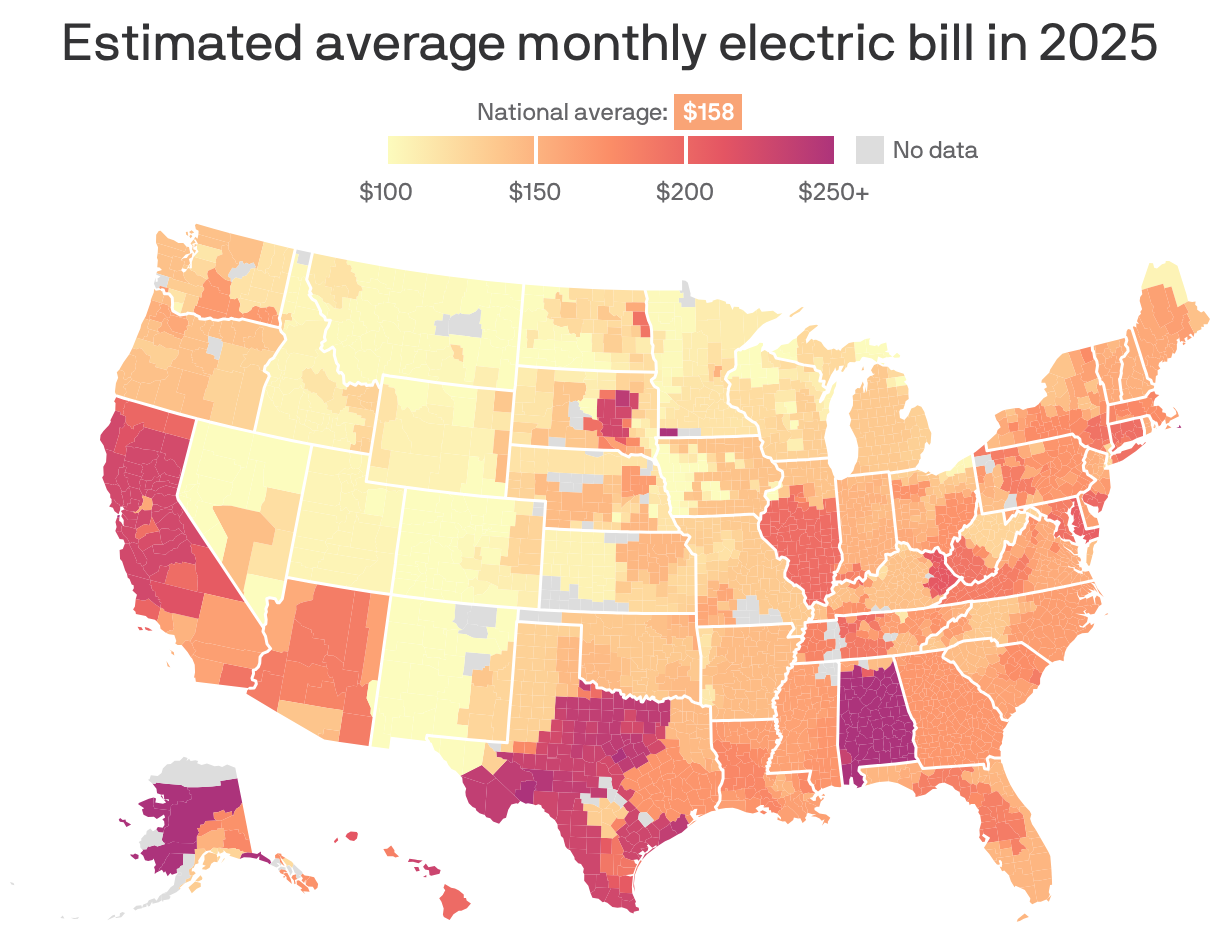
Portlanders pay about $158 a month for electricity, roughly matching the national average, per a new Axios analysis of data from climate newsroom Heatmap News.
Why it matters: Despite sharp rate increases in recent years, Portland residents still pay less than those in some higher-cost U.S. regions.
The big picture: Tensions over rising energy bills and power-hungry AI data centers are emerging as a key political issue.
- Americans are also paying more for other forms of energy, like auto gas, amid the Iran war.
Zoom out: Nantucket County, Massachusetts ($296); San Francisco County, California ($282) and Nobles County, Minnesota ($273) had the highest estimated average monthly electric bills in the continental U.S. across 2025.
Yes, but: Electricity rates have risen by about 50% in Oregon since 2020.
What we're watching: Lawmakers last year passed the POWER Act, meant to protect residential power customers from price hikes caused by the addition of new data centers.
- And in March, the Legislature passed a one-year moratorium on tax breaks for data centers.
😇 Kale is hoping Anthony from the latest season of "Jury Duty" is having a good day.
🍎 Meira is in New York.
This newsletter was edited by Geoff Ziezulewicz.
Sign up for Axios Portland