Axios Northwest Arkansas

April 08, 2026

Welcome to Wednesday. We're glad you're here.
🌤️ Today's weather: Mostly sunny, with a high of 73 and a low of 55.
Today's newsletter is 928 words — a 3.5-minute read.
1 big thing: Families navigate uneven surrogacy laws

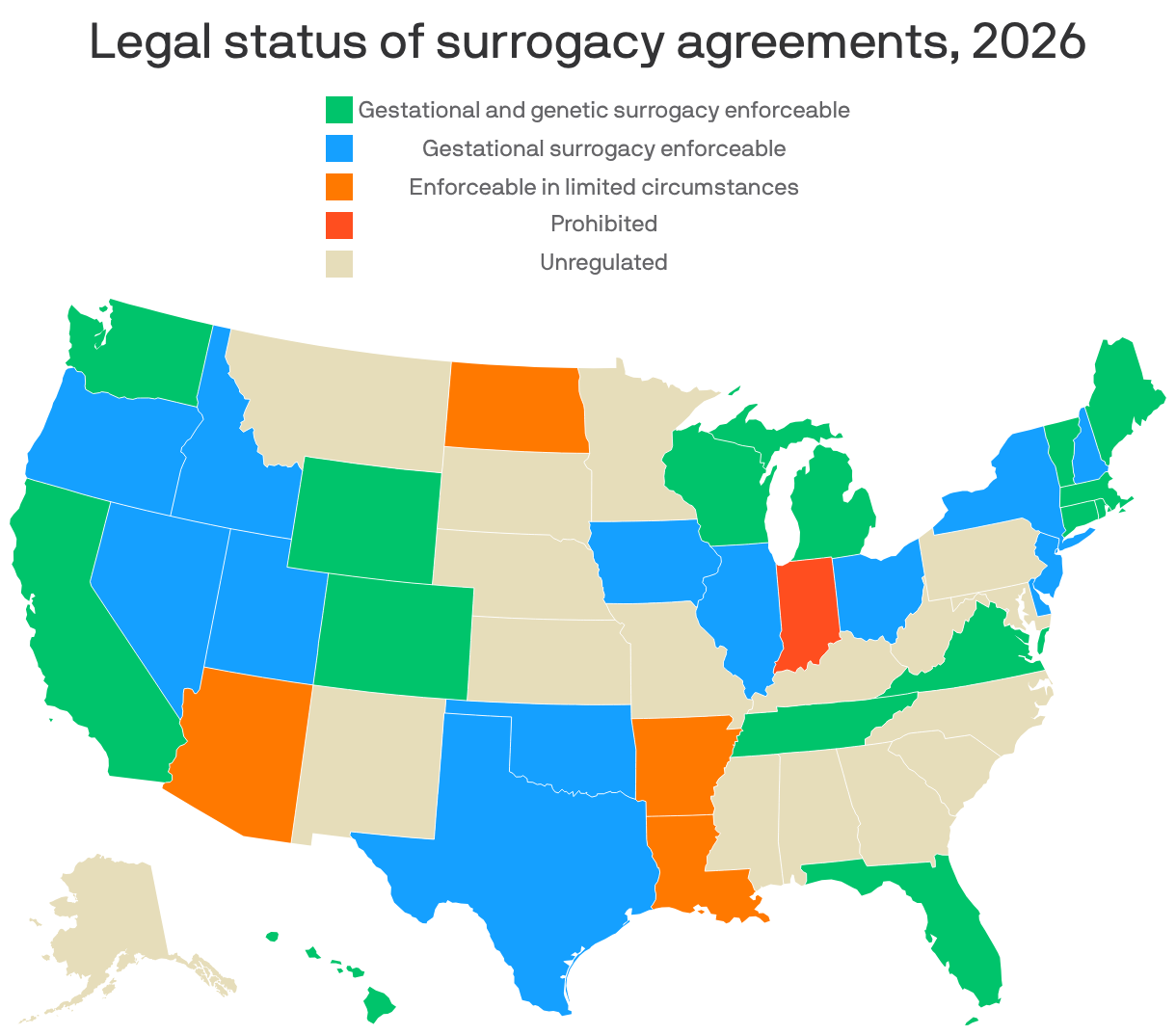
Without a federal law, surrogacy in the U.S. is governed by a patchwork of state regulations that can determine everything from whether agreements are legally binding to who is recognized as a parent at birth.
Why it matters: More Americans are turning to surrogacy to build their families, making ethical, legal and cultural tensions harder to ignore.
- U.S. clinics reported more than 11,500 gestational carrier cycles in 2023 — nearly seven times as many as in 2004, when the American Society for Reproductive Medicine began tracking the data.
How it works: A surrogate carries a pregnancy for intended parents — typically via in vitro fertilization (IVF) with an embryo that uses a donor or the intended mother's egg.
- That's called gestational surrogacy, and the surrogate can be referred to as the gestational carrier.
- It's an option for people who want biological kids but can't — or can't safely — carry a pregnancy.


Major differences between state laws include:
- How a surrogate must be compensated (if not considered "altruistic").
- Who becomes the legal parents of a child born via surrogate.
- Whether genetic surrogacy (when the surrogate uses her own egg) is even allowed.
Some highlights of what's on or not on the books in Arkansas, according to Surrogacy360, include:
- Gestational and genetic surrogacy contracts can be enforced in court, but the law limits which intended parents can enter an enforceable surrogacy contract.
- State law does not address whether a surrogate can be paid beyond reimbursement for expenses.
- Intended parents must be married to each other to enter an enforceable surrogacy contract and can only do so when the intended father is a genetic father.
- The question of whether same-sex intended parents can enter into enforceable surrogacy contracts hasn't been explicitly addressed, but they should be able to if they are married and one is the genetic parent.
- An unmarried biological father may enter an enforceable surrogacy contract, and an unmarried woman may enter an enforceable surrogacy contract using an anonymous sperm donor.
The bottom line: Often, surrogacy agreements happen across state lines, so multiple state laws might need to be considered.
2. Board overturns Swarm Aero classification
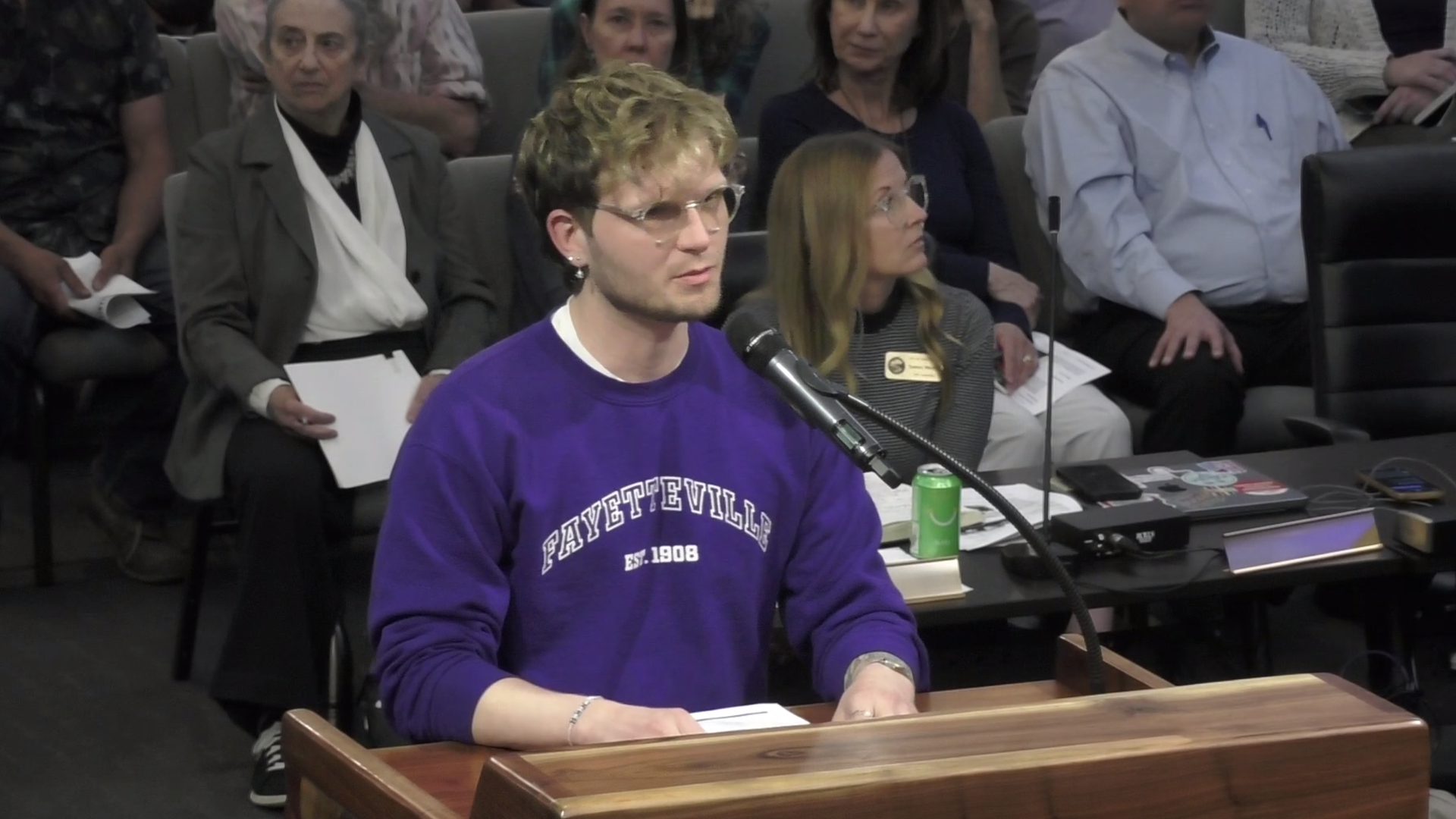
Fayetteville's Board of Adjustments on Monday ruled city planning staff misclassified drone maker Swarm Aero as a "heavy commercial and light industrial" business.
Why it matters: The classification allowed the startup to lease a facility near Drake Field and begin operating without a public rezoning process.
- Swarm Aero must now decide whether to appeal the board's decision, seek to rezone the property on S. School Avenue or move.
Flashback: The appeal came after the company's February arrival caught much of the city by surprise and drew concerns among some residents about safety and noise, as well as ethical issues tied to the defense industry.
Context: The core argument at the hearing dealt with how Fayetteville planning staff classified and zoned Swarm Aero's business.
- The city's zoning code does not classify drone manufacturing, so its staff used existing code and the company's application to make the call.
- Opponents argued the classification was inaccurate, citing the planned 41-foot wingspan of its drones, the use of carbon composites and potential traffic to the site created by its supply chain and other concerns.
By the numbers: For a size comparison, a typical trailer hauled by most semi-trucks is 53 feet long.
What they're saying: The appellant, Jesse Buchanan, told the board that the production of carbon composites would be part of the manufacturing process.
- "And there are some components of this carbon composite production that can be highly flammable … if they are at high temperatures or catch on fire."
The other side: "We respect the concerns raised by members of the community and appreciate the opportunity to engage in an open and transparent dialogue about our aircraft manufacturing facility in Northwest Arkansas," Swarm Aero said in a statement shared with Axios.
- The statement acknowledged that new technologies raise many questions and said the company remains "committed to listening, providing transparency, and ensuring that our presence contributes positively to the broader community."
What we're watching: A spokesperson from Swarm Aero said the company was considering its options and would make a decision in the coming days.
3. Kitchen Sink: News drip
🌾 Arkansas farmers are expected to plant 24% less long grain rice this year, but should plant more soybeans and corn, per the USDA. (Arkansas Democrat-Gazette)
🏥 Mercy Hospital said it will invest $60 million in its Fort Smith operations during the next few years. (5News)
🦃 Turkey hunters harvested 11,332 turkeys in Arkansas during the spring 2025 hunting season, up 22% over the 2024 harvest of 9,296, according to the Annual Turkey Program Report. (Northwest Arkansas Democrat-Gazette)
4. Mark your calendars: Gulley Park concert series

Fayetteville's 30th annual Gulley Park concert series is coming up for those who want to spend their Thursday nights with free live music plus food trucks, an art market and other local vendors.
🗓️ The lineup includes:
- June 4 – Jon McLaughlin
- June 11 – Mae Estes
- June 18 – Jukeboxx
- June 25 – Arkansauce
- July 2 – Barrett Baber
- July 9 – J & the Causeways
🧒 Zoom in: June 18 is "Kidz Night" starting at 6:30pm, and the festival will include obstacle course inflatables, a bounce house, face painting and yard games.
🕖 If you go: Music starts at 7pm each night.
🥪 Alex had a sandwich at Zelli Deli and echoes Worth's praises.
🎸 Worth is now thinking about seeing Bob Dylan and Billy Idol at the AMP, especially after seeing the Bob Dylan Center in Tulsa, Oklahoma.
Sign up for Axios Northwest Arkansas