Axios New Orleans

May 27, 2026

It's Wednesday. Halfway there!
π§οΈ Today's weather: Showers and thunderstorms likely, with a high of 86.
π Happy birthday to our Axios New Orleans members Mats Brastedt, Emily Eagan and Mickal Adler!
ποΈ Situational awareness: Chelsea and Carlie are off this week so the newsletter is in vacation mode.
Today's newsletter is 646 words β a 2.5-minute read.
1 big thing: π³ A popular pest

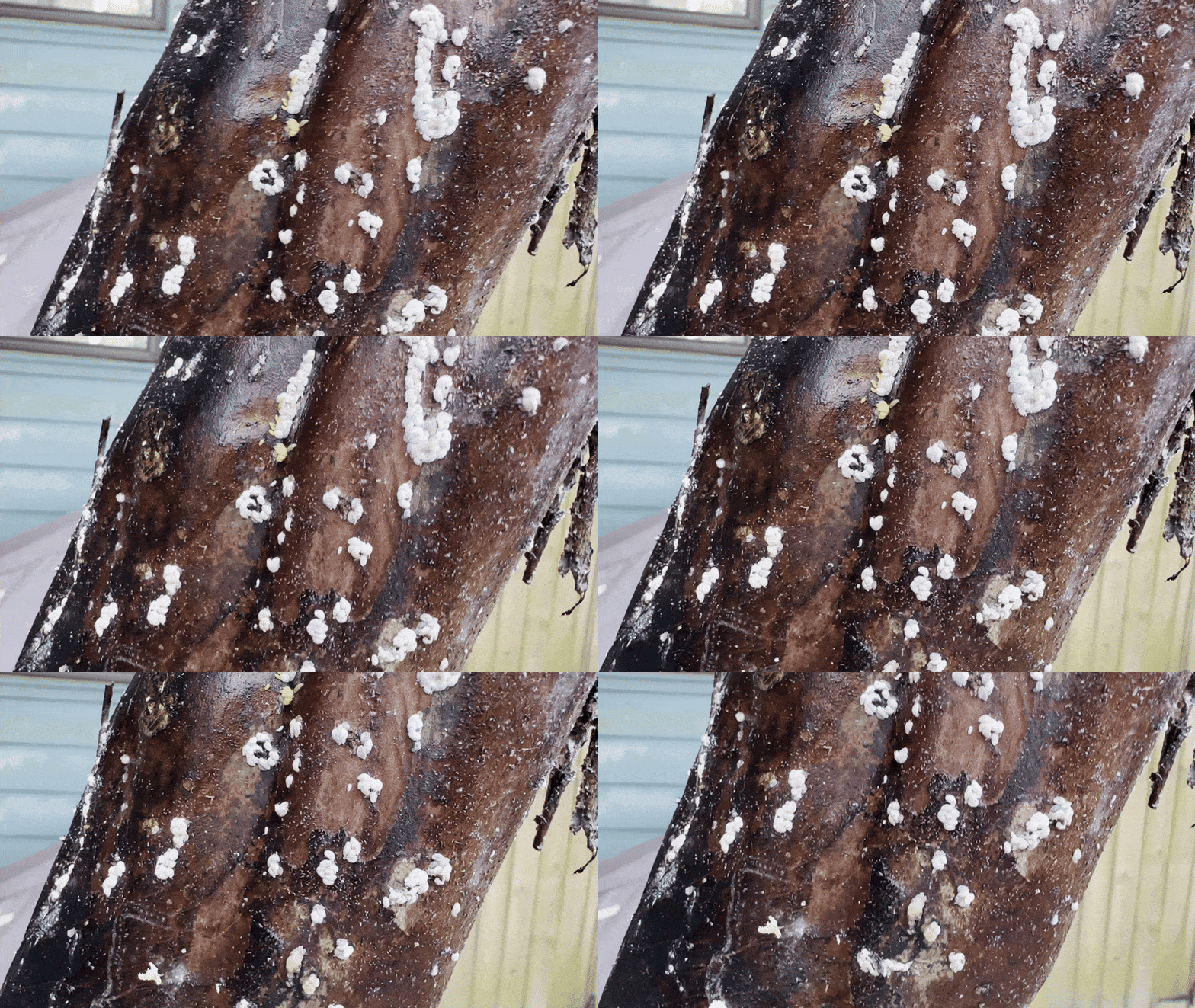
π Chelsea here. The destructive creepy-crawlies known as bark scale came for my crape myrtle seemingly overnight, filing its limbs with sticky, furry little insects that threatened to kill the tree it fed upon.
Why it matters: This was preventable, and you can learn from my mistakes.
The big picture: Crape myrtles aren't native to the U.S., but remain wildly popular.
- "The total number of crape myrtles planted in cities is more like monoculture in" some parts of the state, says the LSU AgCenter's Yan Chen.
- In whole neighborhoods, she says, there might not even be anything else.
Yes, but: That's a problem when pests like feasting on a specific kind of plant or tree.
- "It becomes a continual corridor, a pathway for them to constantly find their food," Chen says.
- And with the popularity of crape myrtles in South Louisiana, so too has there been a rise in the invasive crape myrtle bark scale.
- Chen notes one North Shore example where a neutral ground was filled with about 500 crape myrtles, all of which became infested with bark scale.
Zoom in: Our tree never caused us any trouble until last fall when the bark scale crept in, finding a pathway along the half dozen or so crape myrtles along our street.
- The infestation looked like tiny, furry insects that took over the tree's limbs, which became sticky and covered with a secondary infestation of black, sooty-looking mold. Gross!
- Happily, there is a solution. Unhappily, as Chen notes, "it's impossible to get [the infestation] down to zero."
The bottom line: Crape myrtle bark scale isn't going away anytime soon, especially as climate change makes our region more attractive to the pest, Chen says.
- But it can be managed "as long as you keep an eye on it," she says.
2. Fully Dressed: βοΈ Ahoy, landlubbers!
β΅οΈ The international tall ships begin arriving today for Sail 250. Free tours start tomorrow along the riverfront. (Axios)
π Gov. Jeff Landry is creating a 15-person task force to determine the necessary budget cuts for a permanent teacher raise. The committee will form by July 1 with a goal of finishing by Dec. 31. (WWL)
πΊοΈ A three-judge panel blocked Alabama's efforts to revert to its 2023 congressional maps for this year's elections, despite the Supreme Court's ruling in Louisiana v. Callais. (Axios Huntsville)
- Louisiana state lawmakers are expected to take a final vote this week on their own new map.
π RTA's leadership board appointed Ronald Baptiste to serve as its interim CEO after accepting the resignation of current CEO Lona Edwards Hankins. (The Times-Picayune)
3. πΌ America's dissatisfied workforce
Workers have never been more dissatisfied with their pay or their ability to get ahead. But the likelihood of moving to a new employer is at multiyear lows.
- Those are the bleak findings from a recent New York Federal Reserve Bank survey.
Why it matters: For most workers, switching jobs is the fastest route to a raise or a promotion. But with hiring at historically low levels, that path has all but disappeared.
By the numbers: The share of workers who said they were satisfied with wage compensation fell 3.3 percentage points, to 52.3%, in March, the smallest share in the survey's 12-year history.
The intrigue: Record dissatisfaction is not accompanied by plans to exit, at least not in the near term.
- On average, workers' likelihood that they will have a new employer in the next four months dropped to 9.7%, the lowest since March 2021.
ποΈ Carlie is off.
π£ Chelsea is on parental leave.
Tell a friend to subscribe.
Thanks to our editor Jen Burkett.
Sign up for Axios New Orleans