Axios New Orleans

August 21, 2025

🏈 It's Thursday. Happy Tyrann Mathieu Day!
- The now-retired Saints player will get a key to the city today. Details.
Today's weather: A sunny start gives way to a chance for storms. High of 93.
🧩 Become a core piece of our newsroom when you become a member today.
🎧 Sounds like: "We Made It Through That Water" by the Free Agents Brass Band.
Today's newsletter is 903 words — a 3.5-minute read.
1 big thing: 🌀 Displaced by Katrina
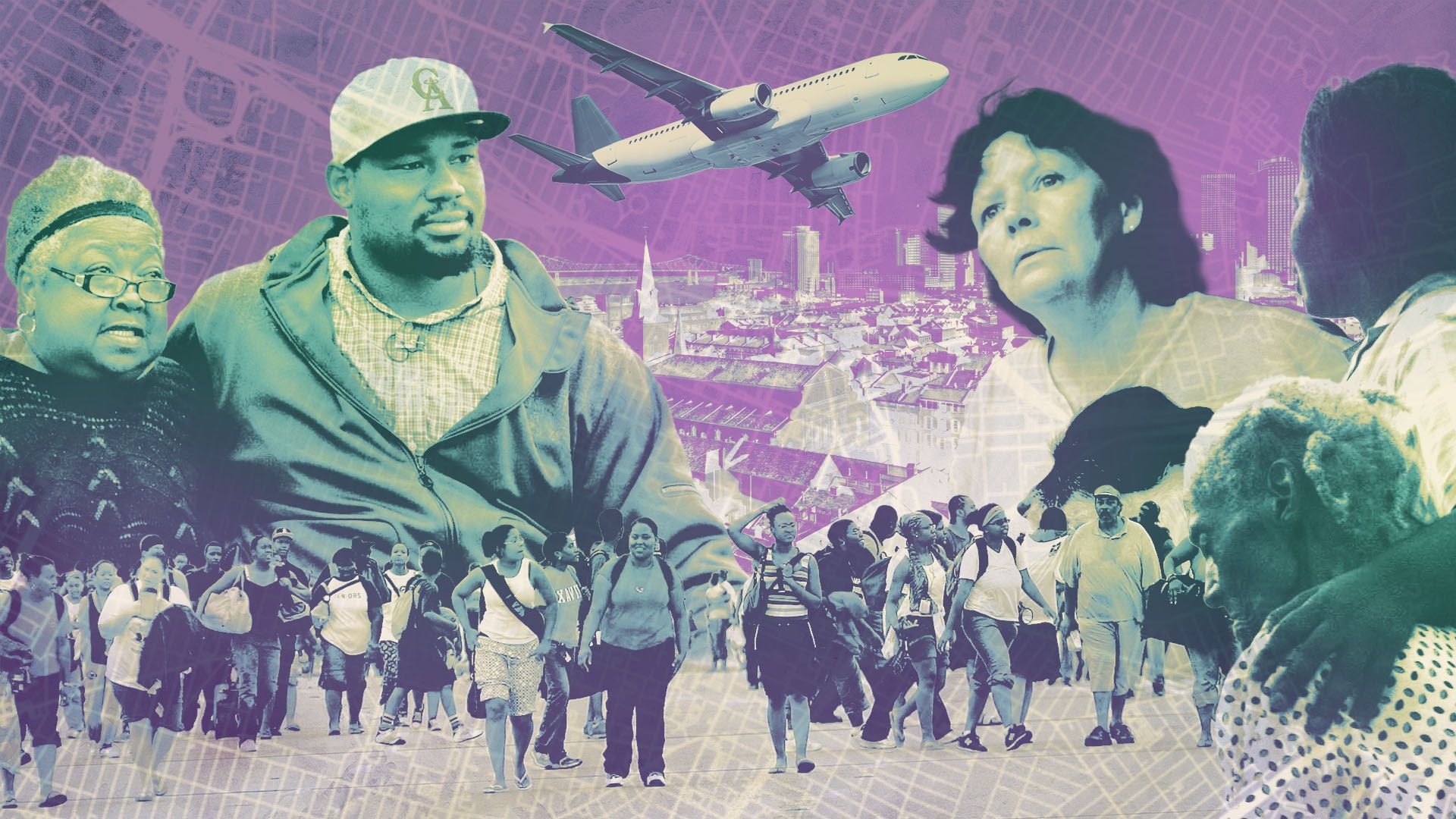
When thousands of New Orleans homes flooded in the aftermath of Hurricane Katrina, the city lost more than half its population overnight.
Why it matters: Residents went somewhere, and we're finally getting a clearer idea of where they landed in a first look at data shared with Axios.
Flashback: Under the city's first mandatory evacuation, New Orleanians began leaving before the storm made landfall on Aug. 29, 2005, fleeing to Baton Rouge, Lafayette, Houston, Atlanta and beyond.
- When the levees broke, thousands more evacuated from a suddenly uninhabitable New Orleans.
- The storm was also responsible for the deaths of nearly 1,400 people, according to the National Hurricane Center, with most "presumably" in Louisiana.
The sodden shell of a city left behind needed to be rebuilt before it could be functional, but it needed to be functional to be rebuilt.
- And New Orleans' population was cleaved in two.
By the numbers: The city's population fell from 484,674 in April 2000 to an estimated 230,172 in April 2006, the Data Center says, a loss of more than 250,000 people.
- The estimated population rose to 362,701 by 2024, despite recent struggles the city and state have faced in keeping and attracting residents.
Yes, but: Ever since the storm, many have tried to get at exactly where these displaced New Orleanians ended up.
- Tracking that, however, has been exceptionally hard to do. Population data tells us trends but doesn't follow individuals.
- In the end, government officials granted only one researcher access to that kind of specificity within the data.
Continued below
2. 👋 What new data says


That person is Elizabeth Fussell, an assistant professor at Tulane University from 2001 to 2007, who's now at Brown University.
- "The challenge is to have longitudinal data on individuals that would show you, 'this person was living in New Orleans at the time of Hurricane Katrina, and here's where they lived the next year, the next year, the next year, up until the present," Fussell tells us. "I have taken up that challenge."
Fussell's research found that 33% of people living in New Orleans when Katrina hit had not returned to the metro by 2006.
- By 2019, her research shows, 30.9% of Katrina-affected New Orleanians still lived elsewhere, though by then, Texas cities had proven stronger at keeping and even attracting more of them.
"People found more reasons to stay in Texas than they did in Baton Rouge or Atlanta," Fussell says.
- "What made the places stickier for some people and less sticky for others? … You need more than friends and family; you need jobs and housing."
3. ⚜️ New Orleanians, wherever they are

In the immediate aftermath, many displaced New Orleanians were referred to as "refugees," a loaded term that emphasized otherness despite a core truth: They were Americans.
- And it was primarily elsewhere in the United States — every single state, according to Fussell — that they settled.
- That is a keenly felt loss for New Orleans, where its neighborhood fabric changed forever.
- But these New Orleanians enriched the places they ended up, too.
These are some of their stories:
🎺 Lonnie Davis established JazzArts in Charlotte, creating a jazz scene in a city that lacked one and educating more than 50,000 students. Her story from Axios Charlotte.
🔄 Diane Chaine moved to New Orleans in 1998, temporarily ended up back home in her native Chicago before returning to New Orleans in 2006 to help rebuild. Her story from Axios Chicago.
🎶 David Brown created a community choir in Columbus, where participants bring arts into area schools and prisons. His story from Axios Columbus.
🏛️ David Faulk lost his home in St. Bernard Parish but found one in Prairie Grove, Arkansas, where he's served as mayor since 2023. His story from Axios Northwest Arkansas.
📣 Did you move away after Katrina? Reply and tell us your story. We might use it in a future newsletter.
4. Fully Dressed: 🍴 New riverfront restaurant
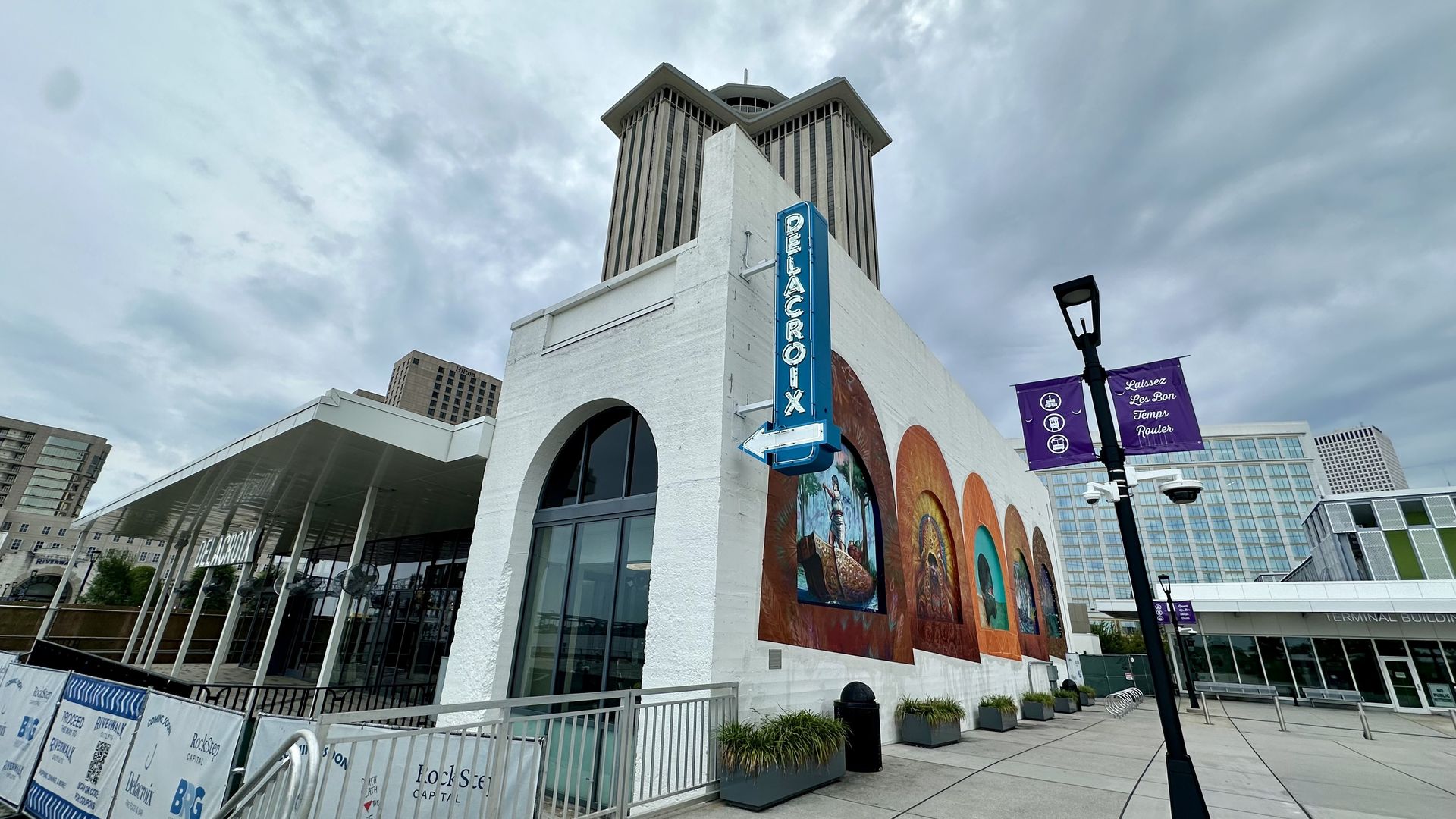
🍽️ Delacroix, the newest restaurant from chef John Besh's BRG Hospitality, is due open at the end of September in a highly-visible riverfront space in Spanish Plaza. To celebrate, the restaurant is offering tastes of the upcoming menu at its sister restaurants. See details.
⚖️ Mayor LaToya Cantrell is expected in court Sept. 10 to enter a plea in her federal indictment. Her former bodyguard, Jeffrey Vappie, is expected to enter a plea in the same appearance. (Fox 8)
🚓 The inmate who was accidentally released from the New Orleans jail was recaptured in Texas. One of 10 inmates who escaped previously remains on the run. (WDSU)
⚡️ State regulators approved Entergy's controversial plan to power the new Meta data center in north Louisiana. (The Times-Picayune 🔒)
🙏 Chelsea has never been more grateful to have cool parents than this week while they house her family during an ongoing AC outage.
👎 Carlie's AC went out the summer of 2020 and it was the worst. She's sending good vibes Chelsea's way.
Tell a New Orleanian to subscribe.
Thanks to our editor Jen Burkett, who's back after successfully beating off a brutal cold.
Sign up for Axios New Orleans