Axios Nashville

August 10, 2026

👋 Good morning, everyone! Nashville is heading back to school tomorrow, and we're marking the occasion with a special edition.
☀️ Today's weather: Sunny, with a high of 96 and a low of 75.
⏰ Situational awareness: Metro Schools is pushing back start times at elementary and high schools this year. The move is based on research that shows students benefit from later start times.
Today's newsletter is 1,054 words — a 4-minute read.
1 big thing: 🛝 School recess is back in play
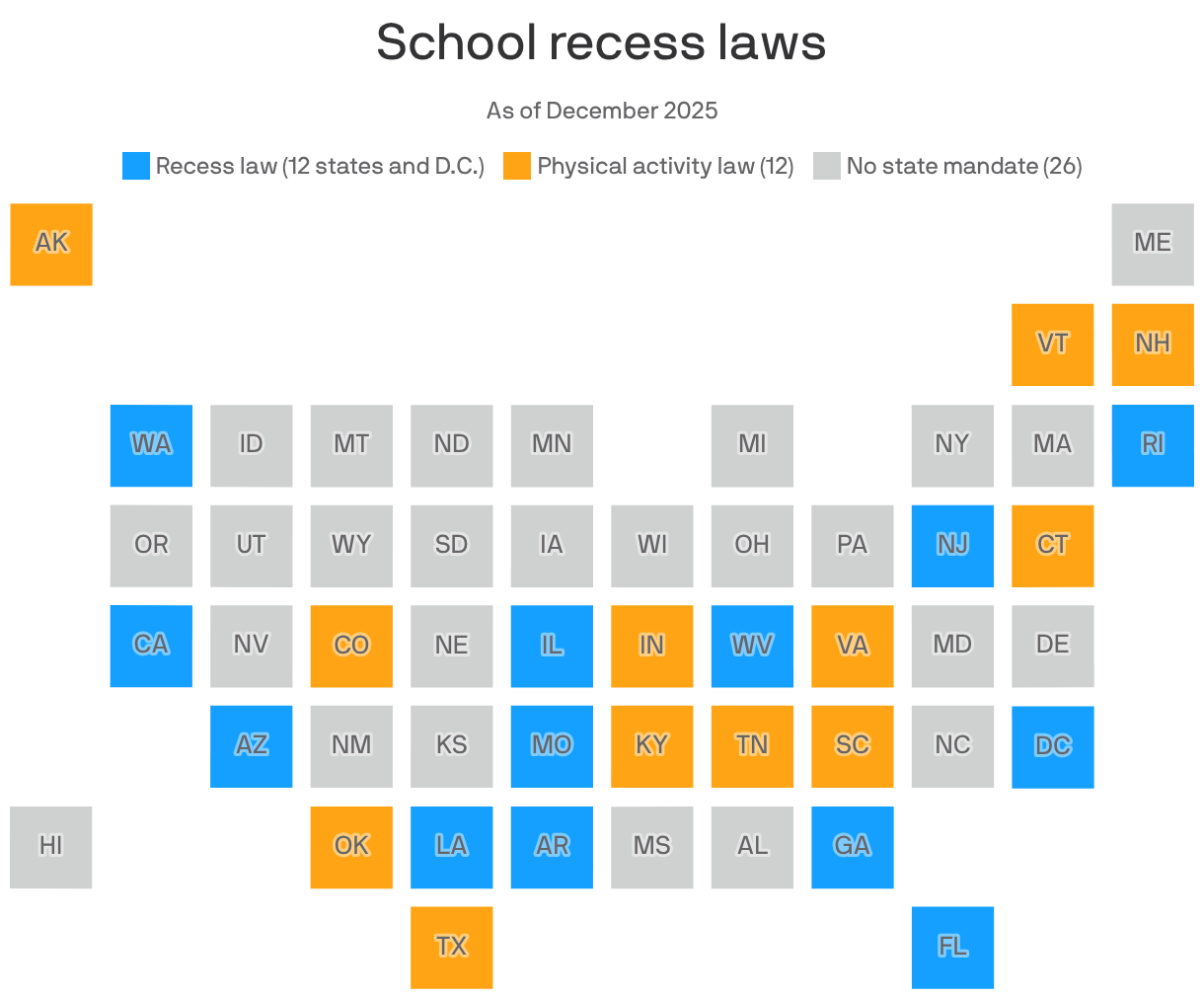
After decades of chipping away at recess, nearly half of U.S. states now require play time or other physical activity by law.
Zoom in: Tennessee expanded its recess requirements in 2025 after a group of Clarksville parents pushed the state to give kids more time to get exercise.
- The law, which passed with broad bipartisan support, requires that elementary school students get a minimum of 40 minutes for physical activity per day. Middle and high school students must get a minimum of 90 minutes per week.
- The law specifies this time should be for "unstructured play" such as jumping rope. PE classes do not count toward the requirement.
Why it matters: Researchers, pediatricians and parents say recess is crucial for young students' physical and mental health.
The big picture: Unstructured play doesn't just teach social skills; research connects it to increased classroom motivation and behavior, better school attendance, and less stress for students.
- And more physical activity could help academic performance.
What they're saying: "Anyone who's ever spent even a day with a kid can recognize that if you kept them sitting all day, they'd go insane, they'd drive everybody else insane," says Hannah Thompson, a physical activity epidemiologist with UC Berkeley's Nutrition Policy Institute.
- Although schools don't tend to fight the idea of recess itself, Thompson says it can be a challenge for administrators to carve out more time and ensure it's not withheld as punishment.
Catch up quick: From 2001 to 2019, weekly recess time in U.S. schools dropped by 60 minutes, education consulting company EAB found.
- One oft-cited factor for the decline: the signing of "No Child Left Behind" in 2002, which led to more time focused on reading, math and school testing.
2. 📈 More AI-driven schools
The high-end, AI-powered private school Alpha Schools plans to grow from a dozen to roughly 50 campuses in the 2026 school year, its founder tells Axios.
- A Nashville location is set to launch this fall.
Why it matters: While traditional schools navigate how to adopt AI, Alpha Schools has created an AI-dependent classroom model that the company claims reduces screen time and increases human interaction.
- Tuition costs $45,000 to $75,000 a year.
State of play: Nashville is one of 27 markets where Alpha plans to open a campus this year. Other new additions include Atlanta, Boston, Charlotte, Chicago, Denver and Raleigh.
- Some of those campuses were previously announced and delayed, largely because of issues with the real estate, says MacKenzie Price, co-founder and CEO of Alpha Schools.
- Alpha's existing locations include campuses in California, Texas and Florida.
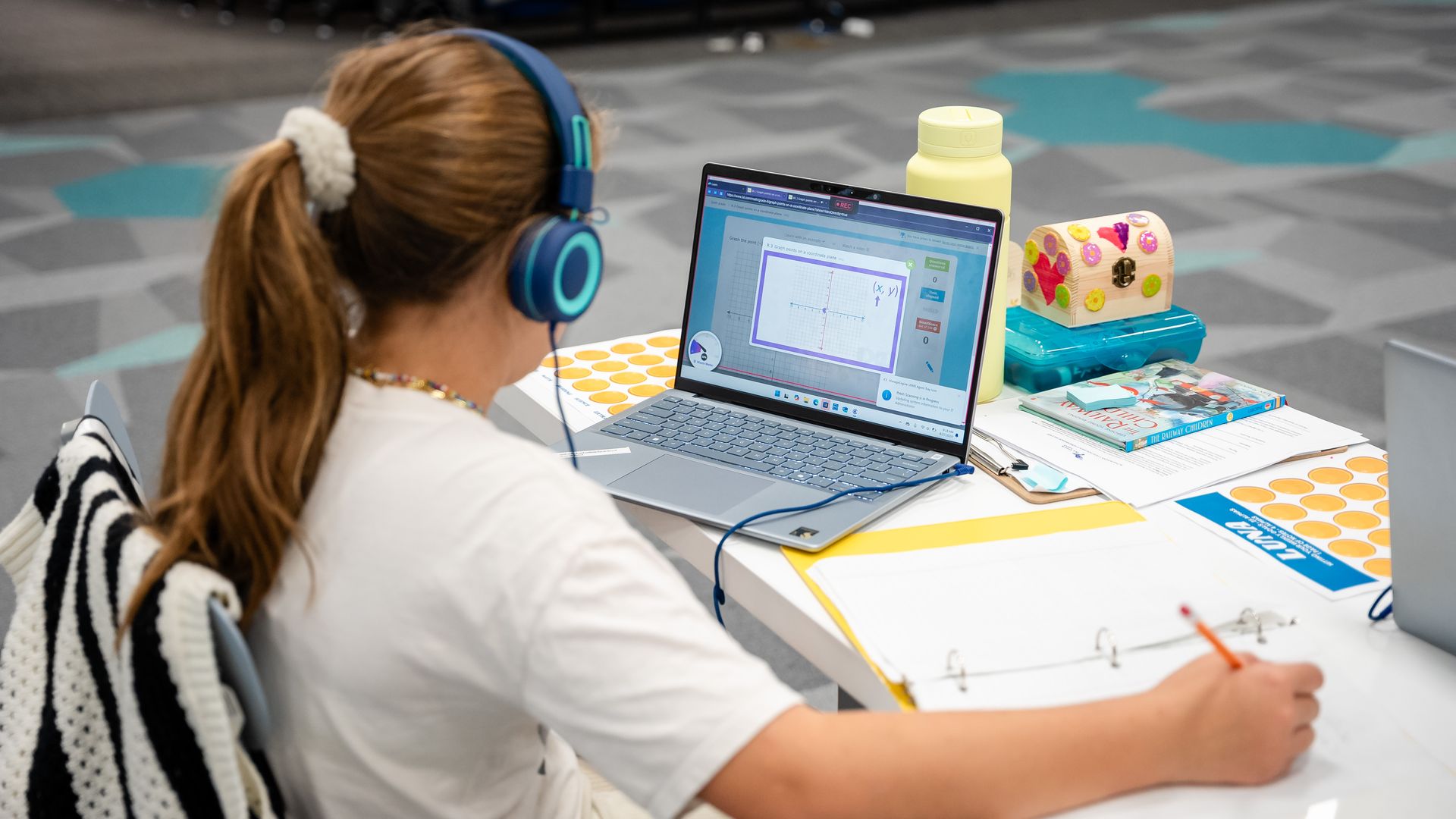
How it works: Students spend no more than two hours a day on AI software to learn core subjects, Price says.
- They spend the rest of the day developing life skills in workshops. (For example, students have organized a music festival for a nonprofit.)
- Instead of licensed teachers conducting lessons, Alpha Schools hires "guides" whose jobs are to motivate and coach students. They're paid at least $100,000 a year.
The big picture: Many public schools have been slow to put clear guardrails around AI.
- Just 18% of teachers in public K-12 schools in a recent Gallup study said they've received formal guidance from school administrators on how to use AI tools.
- Meanwhile, parents are balancing whether letting their children use AI strengthens digital literacy or results in cognitive decline. The research is limited.
Friction point: Penn State professor Gerald LeTendre says his concern with AI education models — including Unbound Academy and Khan Lab School — is that they risk conflating teaching and tutoring.
- "AI tutoring can help, but it has to be within an atmosphere where there's deep human contact with a highly qualified teacher," he adds.
- He argues helping teachers become proficient in AI is a more promising strategy than replacing them.
3. 📓 Where families spend the most


U.S. families in the South expect to spend more than $800 on average on back-to-school shopping this year, according to a PwC survey.
- Spending in the South is lower than any other region.
Zoom out: Families in the Northeast, West and Midwest plan to outspend the national average of $922 — which includes clothes, tech, equipment for after-school activities, books, school supplies and other one-time purchases.
What's happening: Prices are higher, classroom needs have changed and kids have more say over what families buy — including requests for pricier items.
The big picture: Total K-12 back-to-school spending could climb around 10% this year compared to last, hitting a record $43.3 billion, the National Retail Federation forecasts.
Reality check: The spending doesn't stop once school starts.
- Households nationwide plan to spend $635 a month on recurring expenses like meals, snacks and tutoring, per PwC.
4. 📵 Study: Cellphone bans don't boost scores or attendance
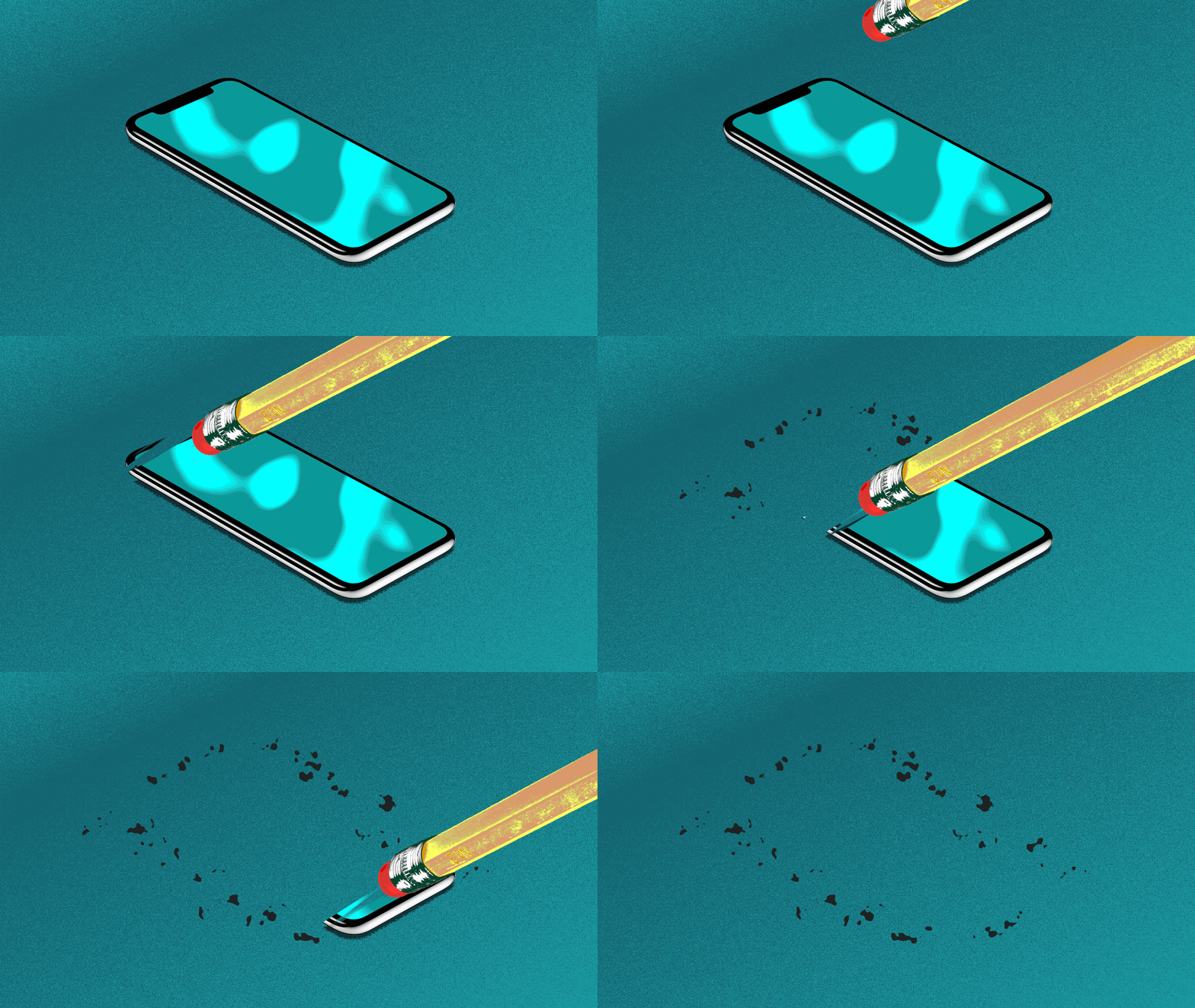
Schools across Tennessee and the U.S. are cracking down on student cellphone use, but a new study finds the restrictions bring mixed results.
State of play: Tennessee currently bans cellphones in schools during instructional time, with some exceptions. Districts have the latitude to set stricter policies.
- U.S. Sen. Marsha Blackburn, the frontrunner to become the next governor, wants a stricter "bell-to-bell" ban that would block phones during the full school day, even when students aren't in class.
The big picture: Schools that require students to lock away their phones during class have seen phone use decline substantially, according to the study shared by the National Bureau of Economic Research in April.
- Student well-being also appears to improve the longer the rules remain in place.
Yes, but: "For academic achievement, average effects on test scores are consistently close to zero," the researchers wrote.
- And they found "little evidence" those policies affect attendance, attention in class or perceived online bullying.
By the numbers: Tennessee is one of many states that have laws limiting student phone access.
- Nearly 5,000 schools use lockable phone pouches, according to the study.
The bottom line: Cellphone bans may still benefit students — even if they don't directly translate into higher test scores.
📬 Nate and Adam will return tomorrow with more news.
Sign up for Axios Nashville