Classrooms lean into analog learning in the AI era

Add Axios as your preferred source to
see more of our stories on Google.

Illustration: Shoshana Gordon/Axios
Parents, educators and lawmakers are pushing schools to curb classroom screen use amid concerns about student attention, behavior and learning.
Why it matters: School cellphone bans are expanding into broader efforts to limit screen use and establish guardrails around AI in education.
The big picture: At least 16 states — both red and blue — have introduced bills to limit classroom technology.
Case in point: Schools Beyond Screens formed with fewer than a dozen parents in Los Angeles Unified School District last year, but the nonprofit has grown to include thousands of parents and educators nationwide, SBS policy director Kate Brody tells Axios.
- SBS worked with the school board in the nation's second-largest district to pass a resolution limiting classroom screen time and eliminating school-issued devices for students in first grade and younger. Similar resolutions have emerged in New York City and Washington, D.C.
Zoom in: McPherson Middle School principal Inge Esping told Axios that the suspension rate at her Kansas school fell 70% after cellphones were banned in 2022. Students also started speaking more with one another and with teachers.
- Suspensions continued to decline as she implemented more safeguards, but Esping says "we weren't quite making the progress that we wished, behaviorally and culture-wise."
- The school's discipline data showed behavioral issues involving Chromebooks, including gaming in class, so the school secured a grant allowing students to return the devices after it shifted to storing them in carts, Esping says.
- The school doesn't cap Chromebook use. Instead, teachers are encouraged to use devices only when they enhance learning, Esping says.
The intrigue: Epsing says students tell her binders and pencils feel lighter than Chromebooks and help them focus better.
Zoom out: Though challenges remain, Body says she's optimistic that analog learning is coming to more classrooms.
- It helps that some teachers appear on board with the shift.
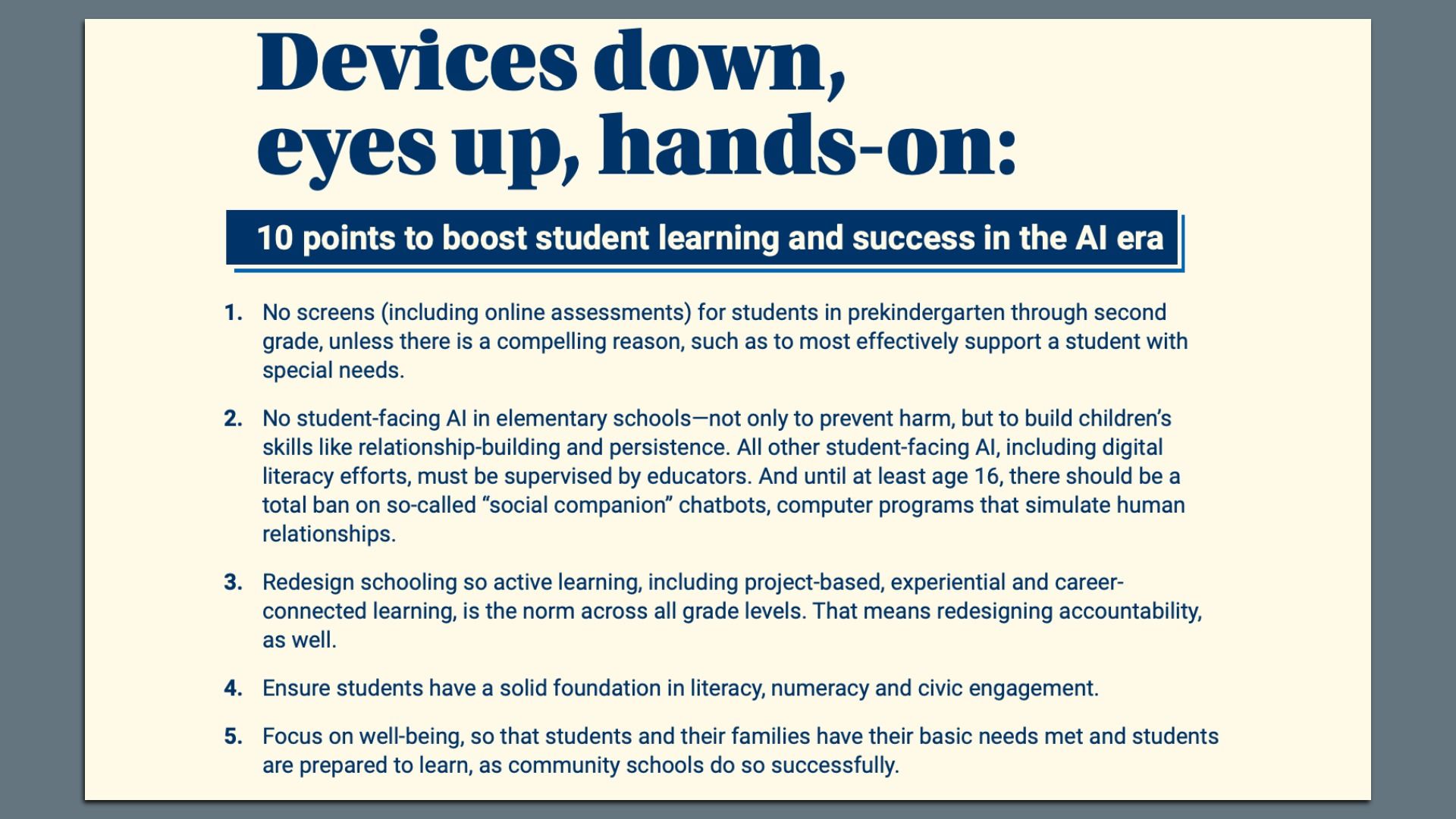
Context: The American Federation of Teachers, the second-largest teachers' union in the U.S., released a 10-point plan to introduce AI and screen-time guardrails in classrooms.
- The plan would limit AI use and ban screens for students in prekindergarten through second grade "unless there is a compelling reason," such as supporting students with special needs.
- The teachers' union wants to get "the balance right to harness the benefits of technology while mitigating the harms," Randi Weingarten, AFT President, said during Wednesday's announcement.
The other side: "When used with intention and balance," ed tech "can support differentiation, accessibility, enrichment, and workforce preparation in the K-12 classroom," says a 2025 report from the Consortium for School Networking (CoSN), a nonprofit for ed tech leaders that has corporate partners including Amazon, Google and Microsoft.
- Beth Holland of K-12 education nonprofit FullScale said during a policy briefing for state leaders posted to CoSN's YouTube channel last month that ed tech is designed to address "that fundamental relationship between teachers and students and content."
Esping agrees with Holland's assessment that "not all screen time is the same" and that there are differences between ed tech and Big Tech.
- But she says educators need to be mindful of when tech can be bad and how it enhances learning.
The bottom line: "We also need to recognize that tech alone is not an enhancement of learning," Esping says.
- Teachers remain "the most important" factor in what students "will or won't learn," she adds.
