AI's education explosion leaves teachers in the dark

Add Axios as your preferred source to
see more of our stories on Google.
AI tools are reshaping the classroom and students' critical thinking — but school leaders are lagging on giving teachers formal guidance for using the tech, a new report shows.
The big picture: AI should amplify the best parts of the classroom and streamline work for already stressed teachers, education experts tell Axios — not create an added burden for educators or replace human connection.
- "AI is out there," All4Ed CEO Amy Loyd tells Axios. "It's not a question of whether or not our students are going to be using it; it's a question of how well our educators are supported and receive the ongoing professional learning and capacity building to be able to be confident in it."
- A growing share of K-12 students already expect they'll have to know how to use AI in college, and the tech is already making college students change majors.
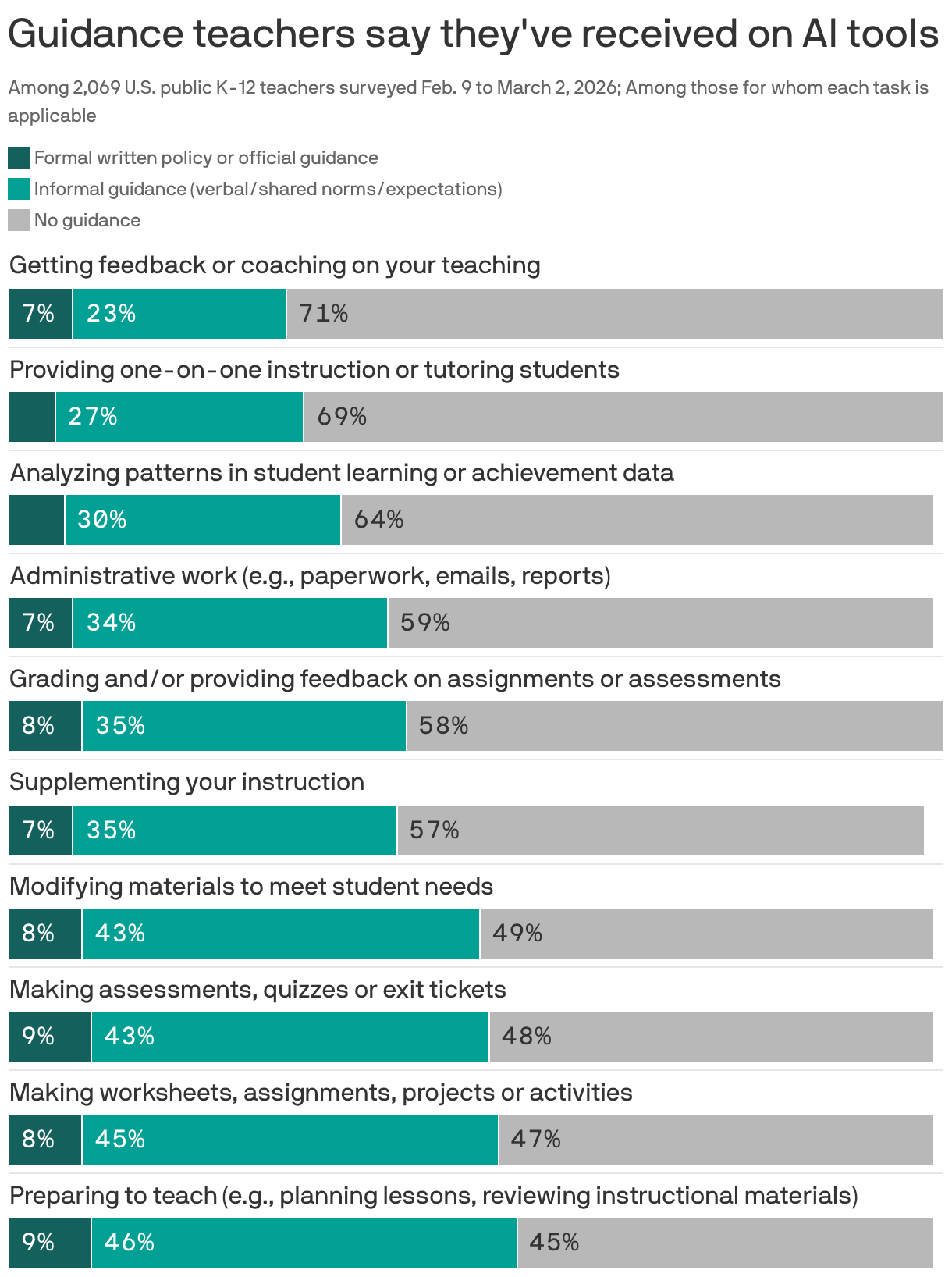
By the numbers: Some K-12 teachers say they are using AI on the job, but around eight in ten say they've received no formal guidance on applying the tools their work, according to a new report from Gallup and the Walton Family Foundation.
- Around 7 in 10 said they received no guidance on using AI to get feedback or coaching on their teaching (71%) and providing one-on-one instruction or tutoring (69%).
- A majority also reported receiving no guidance on using AI to analyze patterns in student learning, do administrative work, grade or provide feedback on assignments or assessments, or supplement instruction.
Between the lines: There is no one-size-fits-all guidance for bringing AI into a classroom.
- "The way an elementary school teacher might be using AI looks very different from a high school AP math teacher," says Arman Jaffer, the CEO and founder of Brisk Teaching, an AI education browser extension designed to embed in a teacher's workflow.
- The horizontal, expansive nature of AI technology makes it difficult for districts to manage guidance, he says. Often, that's left administrators treating AI like an optional tool, not unlike Canva or Quizlet.
- "We're just coming to this realization that ... this is a much more powerful technology, when you look at agents and the future of work ... it is really transforming the way teaching can happen in the classroom," he says.
Zoom out: Among teachers who received guidance, it was mostly informal — like verbal guidance, shared norms or expectations — than institutional directives, the report found.
- Teachers in wealthier schools were more likely to get guidance than those in higher-needs institutions, especially on using AI to create student materials and assignments.
Yes, but: Already strained educators are under pressure to increasingly integrate AI into their classrooms, Loyd says.
- But she adds that they "don't necessarily have the policy, the support systems for capacity building, or ... institutional guidance in their schools to do so holistically — it's more kind of racing to plug it in in ways that may not be ultimately improving outcomes."
The bottom line: A teacher's job is not to explore every ed-tech tool out there, Jaffer says. It's to deliver high-quality education. That means leaders should help find the tools that streamline work, rather than pile on.
- But AI, he warns, "can amplify the best parts of teaching and the worst." More AI is not necessarily the answer — it's about strategic use.
Go deeper: Anthropic, Google and Microsoft fight to win teachers
