Axios Media Trends

February 04, 2025

Hello! Today's Media Trends, copy edited by Sheryl Miller, is 2,086 words, an 8-minute read. Sign up.
🪩 JOIN THE CLUB: Last week, we officially launched Axios Media Trends Executive, a membership that gives my readers access to a slew of new, exclusive products designed for media professionals.
1 big thing: Spotify's epic turnaround


After 18 years, Spotify's business has caught up to its global popularity.
Why it matters: With its first full year of profitability under its belt, the company now has the capital and momentum to focus on "accelerated execution," without eating at its margins, CEO Daniel Ek told me this morning.
- "We really do believe that we can be faster to shift improvements on the platform," Ek said, pointing to investments in its technology and product.
The big picture: In the past, Spotify has spent heavily upfront to build new product experiences, like podcasts, which dragged on its profits. But this year, Spotify plans to do more "with pretty much the same amount of resources that we already have at the company," Ek said.
- That should be a welcome message to investors, who have waited patiently for the Swedish tech giant to post consistent profits since it went public in 2018.
State of play: Spotify beat investor expectations for revenue, profit and user growth last quarter, sending shares soaring 9% to an all-time high in pre-market trading Tuesday.
- The company reported today a record net income (€883 million), operating income (€477 million), free cash flow (€877 million) and gross margin (32.2%) for the fourth quarter of 2024, signaling that its efforts over the past two years to focus on efficiency and monetization are working.
The big picture: With 675 million monthly users and 263 million paid members as of last quarter, Spotify can be considered one of the largest streaming services globally.
- While the company is planning broad product and tech improvements, Ek said 2025 will be the year that Spotify "doubles down" on its investment in music.
- Ek pointed to the company's multiyear deal with Universal Music Group, inked last week, as an example of Spotify's value in driving growth and innovation for the industry writ large.
What to watch: The bundling of non-music content with music as part of the UMG deal represents a key area of opportunity for Spotify as it continues to invest in audiobooks and its app as a destination for multipurpose listening.
- While Spotify competitors such as Amazon and Apple separate listening experiences via different apps for music, podcasts and audiobooks, Spotify has been intentional about bringing those experiences together to drive economic value for its users.
- Spotify's churn rate has remained remarkably low, despite price increases in 2023 and 2024.
2. Exclusive: Middle East bonanza

News organizations are eyeing the Middle East as an expansion opportunity and see countries like the United Arab Emirates and Qatar as key areas to start.
Why it matters: Amid a harsh financial environment, the Middle East offers global media brands the opportunity to tap into an ultra-wealthy class of investors and business leaders.
Driving the news: Reuters is bringing its flagship leadership summit, Reuters NEXT, to Abu Dhabi in October and is launching a new Arabic website catered to readers in the Gulf, Josh London, head of Reuters Professional, told me in an interview.
- Reuters has had an editorial presence in the Middle East since 1866, but it hasn't fully leveraged its editorial track record there to build out its business catered to professional audiences.
- London said the company plans to expand its new subscription offering to the region with its Arabic website. The new site and event will drive incremental advertising and sponsorship opportunities.
Zoom out: Other news giants are also trying to grow their presence in the region.
- CNN last week said it will expand its footprint in the Middle East this year with a new operation in Qatar.
- Dow Jones is expanding the Wall Street Journal's flagship Tech Live event to Qatar this year as a part of a broader effort to build its business in the region.
What to watch: News organizations pulled back from Middle East expansions following the brutal murder of Washington Post journalist Jamal Khashoggi, which U.S. intelligence officials say was approved by Saudi Crown Prince Mohammed bin Salman.
- Any humanitarian concerns related to the treatment of journalists in the region could disrupt further investment.
3. Exclusive: PBS on the offense
Amid a slew of new efforts by Republicans to revoke funding for public broadcasters, PBS has commissioned a new poll that shows broad support for the public broadcaster from Trump voters, according to a copy of a new internal survey obtained by Axios.
Why it matters: Pulling its budget would be catastrophic for the 54-year-old public broadcaster.
- Congressionally approved government funding amounts to roughly 15% of the overall PBS budget across PBS and hundreds of its local member television stations.
By the numbers: The new internal poll, conducted in conjunction with YouGov, shows 65% of Trump voters think the public broadcaster is either underfunded or adequately funded, according to a copy of the poll obtained by Axios.
- 82% of voters, including 72% of Trump voters, said they valued PBS for its children's programming and educational tools.
Of note: PBS has conducted internal sentiment polls for years, but opted to switch to a new polling methodology with YouGov this year that breaks down sentiment by political party.
- The poll included over 2,000 respondents, 792 of which said they voted for Trump.
Reality check: The poll offers PBS an individual temperature check as it gets lumped with NPR amid discussions about funding.
- Other parts of the Trump administration have gone after NPR for what it perceives as coverage bias, but not PBS.
- Last week, a Defense Department memo said NPR, as well as the New York Times, NBC News and Politico, will have to move out of their longtime workspace on Correspondents' Corridor in the Pentagon, an unprecedented move.
What to watch: Rep. Marjorie Taylor Greene (R-Ga.) on Monday called on the CEOs of NPR and PBS to testify at a DOGE subcommittee hearing on what she described as "systemically biased content" from federally funded radio and TV organizations, Axios' Erin Doherty and Andrew Solender report.
- The hearing, slated for March, marks the first hearing to be announced for the subcommittee, which underscores the committee's priority in targeting media.
What they're saying: PBS said it and its member stations "are grateful to have bipartisan support in Congress, and our country." They said they appreciate the opportunity to explain their value during the hearing, noting they have earned Congress' support from decades of "noncommercial and nonpartisan work" in local communities.
- NPR similarly defended its editorial integrity and said, "We welcome the opportunity to discuss the critical role of public media in delivering impartial, fact-based news and reporting to the American public."
Zoom out: Greene's hearing dovetails with a Federal Communications Commission investigation into the two broadcasters over whether their member stations violated FCC rules around airing commercial ads.
- The FCC is also applying pressure to private broadcasters, like Disney's ABC. FCC chair Brendan Carr penned a letter to Disney CEO Bob Iger in December warning he will be "monitoring" ABC's negotiations with local stations to ensure they can serve "local communities," per CNN.
4. Nielsen, Paramount end bitter battle
Paramount, one of the largest TV networks in the U.S., announced on Monday a multiyear measurement agreement with Nielsen, ending a contentious four-month standoff between the two firms.
Why it matters: The deal, effective immediately, allows CBS to leverage Nielsen's ratings data from the 67th Grammy Awards, which aired Sunday night on CBS.
- Without a deal, CBS was unable to use Nielsen's viewership data to sell ads against its major live events, such as the Golden Globes and NFL playoff games.
Zoom in: The new deal allows Nielsen to measure all of Paramount's platforms — its national and local broadcast channels, all of its cable networks, and its streaming platforms Paramount+ and Pluto TV.
- As part of the deal, Paramount will license new Nielsen services. That includes advanced audiences, Nielsen's cross-media planning product, and Big Data + Panel national TV measurement — its newly accredited product that includes viewership data from 45 million households across more than 75 million set-top boxes and smart TVs.
Zoom out: While Nielsen has been criticized by TV networks for having an outdated methodology, it's still considered the most authoritative measurement vendor in the industry.
- During its standoff with Nielsen, Paramount relied on viewership data from VideoAmp, an alternative measurement provider that is not as popular.
- VideoAmp and Paramount renewed their partnership in January.
What we're watching: Ratings for the Grammy Awards were down 14% from last year's 24-year high, according to newly released Nielsen ratings. Shutouts for Taylor Swift and Billie Eilish, combined with the show's somber tone, likely impacted viewership.
Go deeper: Grammy stars rebuke Trump's America
5. Fox's new streaming strategy
Fox Corp. plans to introduce a broad, new subscription streamer at the end of this year, CEO Lachlan Murdoch told investors this morning.
- The unnamed service, which will feature existing sports, entertainment and news content from its brands, will be priced "relatively low," to attract non-cable viewers, he said.
Why it matters: Coupled with news that Fox plans to stream the Super Bowl on its free, ad-supported streamer Tubi, the new service marks a significant shift in Fox's strategy.
- Unlike its entertainment peers, Fox Corp. has shied away from investing in one holistic paid streaming service like Max, Disney+ or Peacock.
- Instead, it focused on building out Tubi and a few niche services catered to news watchers, such as Fox Weather and Fox Nation.
Reality check: While Fox's lean streaming strategy helped it avoid the spending trap that put its competitors in hot water with investors, it set the company behind in developing a paid product to funnel a wide swath of non-cable viewers.
- Fox explored a broader streaming plan when it announced plans to launch a joint streaming service with Disney and Warner Bros. Discovery that would be catered to sports fans, but the service shuttered before it was to launch in January.
6. 🏈 Super Bowl goes healthy

A slew of advertisers are bringing a healthier and more woman-focused message to this year's big game, with spots highlighting everything from breast cancer awareness to obesity and body positivity.
Why it matters: The trend is a shift from the last few years when the Super Bowl was flooded with ads that typically target young men and their vices, like sports betting and crypto investing.
- Novartis will mark its Super Bowl debut with a 60-second, star-studded commercial spotlighting breast cancer awareness.
- Hims & Hers, a health startup, will also run its first Super Bowl ad this year, spotlighting America's obesity crisis.
- Dove is back this year with a 30-second ad that will highlight how body confidence issues prevent girls from playing sports in high school and beyond.
- WeatherTech has a 60-second spot showing four older women flirting with other road passengers and spray painting trucks while enjoying a joyride in a vintage Lincoln convertible.
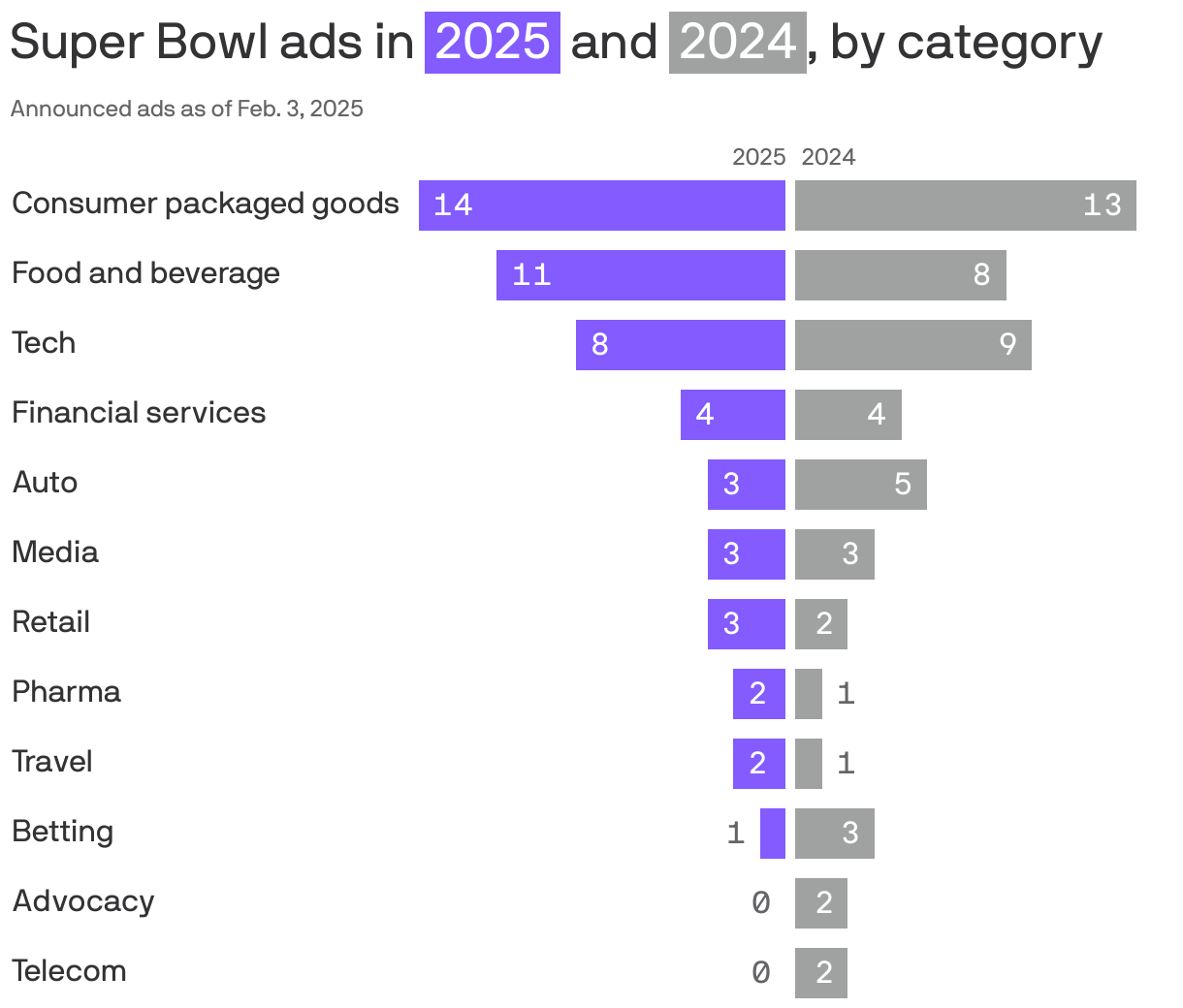
Reality check: A large number of Super Bowl advertisers — 17 of the 51 — are still fast food, snacks and alcohol brands, including Taco Bell, Doritos and Budweiser.
- But there are more non-alcoholic drinks appearing during the Big Game, including Killer Cola and Cherry Obituary from water company Liquid Death and probiotic soda from Poppi.
Zoom out: Super Bowl marketing typically reflects broader economic and cultural trends that impact consumer spending and sentiment. This year, a few key industries are sitting out.
- Fewer politics. No political cause or appeal ads have been teased yet for this year's game. Last year, Robert Kraft's Foundation to Combat Antisemitism and a religious group both ran advocacy spots.
- Less media. The COVID-era digital bubble drove more entertainment and social media firms to advertise. But this year, companies like Netflix, Amazon Prime Video and Snap haven't announced a return. Disney and Tubi, Fox Corp's ad-supported streaming service, are the only entertainment companies that have teased spots so far. Meta is back but showcasing its smart glasses. The NFL will air its annual spot.
- China checks out. Temu, the Chinese e-commerce giant that spent millions on multiple spots throughout last year's game, is sitting it out this year as Chinese retailers and tech giants brace for new trade rules and the possible implications of the TikTok ban law.
- Gambling shrinks. There is only one sports betting company that has announced plans to run a national ad during the game. DraftKings, FanDuel and BetMGM each had splashy spots last year. This year, only FanDuel has announced bringing back its campaign. Crypto advertisers also have yet to return en masse following a big splash in 2022, before the FTX scandal.
The big picture: With big ratings expected this year, Fox has sold out its Super Bowl ad inventory.
- Nearly a dozen spots have sold for a record $8 million.
Go deeper: 2025 Super Bowl ads you can watch now
Sign up for Axios Media Trends