Behind the Curtain: Purges, punishments, payback


Add Axios as your preferred source to
see more of our stories on Google.
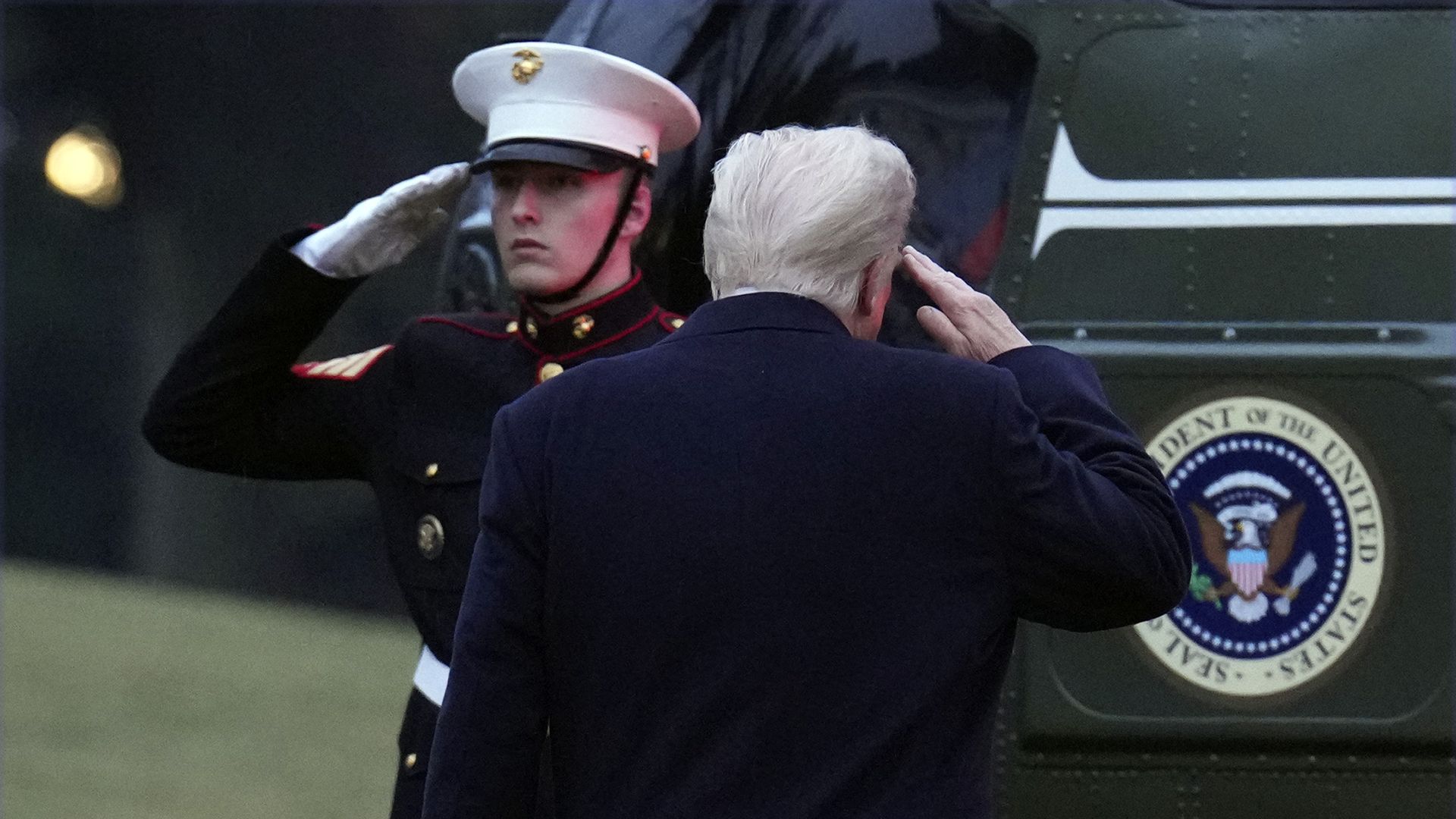
President Trump boards Marine One on the South Lawn as he departs the White House on Friday en route to Florida. Photo: Jacquelyn Martin/AP
America has never witnessed so many people purged or punished by an incoming president so quickly. White House sources tell us this is just the beginning.
- On Friday night, a Defense Department memo said four major news organizations — The New York Times, NBC News, NPR and Politico — will have to move out of their longtime workspace on Correspondents' Corridor in the Pentagon, an unprecedented move, under a new Annual Media Rotation Program for Pentagon Press Corps.
- "Hope those hit pieces on Pete were worth it," a source close to Defense Secretary Pete Hegseth, but not involved in the decision-making, told us.
Why it matters: President Trump long promised to oust and punish people his administration deemed political enemies or unfair critics. His administration is doing this faster, deeper and wider than many in Washington expected.
- Democrats on the Hill are warning that Trump is sometimes acting outside the law — and without regard for government services Americans rely on, and for the American tradition that a president must be subject to checks, balances, scrutiny and criticism.
The big picture: The danger in moving so fast, so wide is losing vital, seasoned talent in hard-to-fill, essential governmental roles. It sets a precedent for future presidents to quickly remake the government in their image or ideological mold — and extend the power of the presidency.
- Trump advisers see this much differently, of course. They argue the government is filled with anti-Trump activists and bureaucratic lifers who can be eliminated with little cost. The depth and breadth of actions in the first two weeks show the results.
Zoom out: In the first 12 days of Trump II, the president also revoked clearances and government security protection for several former officials.
- In a move with city-by-city repercussions across America, Trump temporarily froze trillions of dollars in federal grants and loans. A second federal judge, in Rhode Island, on Friday ordered a temporary pause.
- Trump also offered about 2 million federal employees the chance to resign and get paid through Sept. 30 under a "deferred resignation deal."
Zoom in: This is unprecedented territory for Washington governance. Take the early strikes against the FBI and its role in investigating and prosecuting those involved in the Jan. 6 attack on the Capitol.
- Not only did Trump take the unprecedented step of pardoning virtually all involved, including violent criminals. His team is hunting down those involved in the probe, ousting many. Some of these prosecutors and officials didn't choose the case but were assigned to do it, did their job, and moved on.
Acting Deputy Attorney General Emil Bove identified more than a half-dozen FBI senior executives who were ordered to retire or be fired by Monday, AP reports.
- Bove asked for the names and titles of FBI employees who worked on investigations into the Capitol riot — a list the bureau's acting director said could number in the thousands.
- "Forcing out both agents and prosecutors who worked on Jan. 6 cases would amount to a wide-scale assault on the Justice Department," the N.Y. Times notes (gift link).
Then consider the Friday night announcement about Pentagon workspace for top news organizations. Every administration has the option of who gets seats and who doesn't.
- But the message to mainstream media was unmistakable and not masked. The Pentagon said invitations will go out to the New York Post, One America News Network and Breitbart (Trump-friendly outlets), plus Huffington Post (which doesn't have a Pentagon correspondent and didn't request a space).
NBC News said in a statement: "We're disappointed by the decision to deny us access to a broadcasting booth at the Pentagon that we've used for many decades. Despite the significant obstacles this presents to our ability to gather and report news in the national public interest, we will continue to report with the same integrity and rigor NBC News always has."
- NPR said in a statement to Axios: "This decision interferes with the ability of millions of Americans to directly hear from Pentagon leadership, and with NPR's public interest mission to serve Americans who turn to our network of local public media stations in all 50 states. NPR will continue to report with vigor and integrity on the transformation this Administration has promised to deliver. NPR urges the Pentagon to expand the offices available to press within the building so that all outlets covering the Pentagon receive equal access."
- N.Y. Times spokesperson Charlie Stadtlander said in a statement to Axios: "This move to expel The Times and other independent, fact-based news outlets from the Pentagon's press spaces is a concerning development. The Department of Defense has the largest discretionary budget in the government, millions of Americans in uniform under its direction, and control of a vast arsenal funded by taxpayers. The Times is committed to covering the Pentagon fully and fairly. Steps designed to impede access are clearly not in the public interest."
The bottom line: Moves like this are designed to send signals and make plain the consequences of tough coverage.
- Go deeper: Some federal websites go dark.
Editor's note: Updates with NPR, N.Y. Times statements.
