Axios Media Trends

December 09, 2025

1 big thing: 💰Paramount's foreign funds
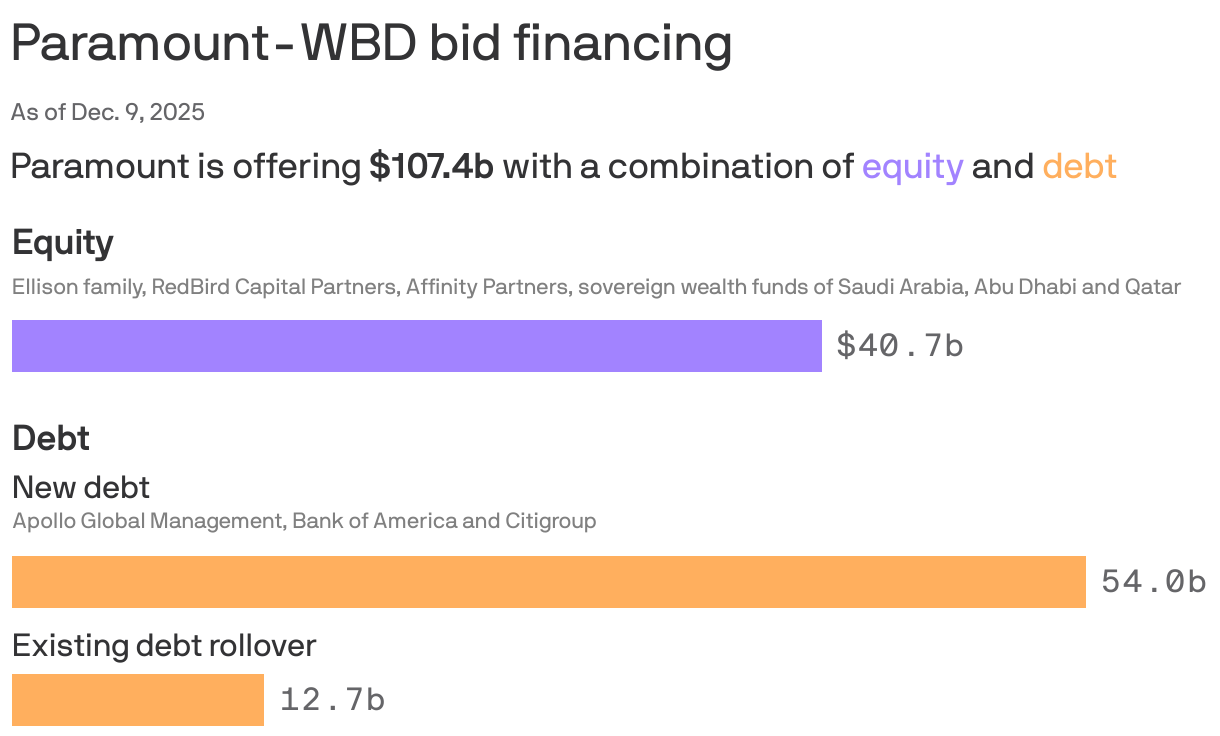
In raising equity from three sovereign wealth funds and Jared Kushner's investment firm, Paramount executives are betting that Warner Bros. Discovery shareholders will prioritize cash over the specter of foreign and political influence in a major media company.
Why it matters: They're probably right.
- It's a good example of how the incentives created by capitalism and democracy can sometimes be leveraged by foreign and political actors.
State of play: Paramount's hostile takeover bid values WBD at a little under $108 billion. (It's received $54 billion in debt commitments and $40 billion in equity commitments to back the bid. The rest of the money comes from the rollover of existing debt.)
- Paramount argues its $30-per-share, all-cash offer is financially superior to Netflix's $83 billion bid for WBD's studio and streaming businesses because it puts a premium on WBD's cable networks, which would need to be spun out with a Netflix deal.
Zoom in: Paramount says its three foreign equity partners — the Saudi Public Investment Fund, the Abu Dhabi-based L'imad Holding Company PJSC, and the Qatar Investment Authority, as well as Kushner's Affinity Partners — won't have board seats or governance control over the combined Paramount-WBD entity, despite contributing $24 billion in equity to finance the deal.
- It's structuring the bid that way to avoid any national security concerns that would have otherwise been raised by the Committee for Foreign Investment in the U.S.
The intrigue: LightShed Partners' Rich Greenfield on Monday asked Paramount chair and CEO David Ellison and COO Andy Gordon why investors would be willing to spend $24 billion — far more than the $11.8 billion committed from the Ellison family itself — on backing Paramount's hostile takeover bid without getting any governance control in return.
- Ellison and Gordon didn't answer the question.
Reality check: The unspoken truth is that foreign wealth funds are willing to accept terms that a traditional investor would balk at because they aren't in the deal simply for financial gain.
- They want access to soft power. And shareholders — who are typically motivated by dollars, not democracy — will likely be fine with that.
I saw a similar dynamic play out in 2023 when a deal to buy Forbes included backing from several foreign investors who agreed to give up voting control despite fronting the majority of the bid.
- Ultimately, that deal fell apart when one of the foreign backers walked from the bid in the eleventh hour.
State of play: A source familiar with the matter told Axios that WBD's board had similar concerns with Paramount's offer, despite the fact that the company has provided assurances it could cover any missing funds — including from Ellison's father Larry's stake in Oracle — if a bidder backed out at close.
The big picture: Both Paramount and Netflix have been lobbying the Trump administration aggressively amid the bidding war.
- Paramount's Ellison has reportedly offered the White House assurances that he would make programming changes at CNN.
- Meanwhile, Netflix co-CEO Ted Sarandos has met with President Trump and White House officials in separate meetings in the past few weeks.
What to watch: WBD's board said it will review Paramount's proposal and issue a decision within 10 business days. It's possible Paramount's proposal could spark another round of bids, forcing Netflix to up its price.
- Meanwhile, Comcast president Mike Cavanagh said Monday that the company "did not expect that we had a high likelihood of prevailing" in its WBD bid, but wanted to try.
- Comcast's bid offered "a significant chunk of equity in a combined entertainment company," he added. "Our proposal was light, relative to other proposals from what I gather, on cash."
2. The foreign influence calculus
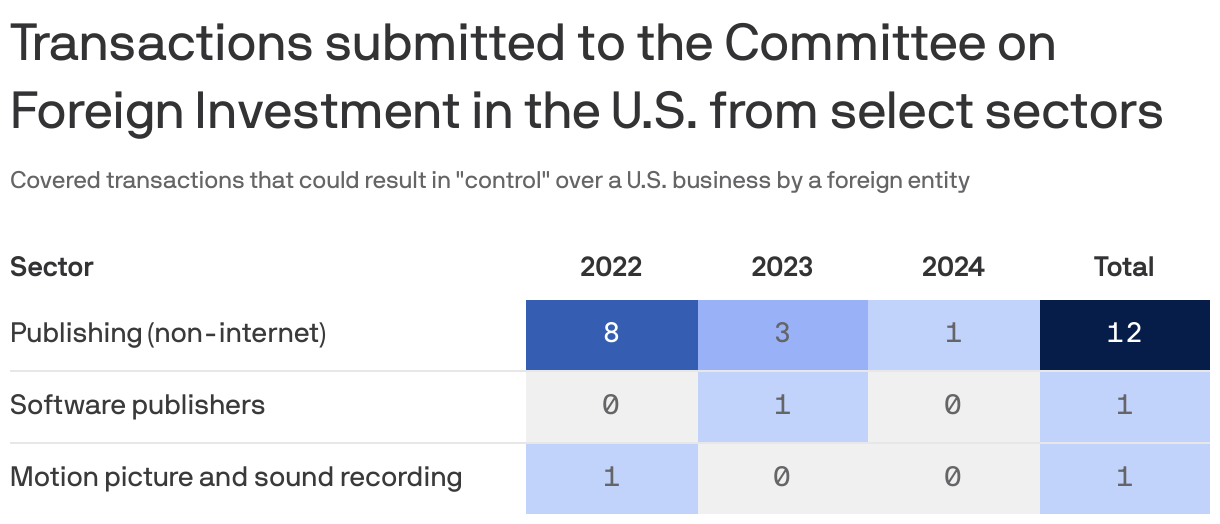
The Committee on Foreign Investment in the U.S. hasn't historically viewed foreign investments in domestic media and entertainment companies with as much national security scrutiny as have other countries.
- 🇨🇦 Canada, for example, strengthened its guidelines on foreign investments in the interactive digital media sector last year.
By the numbers: Only around a dozen foreign transactions involving media, entertainment or publishing companies have been submitted to CFIUS for review between 2022 and 2024.
- By comparison, there have been at least three dozen involving utility companies and well over 100 involving manufacturing companies during the same period, per the Treasury Department.
How it works: CFIUS operates under the Treasury and is mostly made up of Cabinet members, but the president has the power to ultimately decide whether a deal should be blocked.
- Lawyers who regularly work on getting deals approved by CFIUS told Axios they haven't seen evidence of a major increase in political pressure on the process by the White House.
- They acknowledge, however, that there's technically nothing stopping the president from unilaterally blocking a deal for political reasons, under the rubric of national security concerns.
What to watch: It remains to be seen whether Middle East investments receive less scrutiny from CFIUS as the president seeks to develop more commercial relationships with the region, compared to China.
3. Exclusive: The Free Press eyes further CBS News integration
4. 📺 Surprising pay-TV growth


For the first time since 2017, pay-TV subscriptions actually grew quarter over quarter, adding 303,000 net new subscribers in the most recent period, according to new data from equity research firm MoffettNathanson.
🖥️ Why it matters: It offers hope that the live video subscription business can survive longer than expected, but only if video providers are willing to offer streaming bundles with their cable and satellite packages.
Zoom in: The rate of decline for pay-TV subscriptions has actually slowed over the past five quarters, which serves as proof that last quarter's spike wasn't just a fluke.
- Most of the recent growth has stemmed from net new subscriber additions to digital "skinny bundles," or virtual pay-TV companies like YouTube TV, Sling TV or Hulu with Live TV.
Yes, but: While those offerings are still attracting new customers, their growth rate is slowing too.
- Digital skinny bundle subscriber additions have been growing at a rate of 4.6% for the past three quarters — the slowest rate since skinny bundles were first introduced in 2015.
🏈 Reality check: Last quarter's growth was almost certainly tied to the start of football season, which suggests pay-TV additions during subsequent near-term quarters may not be as robust.
Zoom out: Recent and unexpected growth is being fueled by new affiliate deals between cable companies and content owners that give younger consumers access to streaming services along with their live-TV plans.
- Charter, which first championed this model with its landmark distribution deal with Disney in 2023, has paved the way for pay-TV providers to broker these types of deals and start investing in subscription video sales again.
5. 📈 Optimistic ad forecasts suggest tariff fears fading

Advertising analysts have revised their 2025 forecasts to reflect more optimism in the market, thanks to less trade policy volatility and more AI-fueled expansion.
Why it matters: Ad growth began to stabilize in 2024 after years of pandemic-driven volatility. Analysts were worried new trade policies would hamper spending, but so far, that hasn't been the case.
Zoom in: WPP Media, one of the world's largest ad-buying agencies, now says it expects the global advertising market to grow by 8.8% this year (excluding U.S. political advertising), up from 6% in June.
- Similarly, Brian Wieser — a top advertising industry analyst — raised his U.S. forecast for 2025, projecting 11% growth for 2025 (excluding political advertising), compared to 6% in June.
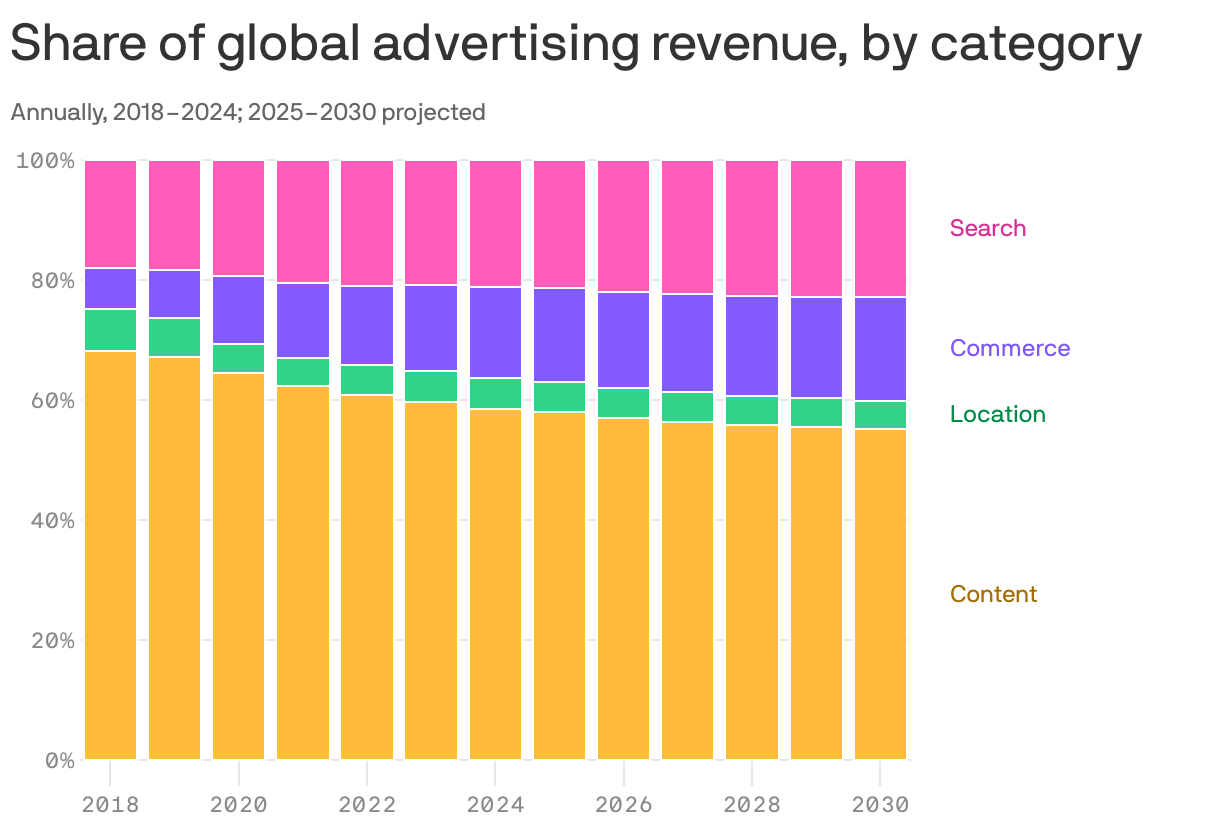
Zoom out: The growth of AI-driven advertising tools has also contributed to enormous growth in the sector over the past year, although most of that is being realized by large tech companies, not traditional media publishers.
- 📻 WPP Media's ad forecast finds that content advertising — or advertising against things like TV, radio and social media — continues to account for the biggest portion of overall global ad revenue (58%), but its share of revenue is shrinking as other ad categories driven by Big Tech firms continue to grow.
- 🤖 Most notably, commerce and search-based advertising is expected to grow the fastest across all advertising sectors, fueled by the growth of companies like Amazon and AI firms like OpenAI.
6. 🚨 Historic shake-up coming for media regulation


7. AI firms strike content deals as legal pressure mounts

Axios Media Trends