Axios Media Trends

March 18, 2025

Good afternoon. Today's Media Trends is 1,950 words, a 7½-minute read. Sign up.
🗞️ Situational awareness: Geoffrey Starks, the senior Democratic commissioner at the FCC, will resign later this spring. Republicans are expected to regain the majority regardless, once the Senate approves Republican nominee Olivia Trusty for the current vacant post.
Join Axios Media Trends Executive to unlock more breaking news, exclusive analysis, data and events. (Use code SARAFRIEND for a special Media Trends reader discount.)
1 big thing: Ad growth slows
President Trump's economic policies will slow advertising growth in the U.S. through at least 2027, according to a new projection.
Why it matters: While analysts anticipated unpredictability with a new administration, the extent of economic volatility has proven greater than previously expected, according to Brian Wieser, a top advertising analyst.
- Specifically, the president's trade policies pose a more extreme threat to supply chains and corporate decision-making than previously expected.
State of play: In a new forecast published today, Wieser said he is reducing his expectations for U.S. advertising growth in 2025 and beyond, calling for 3.6% growth this year (excluding political advertising), down from his previous projection of 4.5%.
- That slowdown will feel more prominent in the second half of the year — when the full consequences of new policy changes are felt.
- He expects a similarly downgraded range at least through 2027 as the economy adjusts to new policies. The 2028 Olympics should help to accelerate spending beyond that.
Reality check: While this level of growth isn't so bad in historical terms, "it is below what the industry has become accustomed to, where growth rates were unsustainable," Wieser said.
- The 2010s saw an unprecedented level of ad growth as the internet created more opportunities to grow the overall advertising pie.
- Now that the digital advertising industry has reached maturity, growth has naturally slowed, but publishers are still adjusting to that new reality in the wake of the pandemic.
Case in point: There continues to be a steady flow of layoffs and job cuts across the media industry as companies try to offset a slower ad market and adjust to a new economic reality.
- Disney's ABC News Group and Disney Entertainment Networks laid off around 200 people earlier this month. CNN cut 200 positions. MSNBC laid off 99 people. The Wall Street Journal, Dotdash, Scripps, the Washington Post, HuffPost, Forbes and others have all experienced cuts this year.
The big picture: For the past decade, political advertising has been a strong source of growth for U.S. publishers, especially local broadcasters, but Wieser expects that fewer competitive congressional seats will slow political advertising growth for the foreseeable future.
- Inflation will also continue to eat into consumer spending across experiences and subscriptions.
- Movie ticket sales are down from the same time period in 2024. Theaters aren't expected to ever fully recover from the pandemic.
What to watch: There's hope that new policy proposals won't all materialize, providing some relief for the industry.
- Trump has suspended tariffs on small packages from China, which should enable continued spend by tech giants like Temu, Shein and TikTok in the U.S.
- Threats to ban or limit pharmaceutical TV ads haven't been realized and are expected to hit legal roadblocks if regulators try.
2. Daily Wire co-CEO steps down
Jeremy Boreing, co-founder of the Daily Wire, is stepping down from his role as co-CEO to focus on creative projects for the company, he told staff in a memo obtained by Axios today.
Why it matters: The company is eyeing a growth investment in 2025.
- Daily Wire's other co-founders, Caleb Robinson and Ben Shapiro, intend to continue looking for investment partners.
The big picture: Boreing has been with the Daily Wire since its inception in 2015.
- He helped grow the outlet from a tiny news startup with $4.7 million in seed funding to a media giant valued north of $1 billion last year.
- In a note to staff, Boreing said he will remain with the outlet in an advisory role. He will focus full time on creative projects, including the completion of the Daily Wire's TV series "The Pendragon Cycle," in which he serves as director and executive producer.
What's next: Robinson will become the company's full-time CEO effective immediately. Robinson and Boreing have been co-CEOs since 2019.
3. Trump guts government media
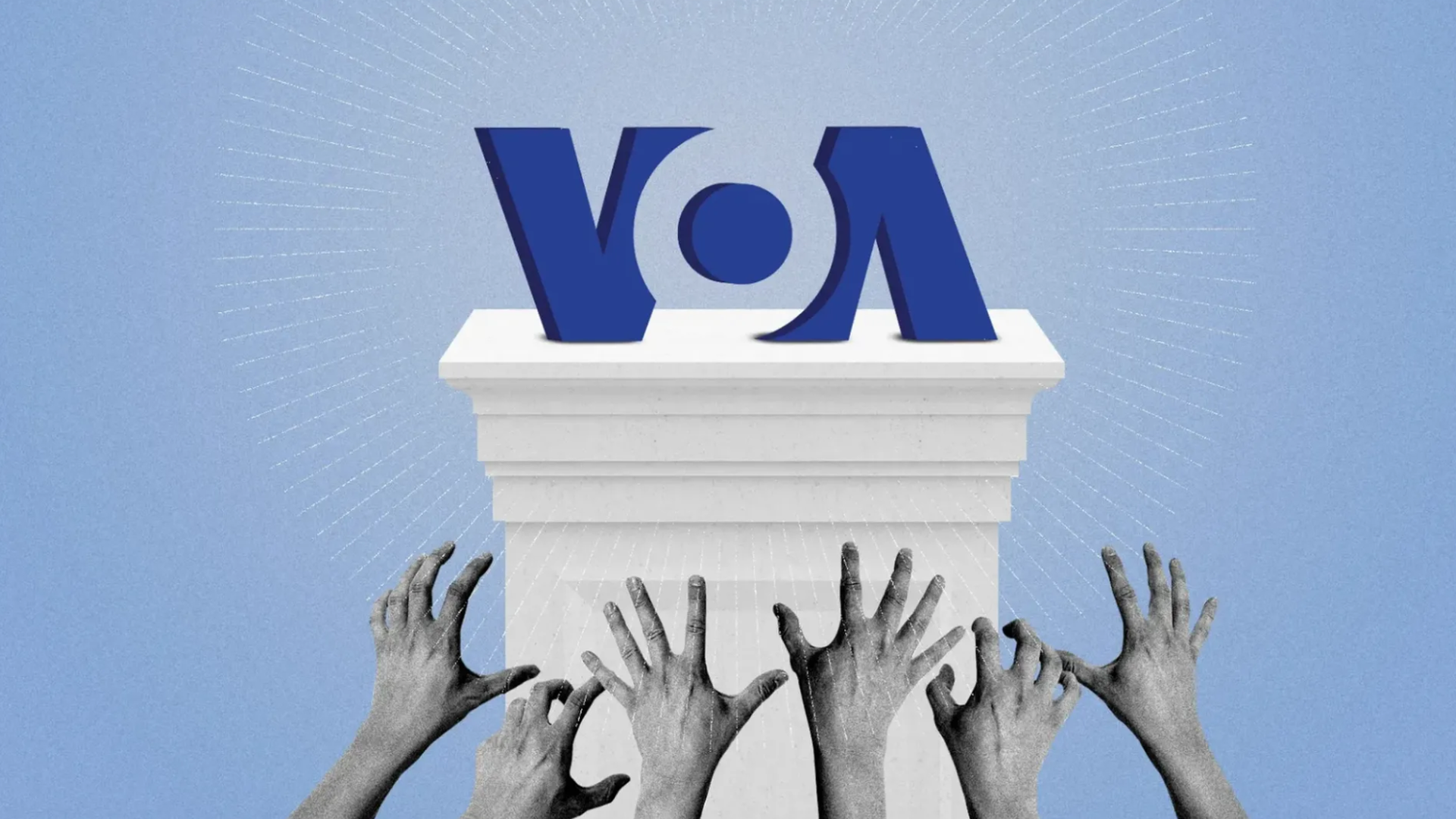
Over the weekend, the Trump administration essentially gutted the U.S. Agency for Global Media, a state-funded agency home to five international broadcasters, including Voice of America.
Why it matters: The decision sparked outrage from press freedom groups who say gutting those programs empowers countries like Russia, China and Iran to spread lies and propaganda.
- Chinese state media has already begun to celebrate the move, per CNN.
The big picture: The dismantling of USAGM also calls into question whether the U.S. will continue to fight for the lives of USAGM journalists currently imprisoned for their work.
- There are nine USAGM journalists currently in jail in places like Vietnam, Russia, Belarus, Azerbaijan and Myanmar.
- "I just hope that they don't get forgotten," said Liam Scott, who served as a press freedom reporter for VOA until its recent dismantling.
For context, VOA was created more than 80 years ago to combat Nazi propaganda during WWII. Its mission is to promote democracy and American interests abroad through fact-driven journalism.
- A legal firewall is supposed to protect it from any government interference.
- Those boundaries were tested during the first Trump administration.
- Trump allies have long criticized the VOA and USAGM press agencies as propagandists. Elon Musk has called for VOA to be shut down.
State of play: The Trump administration on Saturday ordered nearly all 1,300 VOA employees to be placed on leave. On Sunday, nearly half (around 550) of the broadcaster's contract status journalists and engineers were notified that they were terminated, effective at the end of the month.
- It also terminated funding for its sister broadcasters such as Radio Free Europe/Radio Liberty (RFE/RL), Radio Free Asia (RFA) and Middle East Broadcasting Networks.
- A source confirmed a CNN report that leaders of some agencies, including RFE/RL and RFA, have told their staff to continue broadcasting while they figure out the next steps. Those entities were told they had weeks to appeal the termination of their funding grants.
What to watch: Attempts to defund USAGM-funded entities were halted by courts during the first Trump administration and could face legal pressure again this time around.
- Michael Pack, the conservative filmmaker who was nominated by Trump to lead USAGM during his first term, was accused of fraud as well as misuse of office during his short tenure from 2020 to 2021.
4. 🎵 An unprecedented recovery
Spotify's announcement last week that it paid out $10 billion to the music industry in 2024 — more than any single company has ever contributed in one year — proves that a tech platform can single-handedly rebuild a creative industry if its incentives are aligned.
Why it matters: The lack of focus on music specifically by rival tech firms, such as Google/YouTube, Amazon and Apple, has created a clear lane for Spotify to build incremental tools and features that help the music industry grow, said Will Page, author of Tarzan Economics and former chief economist of both Spotify and PRS for Music.
- Spotify's most notable investments have been in discovery and social listening.
- Features like Discover Weekly and collaborative playlists have created new growth opportunities, especially for smaller artists, expanding the overall revenue pie for the industry.
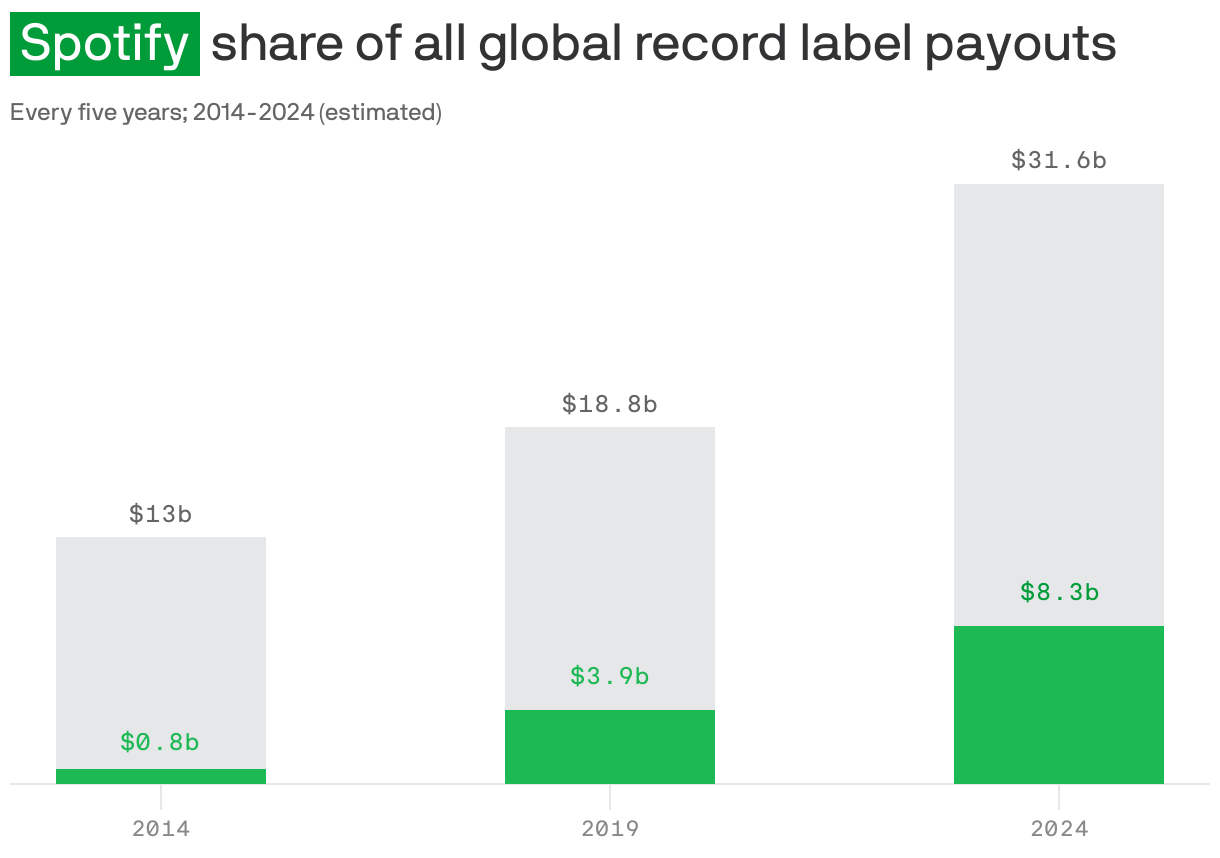
By the numbers: By Page's estimates, Spotify alone has made up over 40% of the global growth in record label revenue over the decade.
- Roughly 80% of the total payouts Spotify contributes to the music industry go to record labels, Page estimates. The remaining 20% goes to artists and songwriters.
- In 2024, for example, Page estimates Spotify paid out around $8 billion to record labels of the $10 billion it contributed in total.
- Last year, Page estimates that the total global recording industry reached $31.6 billion. Spotify contributed more than a quarter of those payouts, up from around 6% in 2014.
Zoom out: Including payouts to artists and songwriters, Page also estimates that Spotify has contributed around 40% of growth to the overall music industry (which includes payouts to artists and songwriters) over the past decade.
The bottom line: The music industry bottomed out in 2014, not because streaming was cannibalizing the industry's growth, but because the industry wasn't addressing the consumer's need for streaming fast enough.
5. Taboola to sell display ads for Microsoft


Taboola struck a deal with Microsoft to sell display ads for MSN.com, Microsoft Outlook, Games and Microsoft's broader Office Suite, Taboola founder and CEO Adam Singolda told Axios.
Why it matters: It marks a significant milestone for the ad tech giant as it looks to expand beyond the native advertising business for the first time since it launched nearly two decades ago.
Zoom in: Microsoft is the first major customer of Taboola's Realize platform, which allows it to sell performance ads, including display and social media advertising formats like vertical video, across the open web.
Reality check: The companies that currently dominate the display ad market, Meta and Google, have been successful because of their enormous troves of first-party data.
- Singolda said he sees a strong opportunity to pull display ad dollars away from those two companies, as well as other ad tech firms, because of Taboola's existing access to first-party data.
- Taboola has relationships with more than 18,000 advertisers and 9,000 publishers globally in the native advertising space.
The big picture: Taboola has built a sizable business since it launched in 2017, mostly selling native ad placements at the bottom of articles across the web. It's pushed to expand its business since going public in early 2021, mostly by striking partnerships with Big Tech firms to sell ads on their behalf.
- Last year, Taboola announced an exclusive deal with Apple to sell native advertising within the Apple News and Apple Stocks apps in the U.S.
- In 2023, it announced a 30-year ad deal with Yahoo estimated to be worth $1 billion annually.
- The company, which has had a strategic partnership with Microsoft for a decade, launched an open web audience network with Microsoft in 2021.
6. 🤖 Media industry bashes OpenAI, Google proposals

More than 60 newspapers owned by Alden Global Capital on Monday ran online editorials slamming OpenAI and Google for requesting looser AI copyright restrictions in an effort to grow America's position as a global leader in AI.
- More than 400 Hollywood creatives, including Ben Stiller, Paul McCartney and Cynthia Erivo also signed a letter to the White House Office of Science and Technology Policy urging the administration to enforce copyright protections.
State of play: Last week, OpenAI and Google submitted letters to the White House in response to calls for AI "action plans."
- Both plans broadly called for the government to allow Big Tech firms to legally train their models on publicly available data, even if it's copyrighted.
Why it matters: AI firms argue that using public data to "teach" AI models is a fair use of the information under existing copyright law, similar to the use case search engines make in cataloging online information.
- Until U.S. courts rule on the issue and/or new legislation updates copyright rules, both media companies and AI makers are operating on unsettled ground.
What to watch: It's unclear whether the Trump administration — which has proven skeptical of supporting traditional media and Hollywood — would consider their positions when evaluating how to regulate AI companies.
7. Dotdash moves into services biz

Dotdash Meredith, one of the biggest digital media publishers in the U.S., has hired Jim Lawson to lead its ad tech division D/Cipher, Dotdash Meredith CEO Neil Vogel told Axios.
Why it matters: The hire coincides with the expansion of D/Cipher from an internal tool used to help Dotdash Meredith's advertisers target ads across its sites to an external tool that can help any advertiser better target their ads across the open web.
Zoom in: The effectiveness of the tool inspired the publisher to expand D/Cipher's targeting solutions and make them available to any advertiser, even if those ads don't run on Dotdash Meredith's own properties.
- That expanded capability, called D/Cipher+, will be sold as a managed service to advertisers, expanding Dotdash Meredith's business to a new revenue stream outside of advertising, licensing and subscriptions.
Sign up for Axios Media Trends


/2025/03/18/1742309129515.gif?w=3840)