Axios Media Trends

October 21, 2025

1 big thing: 🗞️ Independent newspapers disappear
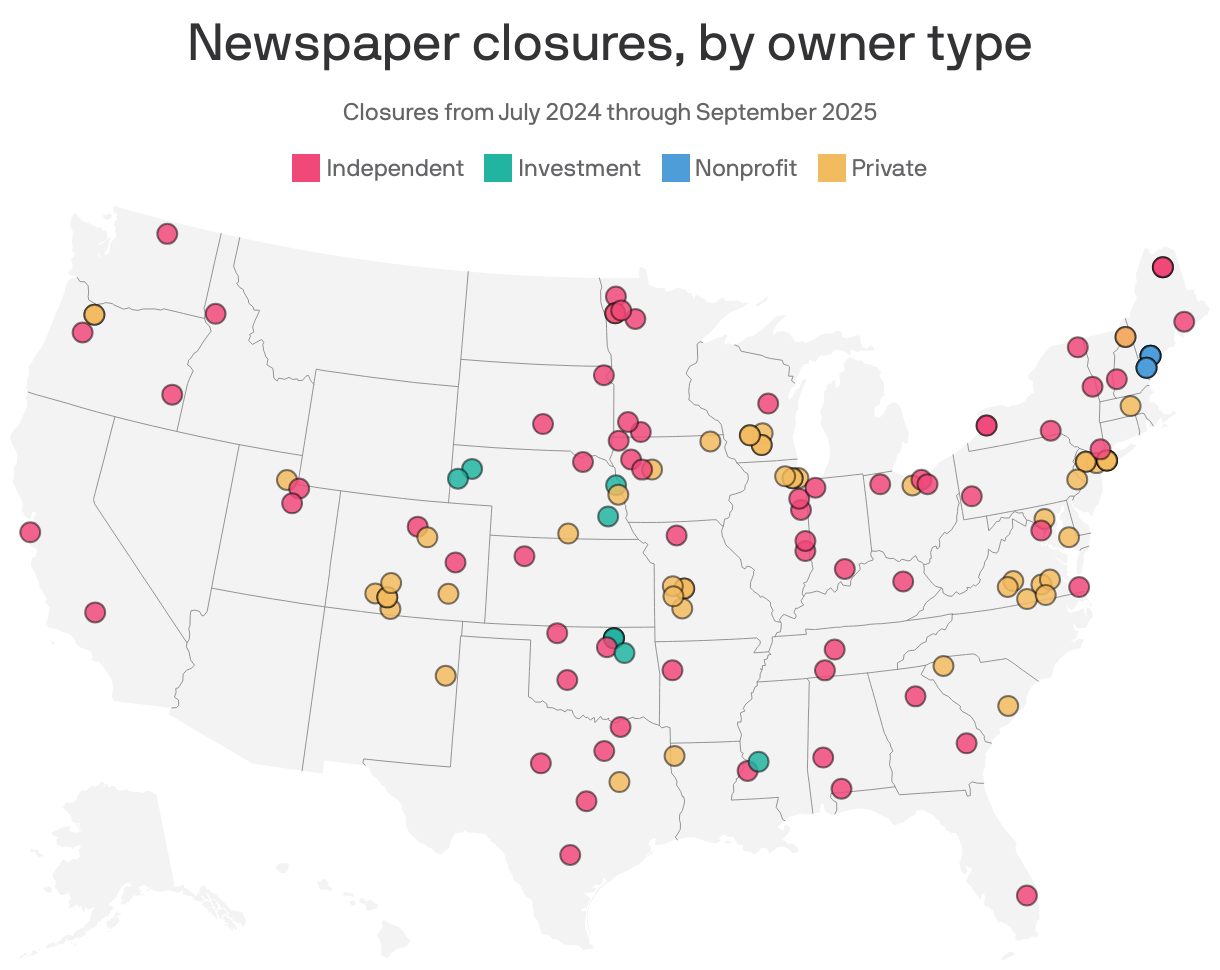
Newspapers owned by small, independent groups — often families or businesses invested in their local communities — are shuttering at an alarming pace compared to those owned by large investment companies.
Why it matters: Independent newspapers are more likely to represent rural communities that are at greater risk of becoming "news deserts," or areas with extremely limited or zero access to local news sources.
🏦 Zoom in: The erosion of small, independent newspapers means that the majority of remaining papers in the U.S. will be even more heavily concentrated among larger hedge funds and private-equity-backed groups that tend to be less invested in local communities.
🚨 By the numbers: Half of the 136 newspaper closures in America over the past 14 months have been from independent, for-profit newspaper chains that own five or fewer for-profit papers, according to a new report from Northwestern's Medill School of Journalism.
- By comparison, only eight newspapers owned by investment firms shuttered in the same time period.
Flashback: Researchers began sounding the alarm about the rise of "news deserts" a decade ago, back when private investment firms began gobbling up and consolidating local papers.
- But most of those closures occurred in suburbs where newspapers could more easily be rolled up into bigger, nearby city papers. Unlike the independent newspaper closures we're seeing today, fewer hyper-rural outlets were impacted by the large investment firm rollups.
Zoom out: More than one-third (38%) of the 8,891 U.S. newspapers that existed 20 years ago have since shuttered.
- Around 50 million people in the U.S. today live with limited or no access to local news.
🏙️ Reality check: While there has been a significant rise in the number of digital-only local news websites that have emerged over the past few years, the vast majority of those news sites are concentrated in urban areas that face less risk of extinction.
The bottom line: For years, small newspapers worried about getting gobbled up and squeezed by hedge funds and private-equity giants. But newspaper economics have become so dire that there's little left for them to squeeze, and smaller groups can't stay in business any longer.
2. 🚨 WBD open to a sale

3. 📱 NYT brings vertical video feed to app

4. 🖱️ Links live on
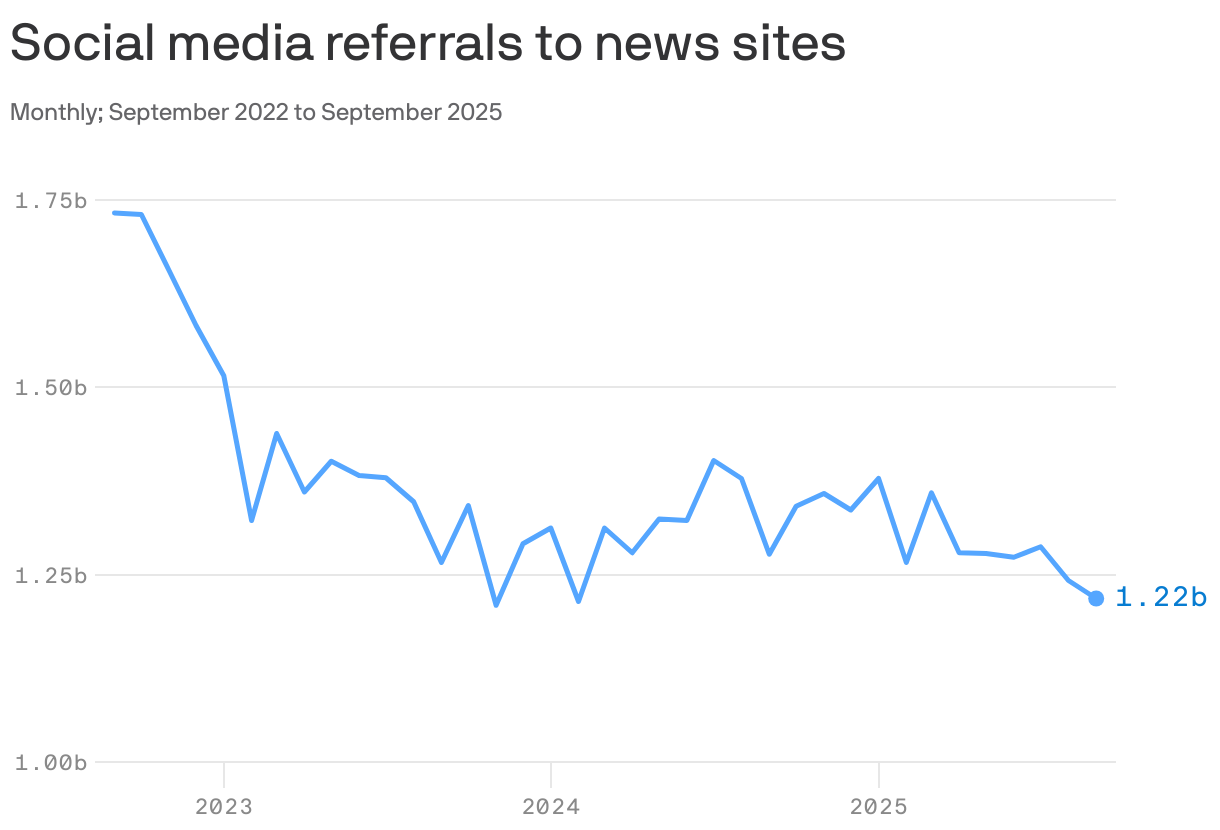
Social giants are eyeing ways to revive links, bringing newfound hope to media publishers that have seen their social media traffic referrals plummet over the past three years.
🔗 X is testing a change to the way it handles links on iOS to make it easier for followers to engage posts while browsing links.
- "For creators, a common complaint is that posts with links tend to get lower reach. This is because the web browser covers the post and people forget to Like or Reply," X head of product Nikita Bier wrote on X.
- "To help get better signal, posts will now collapse to the bottom of the page so people can react while you're reading," Bier wrote, adding this should "make it easier for your followers to engage with your post while browsing links."
Instagram is reportedly testing adding clickable links directly within posts, which would make it easier for creators to send users to their owned and operated sites.
Why it matters: The shift to short-form video on platforms like Instagram and Facebook has made it harder for link-based posts to break through.
- Additionally, social giants like X and LinkedIn have deprioritized links in efforts to keep users on their platforms.
📉 By the numbers: The result has been devastating for news publishers, in particular.
- Social media traffic referrals to the top 100 global news sites have decreased by about 30% over the last three years, according to data from Similarweb.
Zoom out: The shift away from links has created a new cottage industry around link-in-bio tools from companies such as Linktree, Beacons and Linkin.bio that help creators and brands guide users to places they can further communicate and transact.
- Yes, but: Those tools have primarily been used to fuel commerce. For news publishers looking to monetize attention, link-in-bio tools are mostly moot.
Get more data: This chart originally appeared in our new Q3 2025 Media Trends Executive: Platform Insights report, out last Saturday.
5. 🍪 Google quits cookie privacy push



Google has killed Privacy Sandbox, its yearslong effort to create an industrywide standard to replace internet-tracking cookies, after struggling to wrangle uniform acceptance.
🤖 Why it matters: Ad industry leaders have long been wary of letting Google — one of the world's biggest ad companies — dictate the future of ad targeting. And now in the AI era, Google's privacy pivot pegged to cookies is essentially moot.
The big picture: The end of Privacy Sandbox comes amid challenges to the open web — once fueled by cookie-powered advertising — as Big Tech platforms take a greater share of ad spending and the rise of generative AI draws traffic away from websites.
- Advertisers have been increasingly relying on private marketplaces and direct platforms versus open exchanges.
- According to Emarketer, open exchange has gone from the most popular transaction method in 2013 to comprising only 8.1% of the U.S. programmatic display market this year. That's expected to fall further to 6.7% by 2027.
Zoom in: Google said it was retiring the majority of Privacy Sandbox technology, citing "low levels of adoption."
- Announced in 2019, Privacy Sandbox was Google's plan to replace third-party cookies in Chrome with a set of browser-based tools to balance user privacy with ad performance.
- But from the start, ad firms and regulators feared it would tighten Google's grip on the digital ad ecosystem. The U.K.'s Competition and Markets Authority (CMA) launched an investigation into Privacy Sandbox and proposed commitments to address concerns in 2021.
- On Friday, the CMA said it would release Google from those commitments, saying competition concerns "no longer arise." Last year, Google scrapped its cookie deprecation plans.
Zoom out: Publishers and advertisers have been focused on their own audience data and contextual targeting with privacy-by-design identifiers.
- 📊 American Express is one of the latest nontraditional companies to launch an ad business using its first-party data and own platforms.
- 💳 Other credit card companies like Chase and Mastercard and retailers like Amazon, Target and Kroger have done the same.
6. 💪 Ad duopoly's durability
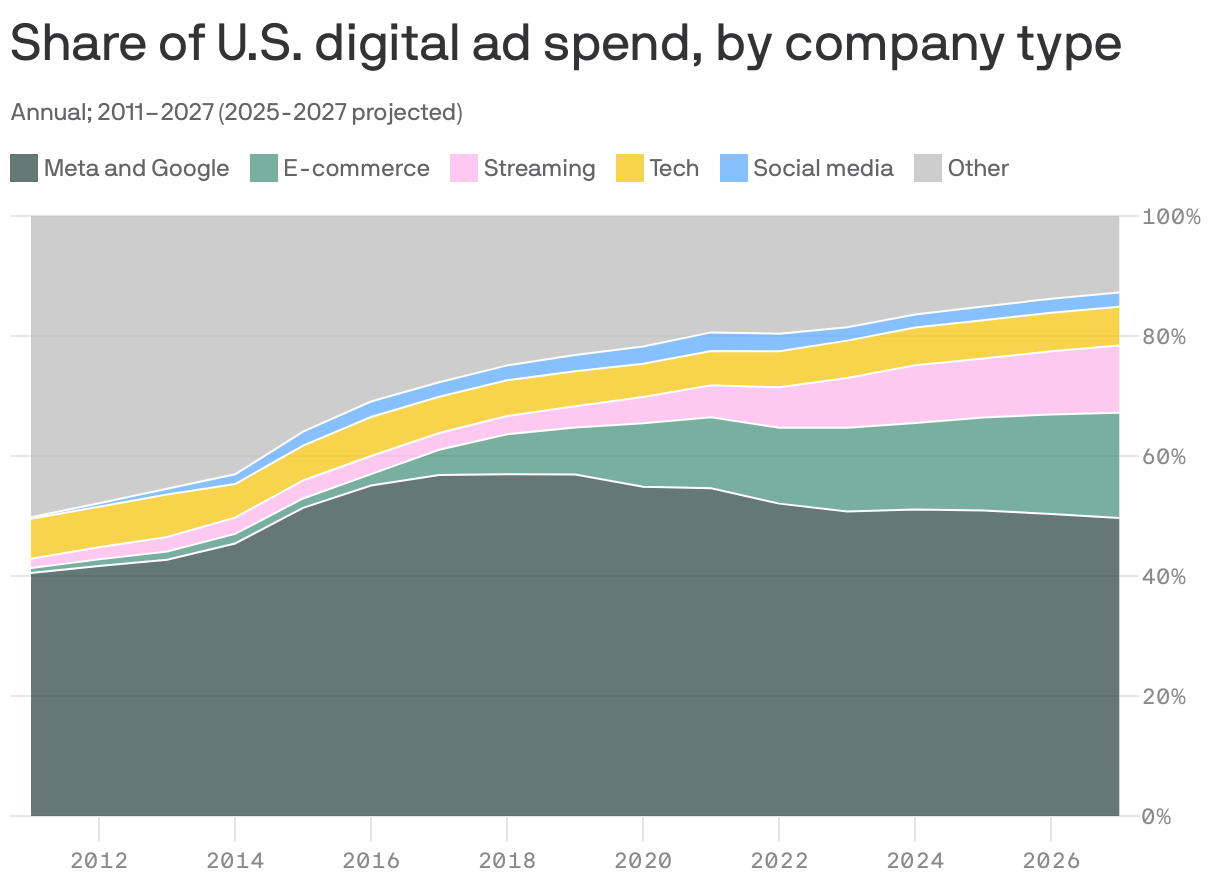
E-commerce and streaming giants are still putting pressure on Meta and Google's advertising duopoly, but not as much as previously expected.
Why it matters: The AI era has proven to be a boon to Big Tech giants, helping to maintain their advertising dominance over traditional publishers and smaller platforms.
Zoom in: The U.S. advertising market is continuing to recover, following uncertainty triggered by President Trump's trade tariffs earlier this year.
- The industry grew ahead of pace — around 10% — in the second quarter, according to Brian Wieser, a top advertising analyst. That growth was driven by digital, which grew 16% in the same period.
What's next: Wieser believes e-commerce media has the most room to grow, with 19% growth forecast for the third quarter, followed by social media with a 16% growth forecast.
- Search and other digital advertising mediums are forecast to grow at a much slower rate, 7% and 4%, respectively.
- Search advertising is being impacted by user migration to AI chatbot apps where the paid advertising market is still nascent.
Get more data: This chart originally appeared in our new Q3 2025 Media Trends Executive: Platform Insights report, out last Saturday.
7. ❌ Disney hit by MAGA cancellation spree

Axios Media Trends