Axios Media Trends

April 22, 2025

1 big thing: 📺 Fact fight fades
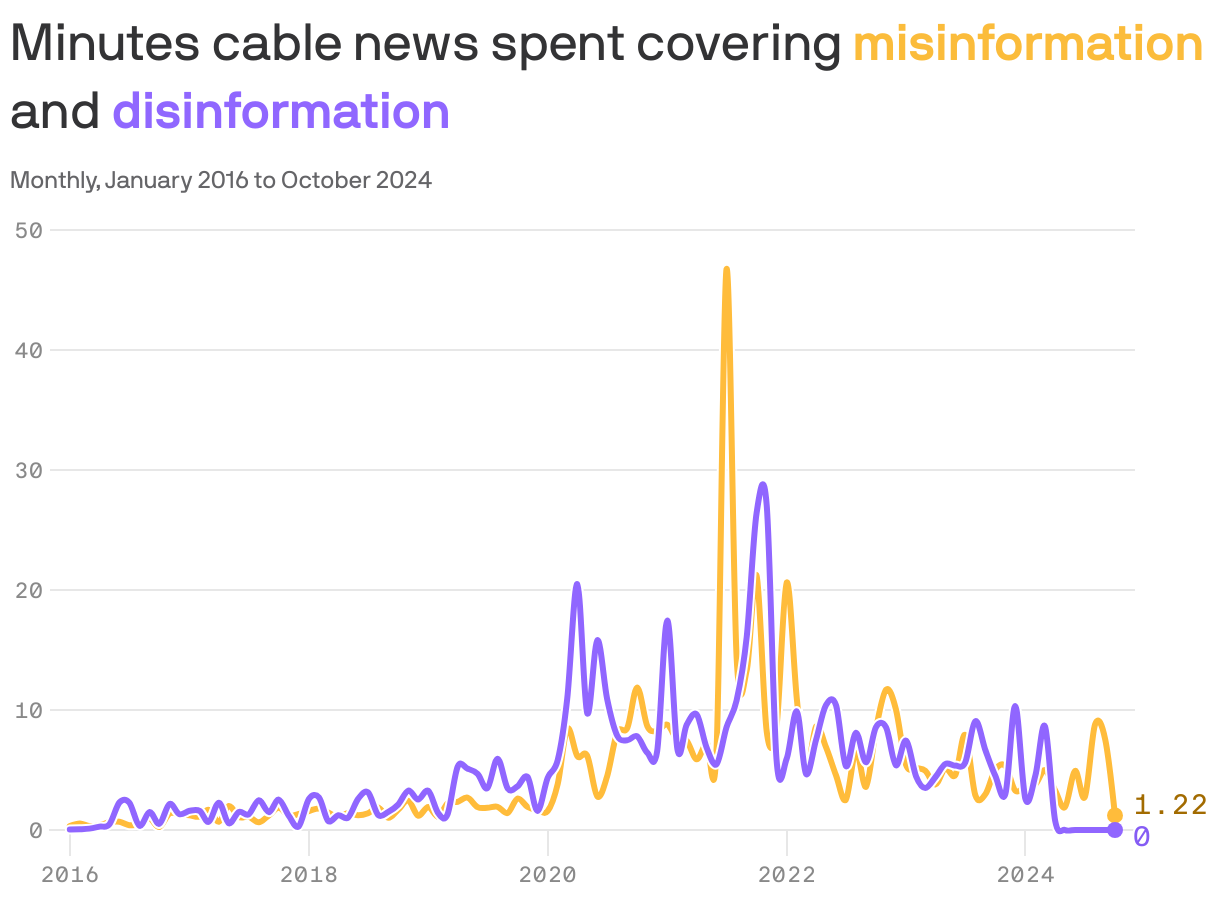
America's obsession with countering misinformation and disinformation has withered as society grows skeptical of institutions once trusted with facts.
Why it matters: Professional fact-checking went mainstream during the first Trump administration, but it's since become politicized.
- Americans are less enthusiastic about policing information today than they were two years ago, and the trend is bipartisan, per Pew Research Center.
🗞️ State of play: Institutions once seen as critical to providing facts about history and current events, such as public schools and news media, are experiencing record-low trust levels, in addition to financial challenges.
- A February YouGov poll found that U.S. citizens are far more likely to trust information coming from the Trump administration "a great deal" or "a fair amount" (44%) than they are the news media (28%).
- In 2017, that gap was much smaller.
🧮 By the numbers: The politicization of fact-checking has contributed to a decline in the number of fact-checking sites globally over the past year, according to data from Duke Reporters' Lab.
- The number of global fact-checking sites increased by 140% from 2016 to 2022, before starting to level off in 2023.
- Mentions of "misinformation" and "disinformation" across the country's three biggest cable news networks — MSNBC, Fox News and CNN — have declined considerably since the pandemic, according to data from Stanford's Cable TV News Analyzer.
Government bodies once focused on combating misinformation and disinformation are being gutted by the Trump administration.
- The State Department's Counter Foreign Information Manipulation and Interference hub is being eliminated, State Secretary Marco Rubio confirmed last week. The office was responsible for tracking and countering foreign disinformation campaigns.
- The National Science Foundation has canceled research grants related to misinformation and disinformation.
🫏 Even Democrats, who have for years pushed tech companies to take action against falsehoods, have begun to lose their truth-seeking appetite amid broader political battles.
- In a new Pew survey, 58% of Democrats say they support government restrictions on false information online, down from 70% two years prior.
The big picture: Facing less progressive pressure, tech platforms have largely replaced fact-checking with community policing.
- TikTok last week said it would test a new feature called Footnotes that lets users add context to videos. The feature is reminiscent of Community Notes on X, which was also adopted by Meta to police speech.
- Meta ended its fact-checking program this year. The company reportedly told teams responsible for ranking content to not penalize misinformation, per Platformer.
- Google told the European Union in January that it would not add fact checks to search results and YouTube videos or use them in ranking and removing content, despite the requirements of a new EU law.
2. Tariffs hang heavy over ad market


President Trump's economic policies are starting to weigh heavily on the U.S. ad market, which was just starting to stabilize after years of pandemic-era volatility.
Why it matters: In addition to economic turbulence, ad-supported companies face very difficult comparisons from last year, which will make it difficult for media and tech companies to meet previous growth projections.
- 📈 2024 marked the fastest year of U.S. ad spend growth since 1983, per analysts at MoffettNathanson, thanks to the presidential election, the Olympics, and AI-driven advertising advancements.
Driving the news: The country's most prominent media and advertising analysts have started to forecast significant slowdowns in ad spend this year.
- Ad-buying giant Magna further reduced its 2025 advertising growth forecast last month, citing "the lack of economic visibility and a decline in confidence" that could impact marketing budgets.
- That followed a similar warning from Brian Wieser, a top advertising analyst, who believes the president's trade policies pose a more extreme threat to supply chains and corporate decision-making than previously expected.
- Media analysts at MoffettNathanson told clients in a note last week that slower GDP growth could result in roughly $45 billion in lost U.S. ad spend versus current forecasts.
Zoom out: While economic uncertainty will impact the entire ad market, certain categories will be hit harder.
- 🛒 Chinese retailers that typically spend billions of ad dollars on platforms like Meta and Google have dramatically reduced ad spending in the U.S., per eMarketer. Temu and Shein have reduced their daily average U.S. ad investment by 31% and 19%, respectively, between March 31 and April 13, per Sensor Tower.
- 🚗 Automotive companies, facing production uncertainty related to tariffs, are expected to reduce marketing spend, per Magna. This is especially true for foreign auto companies that face 25% import tariffs. Auto advertising began to recover last year following a significant chip shortage in 2022 and 2023, boosting local publishers and broadcasters.
- 💄 Consumer packaged goods companies, as well as restaurants, tend to be the most vulnerable to inflation, which is expected to remain high amid economic volatility. Stubborn inflation makes it hard for the Federal Reserve to cut interest rates despite pressure from President Trump.
- 🍝 Restaurants and personal services: The service economy is expected to pull back significantly on ad spend amid tariff exposure from their international supply chains and broader consumer concerns around inflation.
- ✈️ Tourism and travel: President Trump's aggressive stance toward the country's reliable international trade partners threatens billions of dollars across the U.S. travel and tourism industries.
What to watch: While there are concerns about consumer discretionary spending in a recession, analysts are more bullish on subscription-based media services that are less dependent on advertising.
Bright spots:
- 🖥️ Netflix: Analysts at Macquarie said last week after Netflix's positive earnings report that the company's premium valuation "is likely supported by investor flight to safety."
- 💸 Agencies: Experts believe ad agency holding groups, such as Omnicom, Interpublic Group and WPP, are better suited than some of their media clients to weather a possible economic downturn. "With highly variable cost structures, their earnings downside is somewhat cushioned, and multiples are already near historical troughs," analysts at MoffettNathanson wrote.
3. Journalism travel warnings

4. Google ad case, more symbolic than punitive
A federal judge ruled Thursday that Google's dominance of the online advertising and ad-tech markets violates U.S. antitrust laws, but the likely remedy for that guilty verdict isn't expected to completely upend Google's business.
Why it matters: The Justice Department wants a court to force Google to sell off its Google Ad Manager suite, which is part of its broader "network" ad business that sells ads on other publishers' inventory.
- 💰While a divestiture would cost Google billions of dollars in lost revenue and headaches, it wouldn't fundamentally change Google's business.
- 🤖 Rather, it would create a hurdle for Google as it looks to expand into new areas, slowing it down as it faces new competition in the AI era.
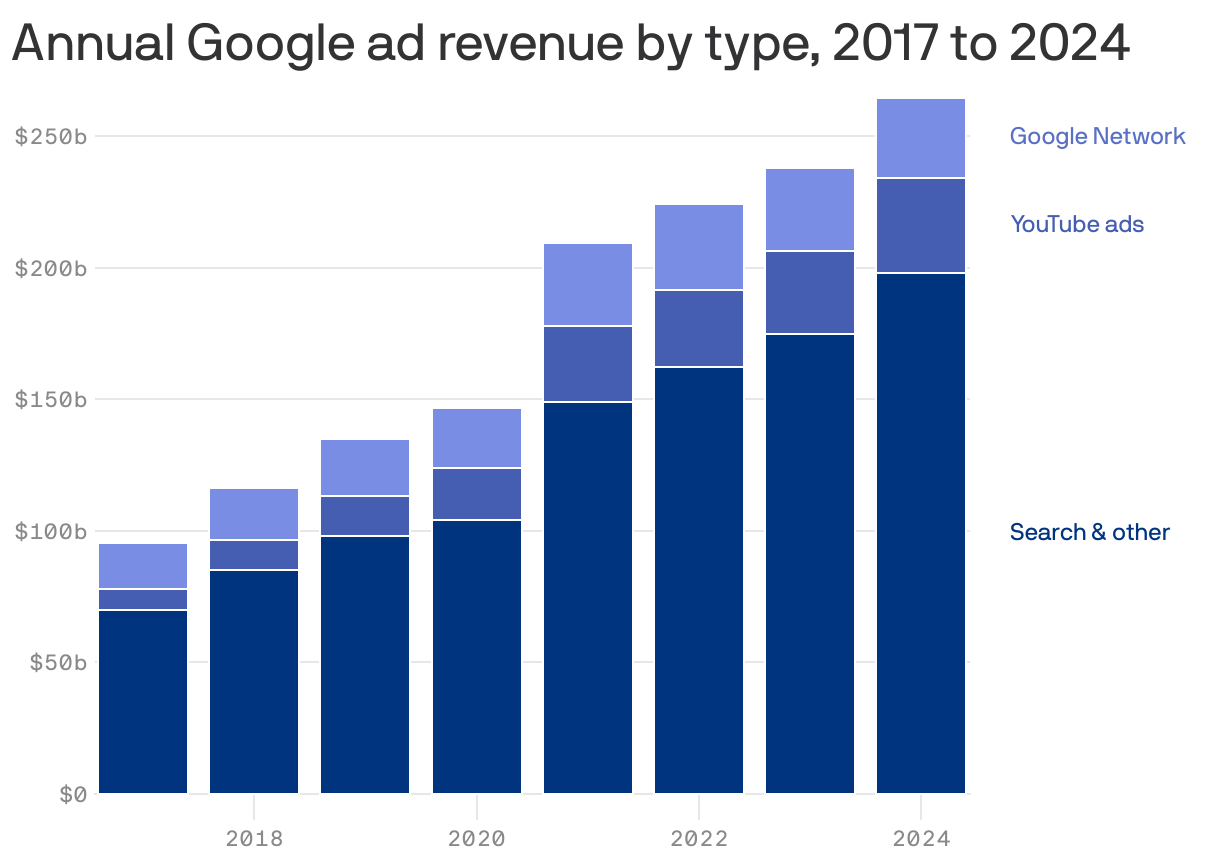
By the numbers: Google has evolved over the past few years to become more dependent on selling ads against its properties, like YouTube and search, versus ad sales against other publisher properties.
- In 2014, Google's "network" ad business represented roughly 18.4% of Google's overall ad business while YouTube represented around 8.5%.
- In 2024, Google's "network" ad business represented just 11.5% of Google's overall ad business, while YouTube represented around 13.6%.
Of note: Google argues spinning out its Google Ads Manager would hurt publishers because it would force them to buy ads through more expensive rival networks.
- Reality check: The likely winners of a divestiture would be Google's smaller ad tech rivals, such as PubMatic or Magnite.
The big picture: This is the second major recent antitrust loss for Google after a different court ruled last year that the giant has abused its dominance of the search market online.
- While remedies in that case have not yet been determined, the Justice Department seeks to force Google to sell off its lucrative Chrome search engine.
What's next: The court last week drew a distinction between the markets for advertising exchanges and ad servers, where it found Google has an illegal monopoly, and the general market for display ads online, where it found Google does not.
- ⚖️ Google said it plans to appeal the guilty part of the ruling.
5. 1 fun thing: ⏩ Podcast vibe shift
Axios Media Trends