Axios Media Trends

November 26, 2024

1 big thing: 💼 Hearst's profit pivot

For the first time in Hearst's 137-year-history, more than 50% of its profits will come from professional products, not consumer-facing newspapers, magazines and TV stations, CEO Steve Swartz told Axios in an interview.
- That's up from 13% in 2013.
Why it matters: Swartz credits the company's B2B (business-to-business) investments for helping Hearst grow amid a volatile consumer advertising and subscription landscape.
- "I do believe we are a stronger publisher of newspapers and magazines — two very difficult businesses — because we have other sources of growth," he said.
By the numbers: Hearst projects it will earn $12.8 billion in top-line revenue this year, up from $11.95 billion in 2023, making it one of the largest privately-owned media businesses in the country.
The big picture: Hearst has relied on a strong balance sheet, originally stemming from consumer media, to buy its way into the B2B world.
- It has spent a whopping $14 billion on mostly B2B acquisitions over the past decade, including $3 billion in the last two years.
- Hearst has homed in on three focus areas for its B2B investments: financial services, health care and transportation. Many of those investments stemmed from Hearst's early forays into trade publishing.
State of play: Hearst's professional data and services products have helped the company offset a challenging environment for consumer media, particularly within its magazine portfolio.
- Last week, the company announced layoffs within its magazine publishing group, which houses more than two dozen brands, including Cosmopolitan, Esquire, Good Housekeeping and Harper's Bazaar.
- The general-interest magazine market is tougher than the local newspaper market right now "because you cannot rely on high subscription prices," Swartz said.
- Hearst's newspaper business, driven by major papers like the Houston Chronicle and San Francisco Chronicle, has been able to nearly offset print declines through digital subscription growth.
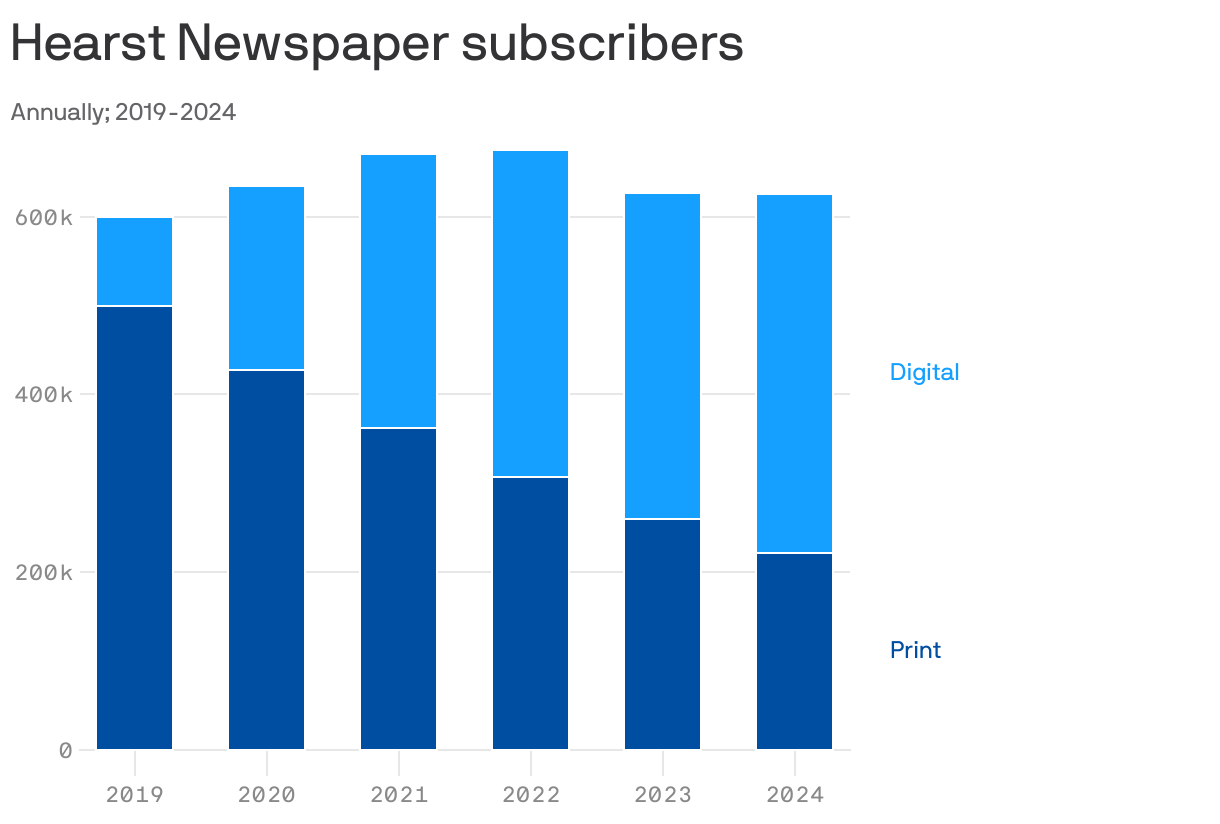
Yes, but: While print continues to face challenges, Hearst's local television business continues to be very profitable.
What to watch: The 22,000 company is owned by a family trust. Only five of the 13 seats on Hearst's board of trustees are reserved for descendants of the Hearst family. The rest are made up of current and former Hearst executives.
- The trust doesn't expire until the last of William Randolph Hearst's grandchildren who were alive at the time of his death have died.
2. 🧵 Rivals eat X

3. 🦃 "Glicked" spurs Thanksgiving movie momentum


With a combined $169.5 million in their domestic box office debuts, Universal Pictures' "Wicked" and Paramount Pictures' "Gladiator II" have reawakened the box office ahead of a highly anticipated holiday season.
- Why it matters: Theaters have struggled to retain momentum this fall after a record-setting showing this summer from Disney's "Inside Out 2."
Zoom in: Although "Wicked" set a record for the biggest opening weekend for a Broadway adaptation ever, it fell slightly short of analyst expectations.
- Distributors were hoping the combined appeal of "Wicked" and "Gladiator II" would drive the same momentum as last year's infamous "Barbenheimer" summer doubleheader.
- Warner Bros.' "Barbie" and Universal's "Oppenheimer" grossed $235 million in their combined domestic debut last July.
- Those films helped establish a new precedent for the cost of marketing a box office hit.
What's next: Disney's highly anticipated sequel, "Moana II," is expected to earn a whopping $225M+ in its day-and-date global opening this holiday weekend.
- The Mouse House hopes the animated film can top the existing domestic box office record for the five-day Thanksgiving weekend that it set in 2019 with $125 million for "Frozen II."
The big picture: The movie business is still reeling from the combined impact of the pandemic and the dual writers and actors strikes last year.
- Year to date, the domestic box office is down 27.7% compared to the same period in 2019.
4. Comcast isn't looking to buy assets after SpinCo deal
/2024/11/26/1732634008104.gif?w=3840)
5. 🚨Israeli government votes to boycott Haaretz

6. 📈 Ad tech deals soar

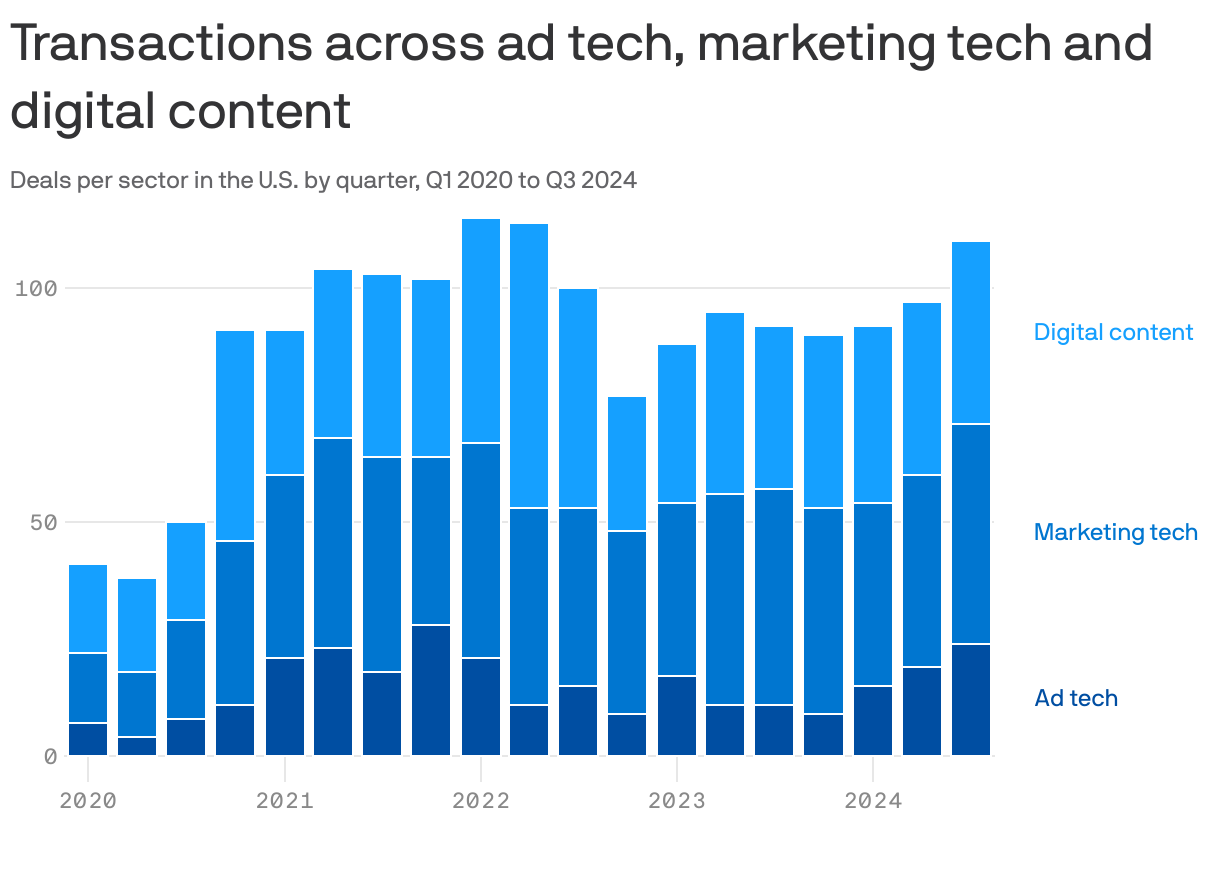
Ad tech, marketing tech and digital content deals are surging to the highest point since the first half of 2022 amid a comeback in digital ad spend.
By the numbers: M&A activity across ad tech, martech and digital content was up 13% in Q3 of 2024 compared to the prior quarter and up 20% compared to Q3 of 2023, per data from Luma Partners.
- For ad tech, specifically, M&A volume was up 118% year over year and up 26% quarter over quarter.
Driving the news: Video platform Brightcove agreed to be taken private Monday by Italian tech company Bending Spoons for $233 million, 14 years after it first went public.
- Notable Q3 deals included Equativ-Kamino Retail, Outbrain-Teads, Publicis-Influential, Optimizely-Netspring and Ziff Davis-CNET.
- Deal flow has continued to heat up in Q4 with Zeta-LiveIntent, Mediaocean-Innovid, Connatix-JW Player and Samba TV-Semasio.
What we're watching: Private equity firms who backed ad tech during a frothy 2021 market are eyeing exits.
- Buyers have eyed Integral Ad Science for a take-private deal, per recent reports. Criteo also has long been viewed as a potential target.
7. 📡 Satellite mega-deal killed

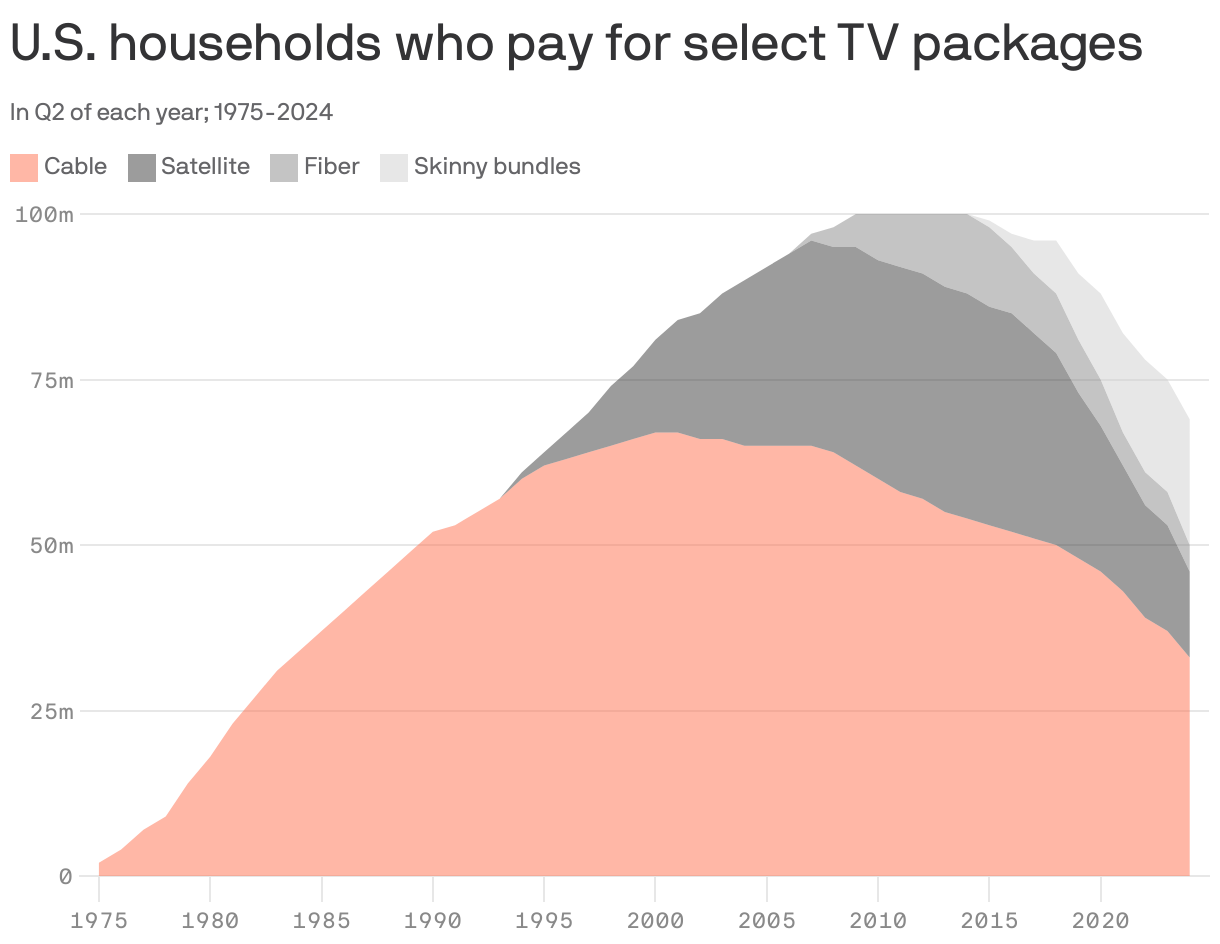
DirecTV terminated its planned acquisition of rival Dish Network on Thursday night following bondholders' rejection of a debt swap that the deal depended on.
Why it matters: A merger between the two struggling satellite TV providers was seen as essential to the survival of both.
- Both have lost nearly half of their subscriber base since 2013, which is considered the high point of the pay-TV era.
Flashback: This is the second time a DirecTV-Dish merger failed.
- The two tried to combine in 2002 in a $26 billion deal, but it was blocked by regulators in the George W. Bush administration over concerns it would reduce competition.
- Those same competition concerns likely would not have been a factor this time, given the decline in the satellite TV business.
Axios Media Trends