Axios Media Trends

February 18, 2025

Good morning. Today's Media Trends, copy edited by Sheryl Miller, is 1,740 words, a 6½-minute read. Sign up.
🎯 Situational awareness: The next edition of Axios Media Trends Executive, an exclusive newsletter for members, will hit inboxes March 1.
1 big thing: Scoop... Pentagon radio shake-up

The Pentagon's chief spokesperson Sean Parnell has invited radio hosts Clay Travis and Buck Sexton to broadcast their show from the Pentagon, sources confirmed to Axios.
Why it matters: The Trump administration has moved quickly to establish new norms within press briefing rooms.
Zoom in: In an interview on Travis and Sexton's podcast earlier this month, Parnell teased the invitation, saying, "You all are welcome anytime in the Pentagon press room, or if you want to broadcast from the Pentagon, we will figure out a way to make that."
- Later in their show, Travis said, "There's a good chance we'll be at the Pentagon. I think there's a good chance we'll be at the White House."
- Asked for comment, the Defense Department said, "We have nothing to announce today" and advised Axios to check www.defense.gov for the department's daily and weekly schedule.
In a separate interview that day with press secretary Karoline Leavitt, Leavitt told Travis and Sexton, "We love what you're doing and hopefully we'll see you soon in the briefing room someday. You're always welcome."
Catch up quick: Travis and Sexton replaced the late Rush Limbaugh's radio show on Premiere Networks in 2021.
- The three-hour talk show, which is broadcast across hundreds of radio stations nationwide, holds weight within the Trump administration.
- On the show last week, Secretary of State Marco Rubio appeared to suggest that Arab countries need to create a plan to combat Hamas.
- In addition to the program, Travis runs a sports media website he founded called Outkick, which has gained influence in the Trump era. Sexton is a political commentator and podcaster.
Zoom out: The radio invitation is part of a set of broader changes to the Pentagon's media strategy.
- The Defense Department informed NPR, the New York Times, NBC News and Politico that they had to move out of their workspaces at the Correspondents' Corridor in the Pentagon last month. It later added CNN, the Washington Post, The Hill and The War Zone to that list.
- Their space will be made available to a slew of mostly conservative outlets on rotation, such as the New York Post, One America News Network and Breitbart News. Bari Weiss' startup The Free Press and HuffPost will also be given space as part of the rotation.
- Reporters from the organizations that were removed will still be members of the Pentagon press corps.
Zoom out: The Trump administration has applied extra scrutiny to the media in its early days, including ending federal news spending on Politico subscriptions and launching FCC inquiries into Comcast, NBC, CBS, PBS and NPR.
2. 🎬 Exclusive... Simone Biles on her next act
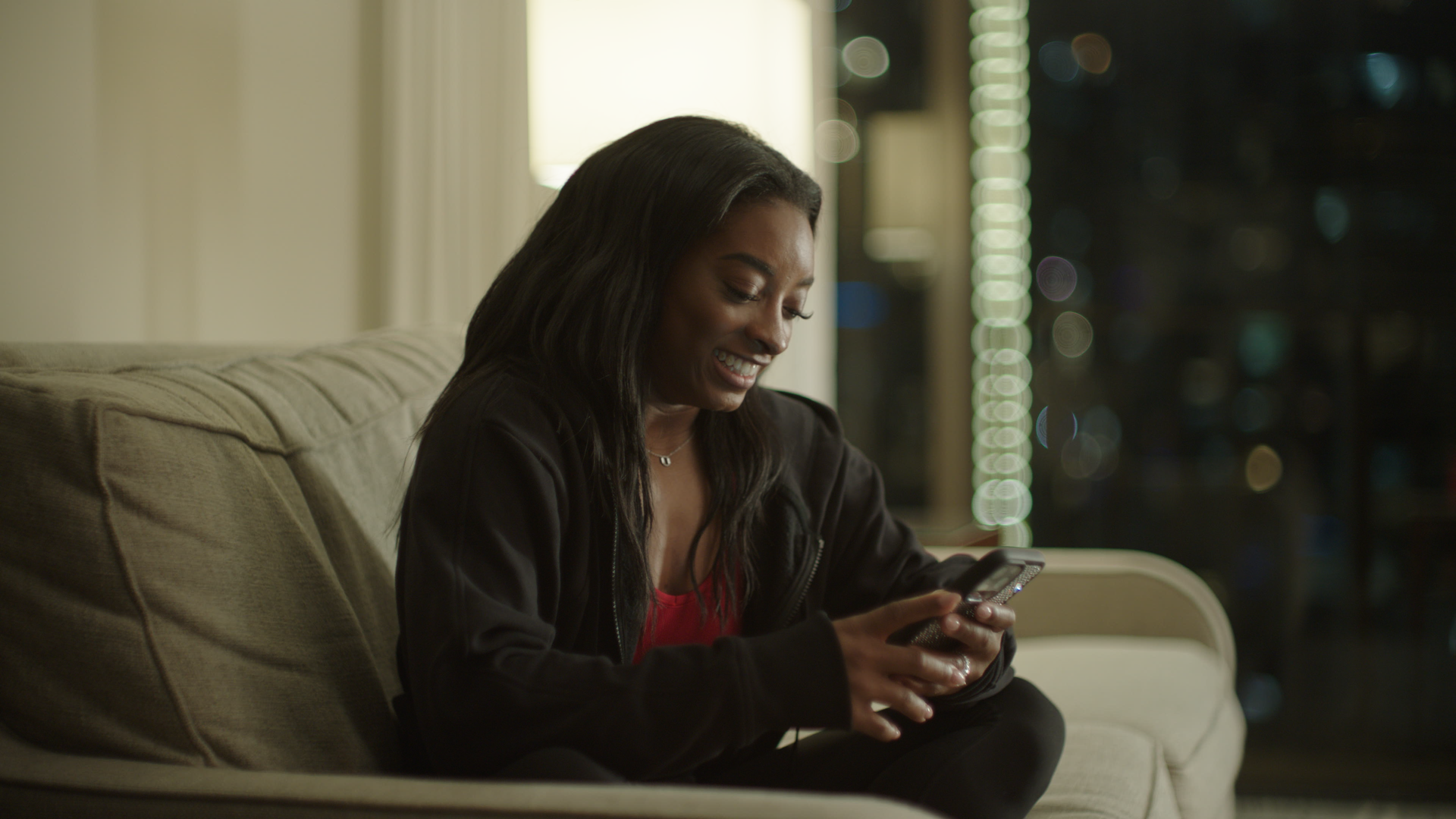
Simone Biles is joining Religion of Sports, the production company co-founded by Tom Brady, Michael Strahan and filmmaker Gotham Chopra, as a creative partner and board member, she told Axios in an interview.
Why it matters: The move firmly establishes Biles — the most decorated gymnast in history — as a media entrepreneur.
- While Biles has experimented with a few media projects, including her Netflix series "Simone Biles Rising" and her best-selling autobiography and its TV adaptation "Courage to Soar," her new role with ROS will allow her to help produce and direct projects for other athletes.
- "I think there are really critical conversations that need to be heard around sports, through mental health and athletes — just even in the Black and brown community," she said.
- While much of her own media experience has been documentary-style programming around her own life, her new role will allow Biles to expand to new formats, such as scripted programming and live events, said ROS CEO Ameeth Sankaran.
The big picture: Biles has worked with ROS over the past five years on projects such as her Netflix show and "Simone vs Herself," a Facebook Watch series.
- Biles joins ROS during a period of major disruption for the sports entertainment industry.
- Turbulence in Hollywood and changes to the media landscape have forced some companies to consolidate, cut costs or raise more cash.
- ROS shuttered its audio unit and laid off staff from that team in 2023.
Zoom out: Today, ROS is in a "very stable place" because it's doubled down on what works, Chopra said.
- With around 40 full-time employees, it's pacing to produce more than a dozen major projects this year.
- The company, which raised $50 million in 2022, has focused over the past year on expanding its streaming partnerships and creating intimate, character-driven stories.
What to watch: Although Sankaran and Chopra declined to discuss any financial figures, Sankaran said the company expects to turn a profit in 2025.
3. 🗞️ Exclusive: $25M poured into local news
The John S. and James L. Knight Foundation this week will announce a $25 million investment in the American Journalism Project, a venture philanthropy dedicated to local news, executives told Axios.
Why it matters: The money represents the largest grant AJP has raised since its 2019 launch and one of the largest journalism grants the Knight Foundation has ever allocated to a single organization, said Sarabeth Berman, CEO of AJP.
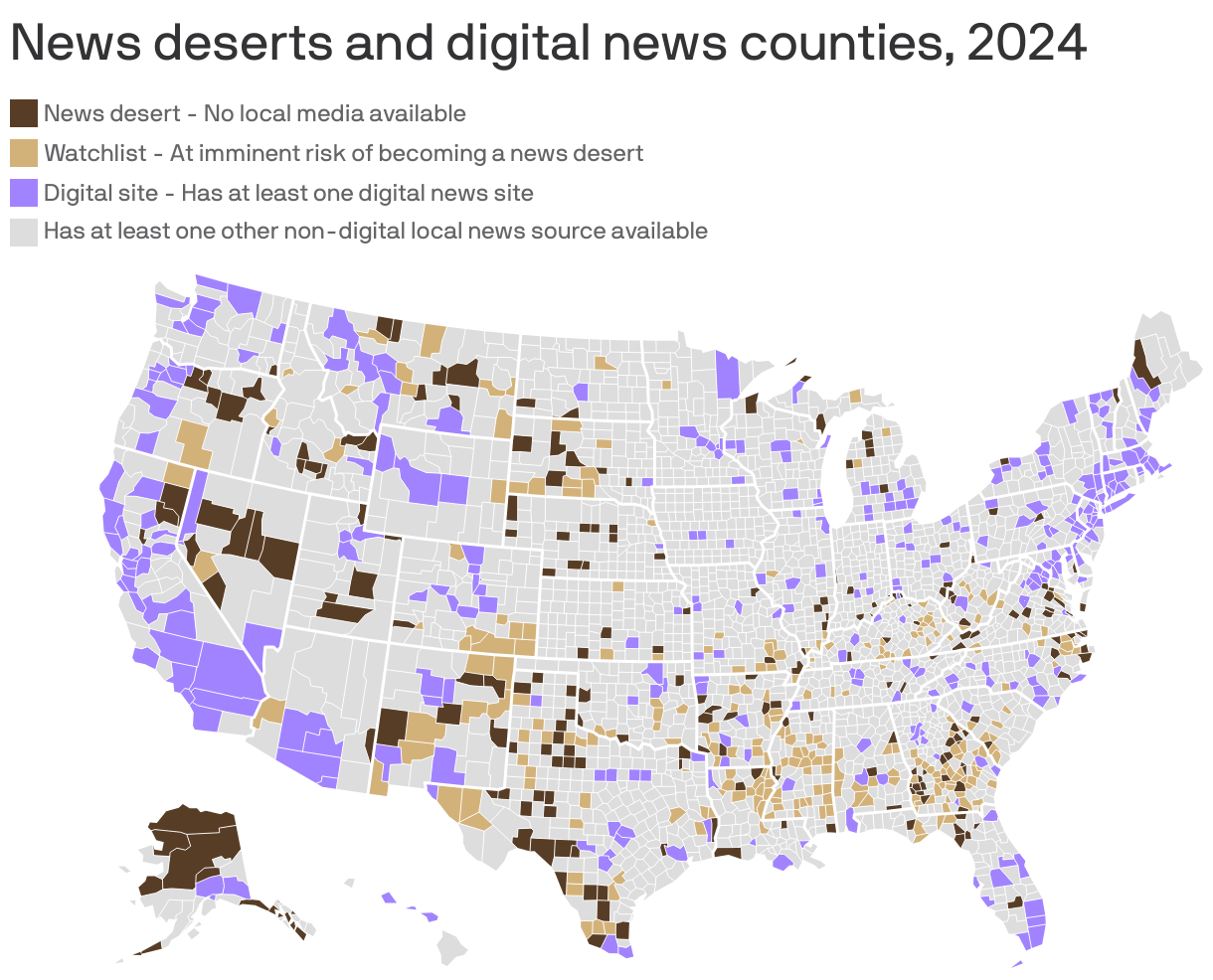
The big picture: Over the past few years, more philanthropists have stepped up to fill the local news void, investing in community-based nonprofit newsrooms in places like Tulsa, Cleveland, Houston, New Orleans, and Baltimore.
- AJP, which specializes in raising philanthropic funds for nonprofit newsrooms, has mobilized over $68 million in local philanthropy to support local news initiatives.
- "I know there's a lot of reporting in that philanthropy is slowing down, but we're not seeing that," Berman said.
Zoom in: The money will be used to grow AJP's reach from supporting 50 local newsrooms today to 60 over the next three years, Berman said.
- It will also be used to build a new unit within AJP called the Knight Resiliency Lab, which will provide local news organizations with "essential expertise and support ... to grow stronger and more sustainable for the long term," said Maribel Pérez Wadsworth, president and CEO of the Knight Foundation, in a statement.
Between the lines: The new funds represent the Knight Foundation's commitment to AJP, which it helped launch with $20 million in funding in 2019.
- Since then, AJP has raised more than $200 million to support a portfolio of 50 nonprofit news organizations across 36 states.
What to watch: More local newsrooms are shifting from for-profit to nonprofit businesses to tap into the growing pile of philanthropist cash.
- Today, around 48% of the Institute for Nonprofit News' members are local news organizations, up from about 20% in 2017.

4. 📺 Flooding DAZN
International sports streaming service DAZN Group has been pumped with nearly $2 billion in investment over the past month.
Why it matters: The Len Blavatnik-backed streamer has burned through billions in its self-described bid to become the "Netflix of Sports."
Driving the news: Yesterday, DAZN announced that SURJ Sports, the sports arm of Saudi Arabia's Public Investment Fund, has taken a minority stake.
- Though terms were not disclosed, it's been widely reported that SURJ is investing $1 billion.
- As part of the deal, DAZN and SURJ will set up a joint broadcasting venture in the Middle East and North Africa region.
- Last month, Ukrainian billionaire Blavatnik invested an additional $827 million, bringing his total outlay to $6.7 billion since the company's launch in 2007.
The big picture: DAZN has yet to become profitable — it lost $1.4 billion in 2023 — as it continues its buying spree.
- In December, DAZN made two other large deals.
- First, it paid $1 billion for the global rights to FIFA's upcoming Club World Cup this summer.
- Then it agreed to buy Australia-based Foxtel Group from News Corp and Telstra in a deal that valued it at $2.2 billion.
What we're watching: DAZN's goal of becoming the "Netflix of Sports" could be undercut by Netflix's own growing sports ambitions.
5. Big AI win for publishers
A long-awaited change from the U.S. Copyright Office is making it easier for digital publishers to build legal cases against AI companies.
Why it matters: Publishers looking to sue AI companies for copyright infringement can often build a stronger case when they can point to statutory damages, which are based on a fixed amount of compensation predetermined by law, over actual damages, which are harder to prove.
How it works: For publishers to claim they are owed statutory damages, they need to register their individual works with the U.S. Copyright Office.
- Previously, that process was extremely cumbersome, limiting the ability of digital publishers to seek protection. (Print publishers faced the same constraints for their online works, but were able to mail their newspapers and magazines directly to the Copyright Office to register their print works.)
- The Copyright Office recently changed its registration processes to make it much faster and easier for digital publishers to register their work. The new system, announced in 2024 and implemented recently, was lauded by news publishers.
State of play: Those Copyright Office changes helped build a recent lawsuit led by the News Media Alliance (NMA), the largest news trade group in the U.S., and more than a dozen of its members against AI startup Cohere.
- NMA and the publishers suing Cohere were able to identify thousands of specific examples of where Cohere copied their copyright-protected works verbatim, NMA CEO Danielle Coffey told Axios.
- The New York Times makes a similar case around statutory damages in its lawsuit against OpenAI and Microsoft.
Zoom out: The copyright changes add to a growing list of small wins for publishers in their legal battles with AI firms.
- Last week, a federal judge sided with Thomson Reuters in a landmark fair use case that found a former Reuters competitor guilty of illegally using Reuters' legal platform to train an AI model for a competitive platform without permission.
6. TikTok whiplash
Google and its rival Apple brought TikTok back to their app stores last week, but that move — at least for Google — is likely temporary, a source familiar with Google's plans told Axios.
Why it matters: Unless TikTok makes real progress in finding a U.S. buyer in the next few weeks, the app will likely disappear from the app stores again when Trump's executive order delaying the ban expires in early April.
Sign up for Axios Media Trends


/2025/02/18/1739903311793.gif?w=3840)