Axios Media Trends

November 07, 2023

1 big thing: 🏈 Betting mega-merger

Illustration: Sarah Grillo/Axios
2. Exclusive: Bloomberg tops half-million subs


Bloomberg Media now has over 500,000 subscribers, the firm's chief digital officer Julia Beizer told Axios. The firm introduced its $34.99 monthly digital subscription in 2018.
Why it matters: Most U.S. national news outlets are eyeing politics or consumer topics, like wellness, to fuel subscription growth. Bloomberg is leaning into niche professional audiences and international users.
- "Where we do best is with business decision-makers, particularly in finance and tech and [telecommunications]," Beizer said.
- Bloomberg Media is also looking to attract modern business leaders outside of finance that it hasn't historically engaged, like HR leaders.
By the numbers: The majority (60%) of Bloomberg Media's subscribers are in the U.S. The rest are in Europe and the Middle East (20%) and Asia Pacific 20%.
- Those numbers, Beizer notes, are consistent with the company's traffic patterns. Bloomberg Media has pushed aggressively to expand its audience abroad, even outside of major financial centers.
- Beizer declined to say how many of Bloomberg Media's subscriptions are enterprise — meaning they are sold to companies instead of individuals — but said the firm is looking to expand in that area. (Bloomberg only began selling enterprise subscriptions in May 2022.)
The big picture: Now that Bloomberg Media's subscription business has reached a critical mass, Beizer said the company is focused on making it more sustainable.
- "We've been bringing users on for longer terms — people who want to stay with us for annual plans as opposed to monthly plans," she said.
- Improvements to the user experience, like removing programmatic ads, better payment processes and tinkering with its paywall, have helped make the product stickier.
What's next: Asked when Bloomberg expects to hit 1 million subscribers, Beizer said, "I don't have a timeline for it, but I know it's not going to take another five and a half years."
3. MSNBC loses prime-time viewers during war
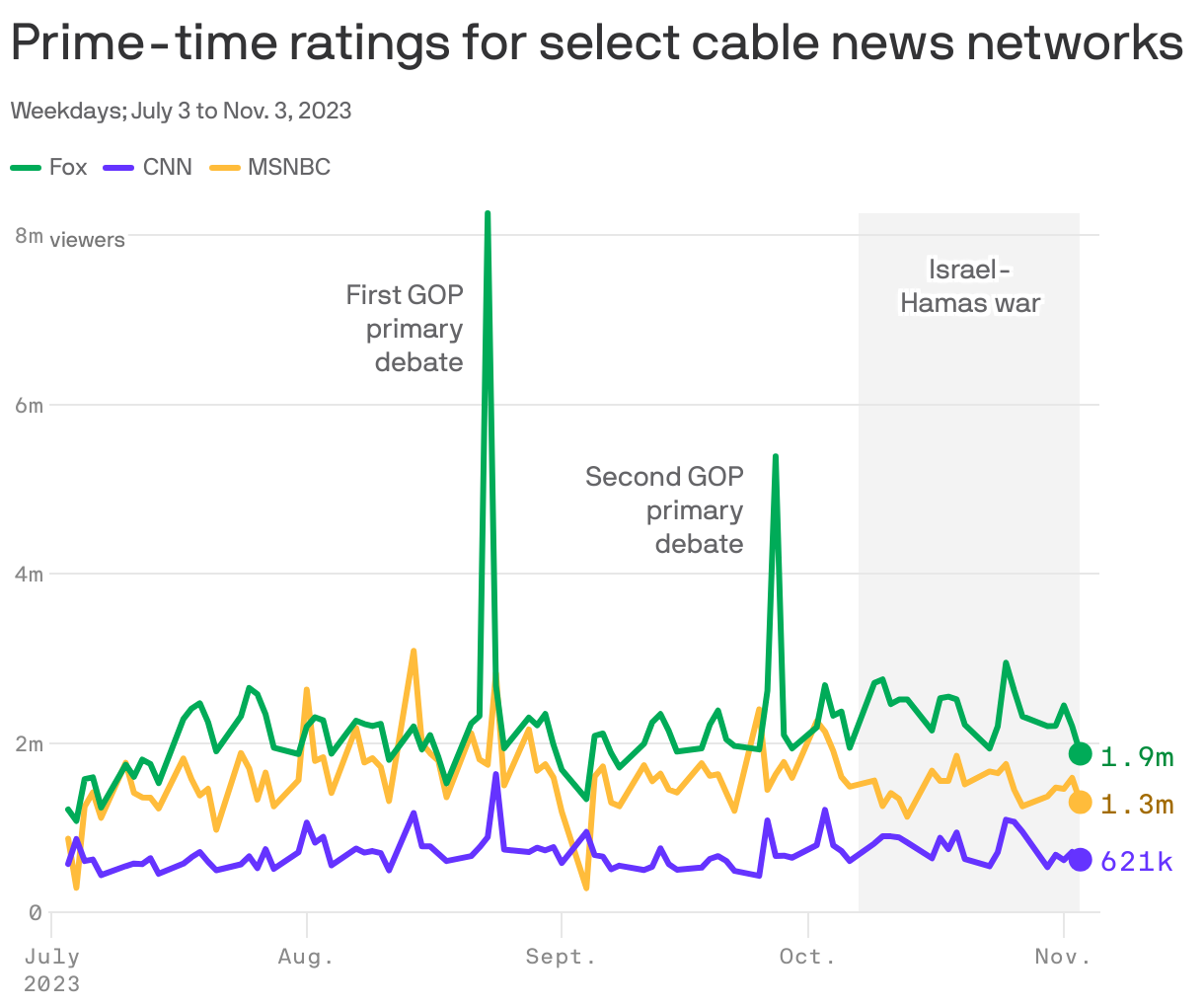
The first month of the Israel-Hamas war was a prime-time ratings win for CNN and Fox News, while MSNBC lost viewers.
By the numbers: The average nightly prime-time audience for CNN and Fox News increased 17% and 10%, respectively, during the first four weeks of the war compared to the four weeks prior.
- MSNBC's prime-time audience, meanwhile, fell 11% during that same time period.
- The first week of the war proved the strongest for Fox News and the weakest for MSNBC in terms of prime-time ratings.
- Total day viewership patterns are consistent with the prime-time numbers, per The Wrap.
Of note: The average audience increase calculation for Fox News does not include its Sept. 27 ratings, which were an outlier due to the network hosting the second Republican presidential debate.
- Including those debate numbers, Fox's prime-time audience was still up around 3% for the first four weeks of the war compared to the four weeks prior.
Yes, but: MSNBC has since started to claw back. The network saw a significant jump in prime-time viewers in the second week of the war compared to the first.
- Prime-time ratings in weeks three and four were also up compared to the first, but have dropped sequentially since the second week.
What to watch: How long any viewership gains last.
- Prime-time viewership across all three networks was the highest during the third week of the war, but dropped significantly last week.
- CNN saw the steepest week-over-week prime-time viewership declines last week, followed by Fox then MSNBC.
- News engagement with the Ukraine war began to drop off after about a month.
Editor's note: Sara is a CNN contributor.
4. 📺 Hulu pricing battle begins


Now that Disney and Comcast have formally set in motion the sale process for Hulu, it will be a long and arduous road to determine how much the 16-year-old streaming service is worth, Axios' Tim Baysinger writes.
- Why it matters: Nailing down the final price of Hulu could add fireworks and a premium for Disney when all is said and done.
Driving the news: Disney agreed to pay an initial $8.61 billion for Comcast's 33% stake. An appraisal process will determine whether Disney pays more.
The big picture: Ever since a 2019 "put/call" agreement between the two heavyweights, Disney and Comcast have been at odds over Hulu's true value.
- Hulu has been a tricky asset to value largely because it relies on licensing deals with other companies and thus doesn't own its own content.
By the numbers: Hulu is one of the few streaming services — the only major one outside of Netflix — that has ever turned a profit.
- Hulu has one of the highest monthly ARPU (average revenue per user/subscriber) of any streaming service — largely due to its high price point and live TV offering — doubling Disney+.
- Hulu also accounted for the bulk of Disney's $873 million streaming advertising revenue for the entire quarter.
What's next: Morgan Stanley and JPMorgan will decide on Hulu's value, and if the difference between the two valuations is more than 10%, a third bank will break the tie.
- While a few analysts have put some figures on what they think Hulu is worth — anywhere between $30 million to $60 million — most are wary of publicly saying anything because they want to be that tie-breaking appraiser.
Sign up for Axios Pro Media Deals authored by Tim Baysinger and Kerry Flynn.
5. Publishers rev up AI copyright fight

Illustration: Sarah Grillo/Axios
6. 1 fun thing: 🇬🇧 British takeover

Left to right: Emma Tucker, Will Lewis, Mark Thompson: Photos: Joy Malone/Getty Images, Elliott O'Donovan for The Washington Post, Roberto Ricciuti/Getty Images
Axios Media Trends

Sara Fischer’s inside look at the forces reshaping media.