Axios Media Trends

September 02, 2025

Good afternoon. Today's Media Trends, edited by Christine Wang and copy edited by Amy Stern, is 2,052 words, a 7.5-minute read. Sign up.
📅 Axios' inaugural Media Trends Live event heads to NYC on Sept. 18.
- 🌟 Speakers include: Shari Redstone, Snap Inc. CEO Evan Spiegel, PBS CEO Paula Kerger, Condé Nast CEO Roger Lynch, NASCAR commissioner Steve Phelps and many more.
- 🎟️ Get your ticket here.
Situational awareness: Google won't be required to sell its lucrative Chrome browser or its Android operating system as a part of its search antitrust case with the Justice Department.
1 big thing: Exclusive ... Disney's FTC settlement

The Walt Disney Company on Tuesday said it has agreed to pay $10 million to settle a children's privacy lawsuit with the Federal Trade Commission related to videos it uploaded on YouTube mostly during the pandemic.
Why it matters: It's the first known case in which a YouTube content provider has settled with the FTC over children's privacy violations since the agency's landmark settlement with YouTube and its parent Google in 2019.
Zoom out: The fine targets Disney for content that wasn't uploaded to its own platforms, likely opening the door to penalties against other content providers that distribute their work on other sites and apps.
- The FTC investigation into the issue began during the Biden administration several years ago, according to a source familiar with the complaint.
State of play: The FTC complaint alleges Disney failed to designate certain YouTube videos as being made for children when it added them to the platform.
- In failing to do so, Disney inadvertently allowed those videos to be targeted with online advertising, which is why the FTC considers the improper designation problematic.
- The videos in question are mostly storytime videos that were uploaded in the early days of the COVID-19 pandemic, which featured celebrities reading to kids.
- In settling the matter, Disney concedes that it made an administrative error in the way it characterized videos it uploaded to YouTube mostly during the pandemic.
Between the lines: In failing to categorize the videos correctly, the FTC claims Disney violated the 1998 Children's Online Privacy Protection Act.
- The law requires companies to notify users of content directed toward children when data tracking occurs, and requires them to obtain parental consent for such tracking.
Reality check: Age verification online is tricky, and many platforms and publishers have struggled to adhere to disparate protocols.
- YouTube itself agreed to pay $30 million to settle a children's privacy lawsuit last month.
- In 2019, it agreed to pay $170 million to settle an FTC children's privacy violation complaint. As part of that settlement, the FTC at the time said it would follow up with investigations of the content providers on YouTube.
2. 📈 Record midterm spend

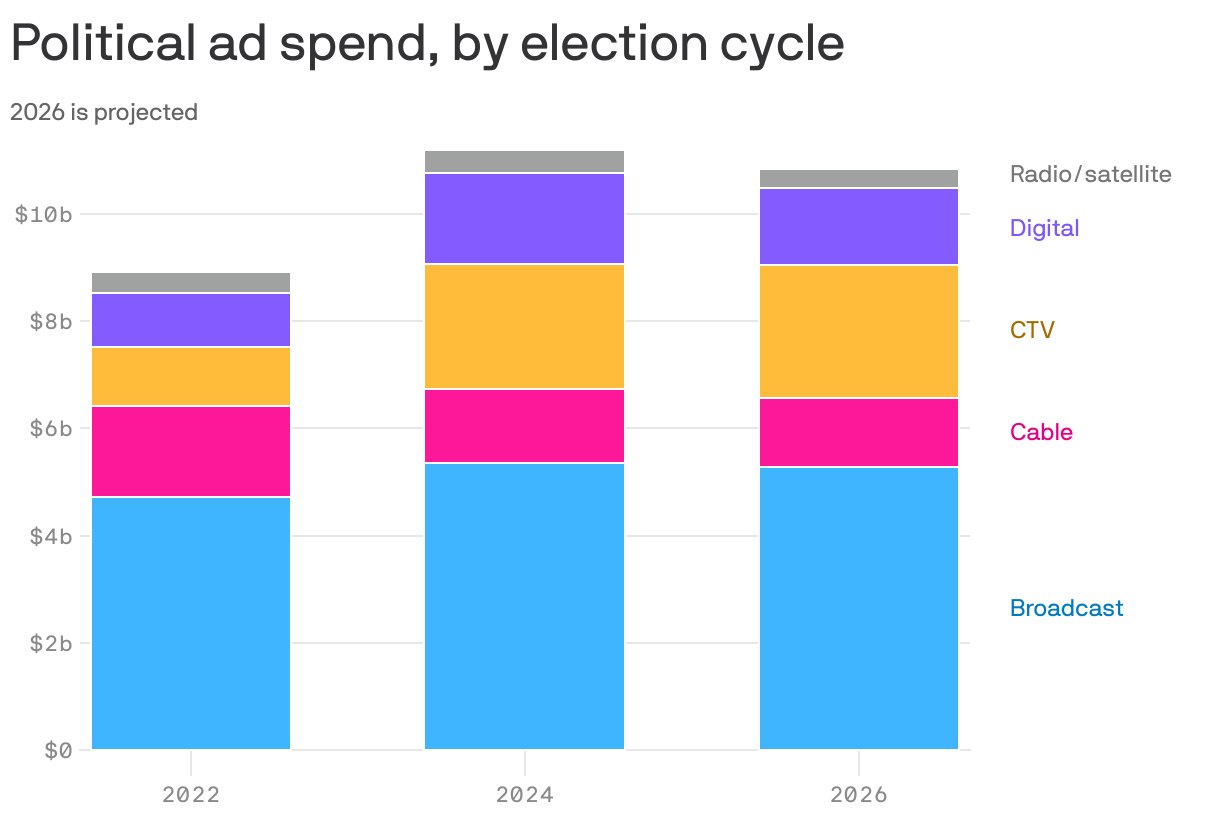
The 2026 U.S. midterm elections are expected to be the most expensive on record, thanks to a competitive battle for control of Congress and a surge in streaming video advertising, according to a new projection from ad analytics platform AdImpact.
Why it matters: The bullish projections are based in part on unprecedented early spending this year, fueled by competitive gubernatorial primaries, tight House and Senate races, and contentious down-ballot issues.
💸 By the numbers: In total, a whopping $10.84 billion is expected to be spent next year on political and issue advocacy ads, per AdImpact, up from the $8.9 billion spent in the 2022 midterms.
- Next year's projected total is down from the last presidential cycle, which saw $11.2 billion in total advertising investment, but that included a whopping $3.2 billion spent solely on the presidential race.
Of note: AdImpact's data tracks the vast majority of, but not all, political and issue ad spending, which is why its projections differ from those made by some large global ad agencies.
Zoom out: Next year's record investments are driven in part by an increase in spending on connected TV advertising, or streaming.
- Streaming advertising is the only medium expected to outpace 2024 spending, with $2.48 billion expected to be invested.
🏛️ The big picture: A lot more money is being spent on state races and ballot measures amid congressional gridlock at the national level.
- Next year, state legislature ads are expected to reach $700 million in spending, up 19% from 2024, per AdImpact.

3. 📣 Media criticism shift
Media and arts criticism, once a vibrant part of most major news organizations, is undergoing sweeping changes as newsrooms face financial challenges and cultural and political pressure around bias.
Why it matters: Critics help audiences better understand the media they consume. Without them, audiences are left to interpret through social media commentary, which can lack nuance, fact-checking and editorial standards.
- "An honest broker, fair-minded, transparent opinion columnist can connect dots about the news and the world in ways that no other journalist can," said Eric Deggans, the Knight Professor of Journalism and Media Ethics at Washington and Lee University.
- "When you remove those jobs from regional newspapers and from smaller publications, you kick away the ladder for people to learn how to do that work," said Deggans, who also works as critic-at-large at NPR.
Driving the news: Vanity Fair recently laid off its longtime film critic and Hollywood correspondents.
- The Washington Post's media critic Erik Wemple took a buyout, after his column about Post owner Jeff Bezos' move to overhaul the paper's opinion sector was reportedly spiked.
- The New York Times' media columnist position has not been filled since Ben Smith left in 2022. Meanwhile, Wemple is joining in a different capacity covering media.
- The Times also recently revamped its culture desk, reassigning four TV, music and theater critics and beginning a search for new critics.
- CNN cut its veteran media critic last year as part of wider layoffs.
State of play: Changes in criticism in traditional newsrooms affect everything from music to movies, television and beyond.
- A recent New Yorker essay argued that music criticism has "lost its edge" amid the rise of "poptimism," where pop music was celebrated, and the power of artists and fans on social media made negative reviews riskier.
- Movie reviewers have seen their roles shrink as studios and fans seek buzzier and friendlier content from festivals and fandoms, per The Guardian.
- AI tools are threatening to replace the work of editorial cartoonists, as recently covered in the San Francisco Chronicle.
4. 🍿 Summer box office slump


The domestic summer box office, which extends from May to Labor Day, brought in roughly $3.67 billion in sales this year, per Comscore, falling shy of last summer's total and behind analyst expectations of $4 billion.
Why it matters: A strong showing in May had movie enthusiasts hopeful that this year's summer box office — which typically comprises around 35%-40% of total annual sales — could help offset the downward trend of moviegoing following the pandemic.
- Getting to the $4 billion mark in the post-pandemic era "has proven to be elusive and challenging," noted Paul Dergarabedian, senior media analyst at Comscore.
State of play: While a slew of big openings had May up 76% year-over-year in ticket sales, attendance dwindled in the following months. Since June 13, there's only been one weekend with stronger sales than 2024. Since July 18, attendance has been down seven weekends in a row, per Dergarabedian.
- Dergarabedian notes that while there were some bright spots at the end of August — including positive showings for Warner Bros. Pictures' "Weapons," Netflix's "KPop Demon Hunters" and the re-release of "Jaws" — the month had very challenging comparisons to last summer.


The big picture: This summer's less-than-expected turnout has movie buffs worried that theaters may never match the global sales and attendance records of the pre-pandemic era.
- For major film studios, that problem is being compounded by fewer international ticket sales, per The Hollywood Reporter.
5. 👀 Wintour succession watch

Condé Nast named Chloe Malle as its new head of editorial content of Vogue U.S., marking the most significant step taken by longtime Vogue leader Anna Wintour in mapping her succession plan.
Why it matters: Malle was a predictable pick for Wintour, who — since stepping down as Vogue's editor-in-chief in June — has mostly named Vogue loyalists to top positions within Condé Nast.
- Malle has been with the franchise for nearly 15 years. Most recently, she served as the editor of Vogue.com.
- She will join 10 executives on a leadership team reporting to Wintour.
Zoom out: Wintour has overseen the editorial restructuring of many of Condé Nast's iconic brands since becoming global chief content officer in 2020.
- She named Mark Guiducci, Vogue's former creative editorial director, as Vanity Fair's first global editorial director in June.
😎 The big picture: Wintour, 75, still serves as Vogue's global editorial director.
- Because the storied magazine has been synonymous with her brand, rumors of her succession plan have run rampant for years.
- Lauren Sherman, the Puck News fashion reporter who first broke the news of Malle's appointment last night, said the move "seems like a simulacrum of Mark Guiducci's ascent at Vanity Fair — both are loyal, longtime Wintour surrogates who manifested some glamour in a meat-grinder age — but they actually have different remits."
6. 🪓 VOA gutted, again
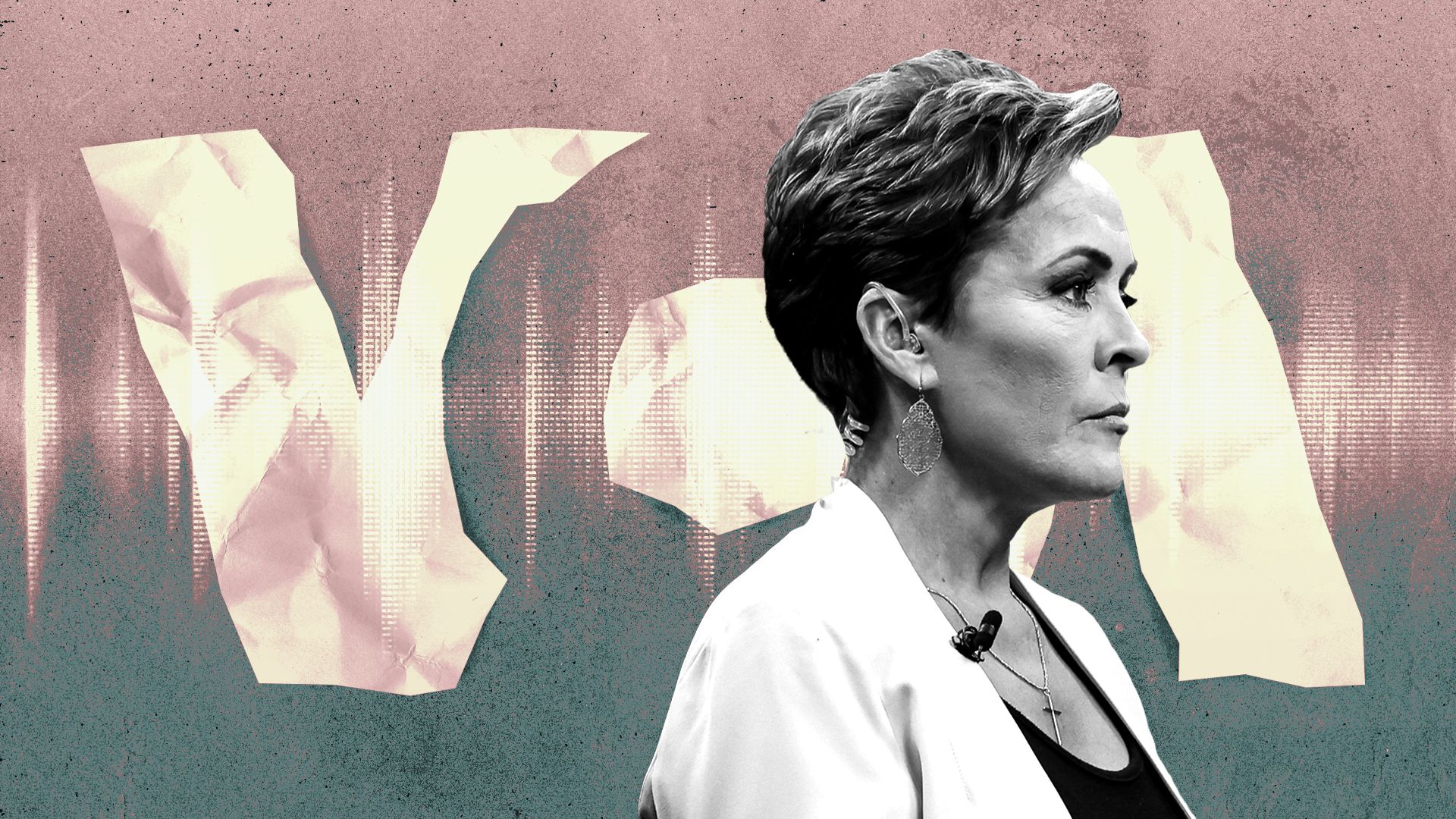
United States Agency for Global Media special adviser Kari Lake last week announced that the organization, which oversees U.S. government-funded international broadcasters, has eliminated another 532 government positions as part of a broader effort to reduce federal spending.
Why it matters: The move effectively guts what's left of Voice of America, the largest government-funded broadcaster. Only around 100 employees remain at the agency, per the New York Times.
⚖️ Zoom in: Lake's latest efforts are likely to face significant legal pushback.
- A district judge in April ruled in favor of VOA in its lawsuit against the Trump administration, saying it could not unilaterally dismantle the broadcaster by systematically firing its staff.
- Last week a federal judge blocked Lake's attempts to remove the VOA's director Michael Abramowitz. The judge threatened to hold Lake in contempt for refusing to comply with his April order demanding the return of VOA employees and contractors to work.
📉 The big picture: Despite the legal challenges, Lake and the Trump administration's actions have successfully run down the VOA. The outlet is only broadcasting in four languages currently, down from 49 before the crackdown, per NYT.
7. 🏈 NFL's digital deal blitz
The NFL has struck a content licensing deal with sports business news outlet Front Office Sports, FOS founder and CEO Adam White told Axios.
Why it matters: It's the first time the NFL has partnered with a sports business-focused news outlet to share content.
🤝 Zoom out: The league has been exploring more digital content deals with new-age websites as it looks to tap into a younger audience.
- Last month, it struck a content deal with the women's sports-focused outlet The GIST, which will create more NFL-focused content that includes NFL branding.
- In January, the NFL struck a highlights deal with Bleacher Report. It also has digital rights deals with Overtime, a Gen Z-focused sports media company, and Betches Media, a women-focused social media brand.
How it works: The yearlong deal will see FOS paying the league to access NFL intellectual property, events and logos to use across its portfolio.
- The content does not include live rights, but it does give FOS access to things like emblems from the league and its teams that FOS can use in its coverage.
- FOS will also get behind-the-scenes access to NFL tentpole events, including NFL International Games, the Super Bowl and the NFL Draft.
- White sees the deal as a critical lever to be able to strengthen FOS' relationship with advertisers, including official NFL partners.
The big picture: The NFL deal represents the latest in a broader pivot by FOS to expand beyond newsletters and into more multiplatform franchises that are anchored by individual reporters.
- Front Office Sports, which White launched while he was in college in 2014, has roughly 65 full-time employees, up from around 10 in 2020.
- White says he anticipates that the company this year will be profitable and earn "between $17 million–$20 million" in top-line revenue, up from around $10 million last year, catalyzed by ad growth.
👀 What's next: White says he hopes to replicate this type of deal with other major sports, as more leagues look to broaden their reach across new digital sites.
- The Athletic, a sports site owned by the New York Times, notably struck a highlights rights deal with the NBA and WNBA earlier this year.
Sign up for Axios Media Trends