Axios Markets

March 16, 2026

🌅 Welcome back! Stock futures in the U.S. are up slightly this morning — and so are oil prices.
- More on that below, as well as a look under the hood of the S&P 500, where things are ... complicated.
🎊 Congrats to Oscar winner Michael B. Jordan. We flagged this one last week: The best actor market was the most exciting one to watch on Kalshi, closing at $25.5 million, larger than for best picture at $25.3 million, the company said today.
📺 "The Axios Show" is back for Season 2: Anduril founder Palmer Luckey talks with Colin Demarest about the Iran war, his redlines for making weapons and why he's so loud on Twitter. Watch the episode on YouTube.
All in 1,282 words, a 5-minute read.
1 big thing: The stock market's wild underbelly
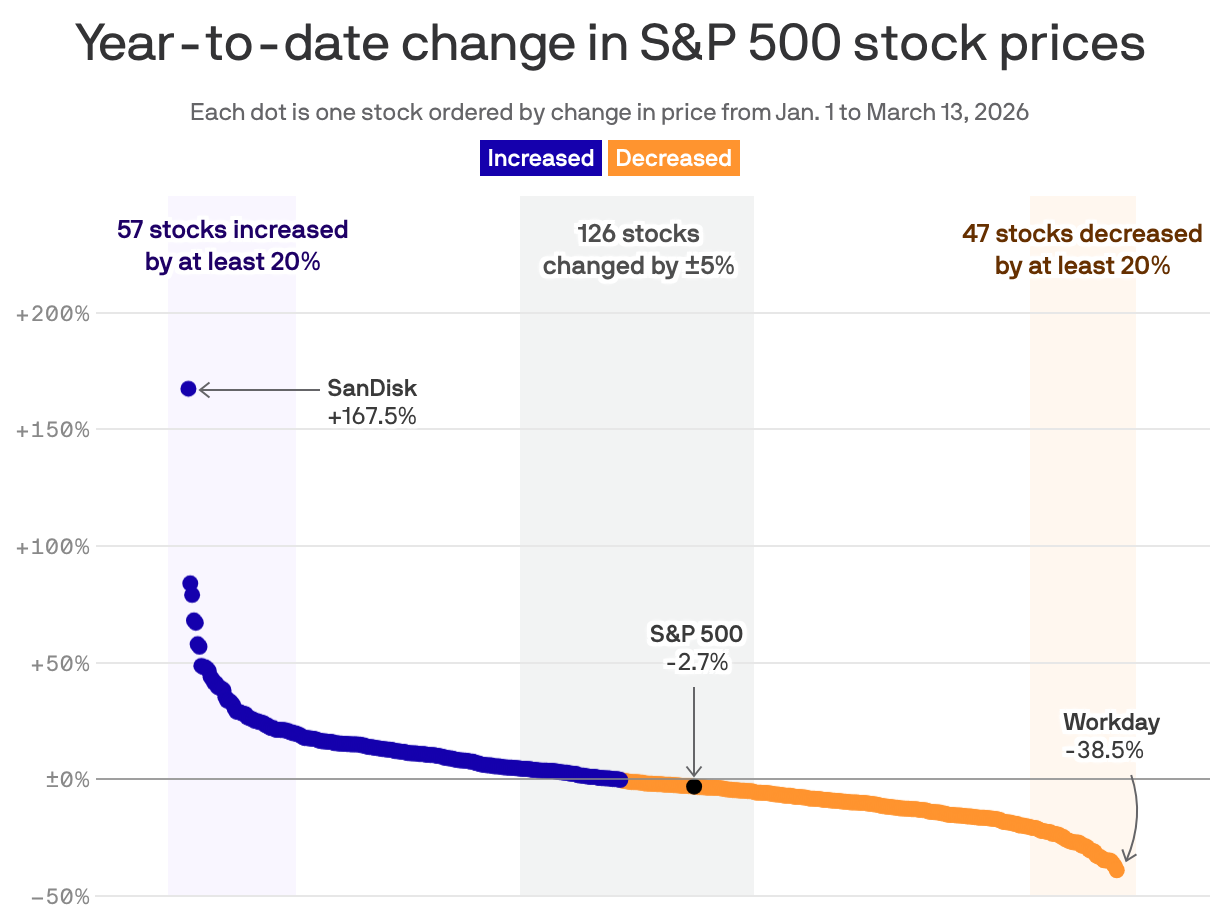
The S&P 500 appears relatively calm on the surface this year, but dig a little deeper and you'll find some wild swings.
Why it matters: Investors have retreated from the Big Tech names that carried the market in recent years, putting downward pressure on stocks.
By the numbers: The S&P 500 has fallen just 3% for the year, but that masks some big-time volatility.
- 57 stocks are up by at least 20%, and 47 stocks are down by at least 20%, according to an analysis conducted Friday afternoon by Bespoke Investment Group.
- That's unusual, says Paul Hickey, the investment advisory firm's cofounder.
The big picture: AI and the war are pushing stocks around in new ways.
- Investors are pulling back from software in the wake of the SaaS-pocalypse and rotating toward defense and energy stocks.
Winners: Energy and defense industry stocks like Valero (+43%), Occidental Petroleum (+40%) and Lockheed Martin (+34%).
Losers: Workday, which makes HR software imperiled by the SaaS-pocalypse, has declined 39% this year. Oracle, an AI darling stock, is down 20%, and Salesforce, the SaaS king, off 27%.
Yes, but: Software might be out, but hardware is very much in: Companies benefiting from the RAM and memory chip shortage are slaying.
- SanDisk is up 168% for the year; Micron (+48%).
Between the lines: The biggest stocks that weigh most heavily on the market haven't seen such wild ups or downs — but things are meh.
- The Magnificent 7 was down about 8% for the year, as of Friday afternoon, when Bespoke pulled the numbers.
How it works: The S&P 500 is weighted by company size — bigger firms have outsized impact on the index.
- The top 10 stocks on the S&P 500 — that includes the Mag 7 —  make up about 40% of the index, as Apollo Global's chief economist Torsten Slok recently pointed out.
- "If they do nothing, the other 60% has to go up to move the needle," says Hickey from Bespoke.
Reality check: You could also argue that the relatively mild fall for the Mag 7 stocks is keeping the market from looking even worse.
The intrigue: If Anthropic, OpenAI and SpaceX are added to the S&P 500 this year, market concentration could approach 50%, Slok noted. That would mean the index "basically doesn't offer much diversification anymore."
What to watch: Some of this trend is actually starting to reverse, says Abby Yoder, U.S. equity strategist at JPMorgan Private Bank.
- Software started performing better in the first week of the war, she tells Axios. Tech is recovering a bit now that it's out of the spotlight.
- "AI is taking a backstep to geopolitics," she says.
The bottom line: "For years we basically heard about how the market was top heavy. Now those mega-cap stocks haven't performed as well," Bespoke's Hickey says. "So they act as a weight on the market."
2. Oil price watch
It's become a Sunday routine: When Brent crude, the global benchmark, starts trading, oil prices rise.
The latest: Last night prices jumped to more than $106 per barrel, up $3 over Friday's close. This morning, prices are back around $103.
- The price of oil is about 45% higher than when the U.S. strikes began, Axios' Ben Geman reports.
Yes, but: The price of oil is still well below its peak during the Russia Ukraine war in 2022. For a few reasons:
- Investors are still betting/hoping that this is a short war. Some retail investors are now trading oil like it's a meme stock, CNBC reports.
- There also might be some oil "leakage" out of the Strait of Hormuz, writes Ed Yardeni in a note this morning. He points to reports that Iran has negotiated "safe passage" deals with India and China.
- He also points to the relaxed Russia sanctions, strategic reserve releases and increased production in Saudi Arabia, through "bypass infrastructure."
- "The lost physical supplies of oil are maybe half as much as they could have been," he writes.
Catch up quick: President Donald Trump said Friday that the U.S. hit military targets on Iran's Kharg Island, the origin point for almost all Iranian oil exports.
- The attacks intentionally avoided oil infrastructure, he said.
What we're watching: Trump is working to assemble a coalition of countries to reopen the strait, sources tell Axios.
- Trump, in an interview with the FT, warned that if NATO doesn't pitch in to open the strait, the coalition faces a "very bad" future.
💬 Emily's thought bubble: European countries could now have leverage to push Trump to lower tariffs — part of the economic trade-offs the war is now forcing the U.S. into.
- More on this below...
3. Hot war vs. cold war
The war in Iran has sent oil prices skyrocketing, scrambling an economic conflict with Russia that's been raging for more than a decade.
The big picture: It's harder to maintain tight sanctions on Russia — effectively a "cold war" — while also grappling with the economic impact from the "hot war" with Iran.
State of play: The Treasury Department last week announced a one-month waiver on U.S. sanctions on Russian oil, even as some European allies objected.
- The waiver followed a more limited one that allowed India to buy Russian oil.
- The waivers apply only to oil already on tankers in the water.
- The idea is to free up supply while the Iranians have 20% of the world's oil blockaded in the Strait of Hormuz.
Where it stands: The move, one of a number of actions the White House is taking on oil, doesn't appear to have lowered prices.
Zoom out: The temporary waivers could wind up having long-term consequences.
- Russia's oil revenue funds the war against Ukraine.
- "This is the first major relaxation of sanctions on Russia we've seen, and risks dismantling the regime that we built starting in 2014 after the invasion of Crimea," says Eddie Fishman, who was a Russia and Europe sanctions lead in the Obama administration's State Department.
- Lifting the sanctions also reduces the stigma around buying Russian oil. That may be challenging to restore.
Friction point: The U.S. government is managing a crisis and needs to pick its priorities, says Kari Heerman, a senior fellow at the Brookings Institution and a former economist at the State Department.
- There are at least three in play: low gas prices, war in Iran and pressure on Russia to end the war in Ukraine.
- The U.S. picked low gas prices and war in Iran, Heerman says: "Those are the kinds of decisions you have to make in a world where you're doing a lot more economic statecraft."
Between the lines: The war also changed Iran's ability to leverage its economic might.
- The country had never before had a reason to justify shutting down the Strait of Hormuz — its most effective weapon against the West — until the bombs started falling.
Send me thoughts and story ideas at [email protected] or just reply to this email.
Thanks to Jeffrey Cane for editing and Carlin Becker for copy editing this edition.
Tell your friends to sign up here.
Sign up for Axios Markets