Axios Markets

September 20, 2023
🐪 Rise and shine! It's Fed day.
- Chair Jerome Powell takes the podium at 2:30 ET. The big question, per Axios' Fed whisperer Neil Irwin, isn't the announcement about rates today, (most observers expect no change) but what if anything is hinted about future plans?
Today's newsletter is 1,155 words, a 4.5-minute read.
1 big thing: On the cusp of a crisis
Illustration: Sarah Grillo/Axios
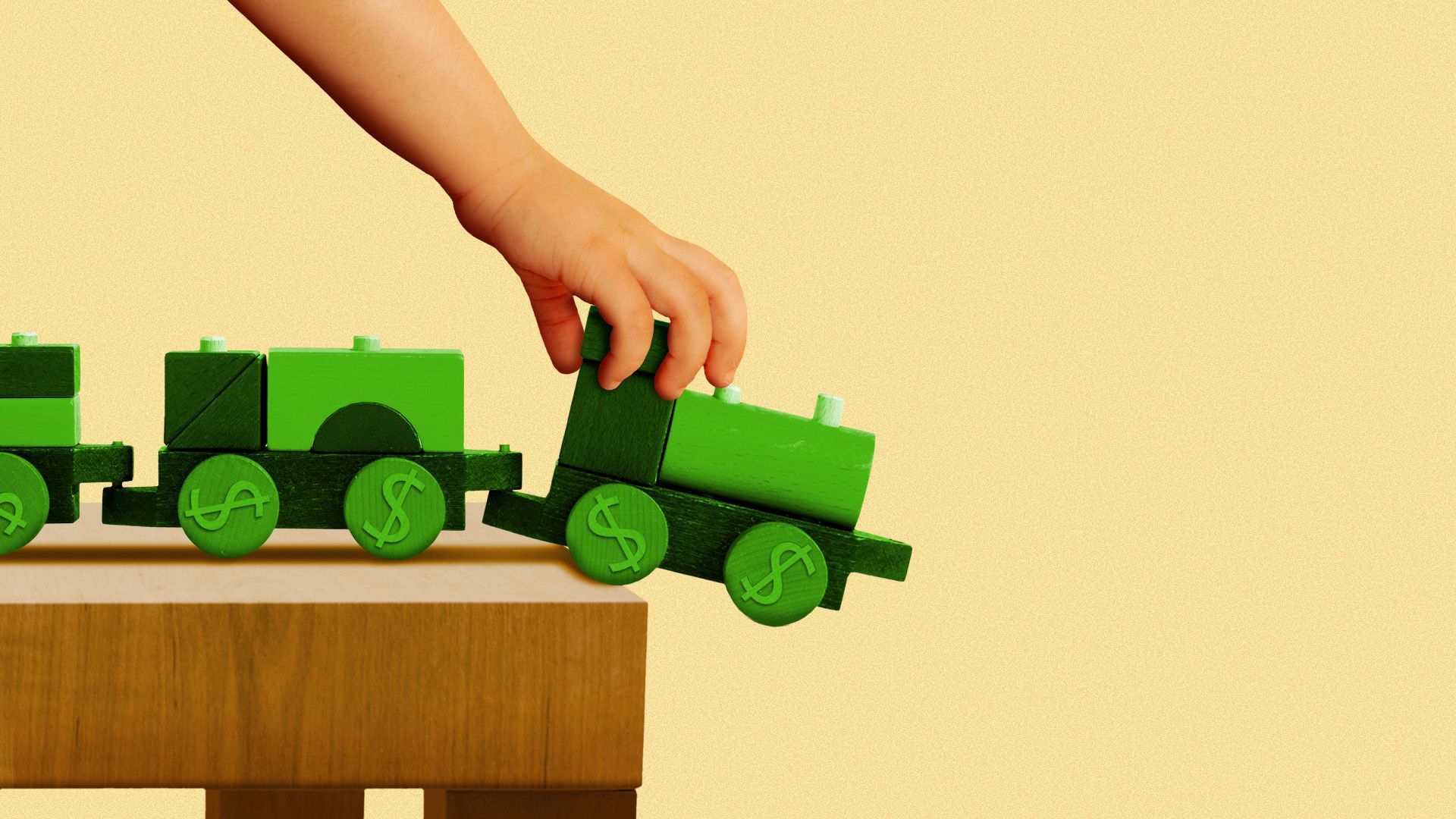
In 10 days, the U.S. will fall off a "child care cliff" — that's the day pandemic-era funding for the industry runs out, Emily writes.
Why it matters: The funding amounted to a $24 billion Band-aid patched over an industry that's long struggled. When the bandage comes off, the state of child care in the U.S. is likely to be even worse than it was before 2020.
- "There's going to be a real crisis here," said Cathy Creighton, director of Cornell's School of Industrial and Labor Relations Buffalo Co-Lab, who's studying the impact of the additional funding for providers.
By the numbers: As many as 70,000 centers, looking after 3.2 million children, may close after the funding runs out, according to one widely cited estimate from the Century Foundation.
State of play: The cliff is approaching just as women, particularly mothers, are hitting their stride in the U.S. labor market — with workforce participation at new highs and the employment gap between men and women at record lows.
- If the dire forecasts prove true, millions of parents — particularly mothers — are going to be left with some hard choices.
- Their child care provider could shut down or raise prices past affordable levels, which is widely expected — and many parents could exit the job market entirely.
The big picture: This cliff is new, thanks to the pandemic funding, but the reality is the industry in the U.S. has been living on the edge for a long time.
- Child care is a public good — studies find kids who get high-quality care wind up getting better educations, and better-paying jobs in the long term — but it's provided by a private market.
- Providers are limited in their pricing power because most parents can't pay all that much for care. To keep costs down, workers make very little — $14.22 per hour on average, per BLS numbers from 2022 — and providers operate on razor-thin margins.
- In many areas of the country, high-quality care is in short supply. Turnover in the industry is high, which turns out to be terrible for children's development (they do better with consistent caregivers).
As Treasury Secretary Janet Yellen put it in 2021: "Childcare is a textbook example of a broken market." (Read her full speech here.)
Where it stands: The $24 billion from the American Rescue Plan allowed providers to stay in business — they used it for things like raising worker pay or bonuses, lowering customer prices, and making infrastructure improvements.
- But it was temporary. And now, these centers are operating in a different labor market than that of January 2020 — low-wage workers have better options these days, and the cost of everything is higher. (Even with the funds, child care costs have skyrocketed in some regions of the country.)
3. Small biz confidence


An index that measures small business owners' confidence jumped six points in the third quarter, nearly reaching its pre-pandemic high, Emily writes.
Why it matters: Score one for team soft landing — the index, published by the Chamber of Commerce this morning, is another sign that the economy is doing OK.
By the numbers: 66% of small business owners say their business is in good health — nearly a 10-point increase.
- 71% say they expect revenue to increase next year — the highest number since the survey launched in 2017.
- While small business owners are upbeat about their own company's health, they're less positive about the economy overall. Only 33% say the economy is in good health — a 9-point increase from last quarter, but still quite low.
Of note: Since 2022, a majority of small business owners have said inflation is their biggest challenge — no other concern comes close. Only about 15% cited rising interest rates as their biggest challenge in the latest survey.
- Wage inflation is of particular concern in Q3: 56% of small businesses said keeping up with employee salary expectations is a challenge.
4. Saudi Arabia tightens its taps
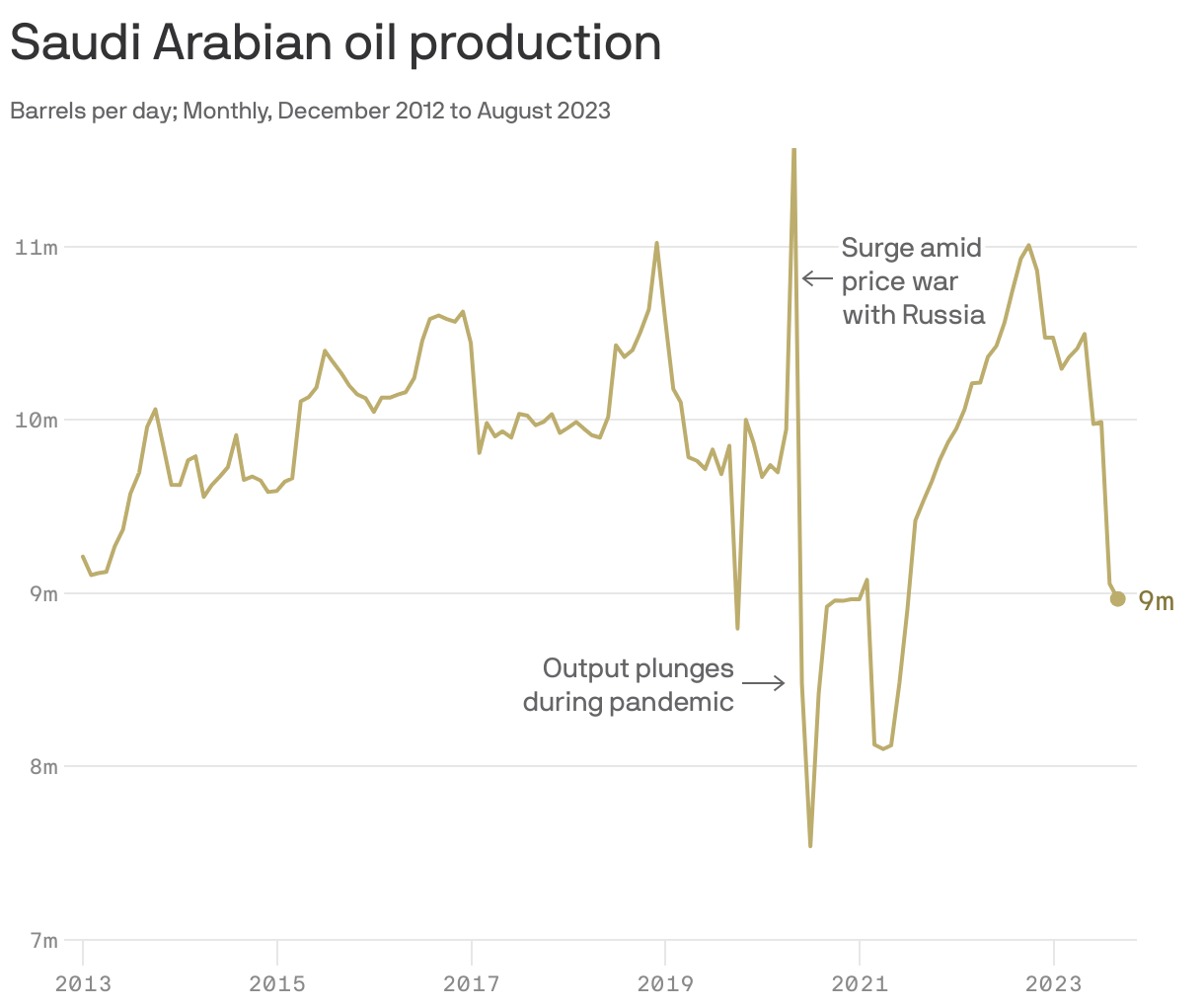
Production cuts coordinated by oil giants Saudi Arabia and Russia have helped drive global crude prices sharply higher, Matt writes.
Why it matters: The rise in oil prices seems to be giving the stock market agita, by reinvigorating inflation pressures and increasing the chances that the Federal Reserve imposes more interest rate hikes.
- The S&P 500 shed nearly 2% in August and is down 1.5% so far in September.
Catch up quick: Saudi Arabian oil production plunged in August, as the oil giant followed through on previously announced plans to cut supply.
- Saudi officials have said production will languish at that level at least through December.
The latest: West Texas Intermediate crude oil prices climbed above $92 a barrel in trading yesterday, the highest in 10 months for the U.S. benchmark.
- Brent crude, the global benchmark, clawed above $95 a barrel.
What they're saying: Saudi officials have argued that the extension of production cuts, which angered many Western officials, is a prudent response to surprisingly soft global demand, especially from China.
The impact: Mike Worth, CEO of Chevron, the second-largest U.S. oil company, told Bloomberg that he sees crude oil getting close to crossing $100 a barrel.
5. 💭 Quoted: Texas two-cents
"I continue to hope that we can work in a bipartisan fashion to address this abuse of our bankruptcy process, and to make sure that injured victims get the day in court that our constitution entitles them."— Sen. Sheldon Whitehouse (D-R.I.) at a Senate Judiciary Committee hearing yesterday entitled "Evading Accountability: Corporate Manipulation of Chapter 11 Bankruptcy."
Why it matters: Bankruptcies involving a divisional merger — sometimes called a "Texas two-step" — were once a novel corporate maneuver that only bankruptcy lawyers were familiar with.
- Now, they're squarely on Congress' radar, Axios' Kate Marino writes.
How it works: Large, profitable companies facing billions in potential legal liabilities isolate those liabilities in a newly created subsidiary, and kick just that entity into bankruptcy. There, they try to pursue one overall settlement with the claimants.
- Companies like Johnson & Johnson and 3M have used the tactic.
- In both of those cases, bankruptcy judges rejected the companies' Chapter 11 filings and tossed them from court. Another, for a unit of the Koch family-owned Georgia-Pacific that faces asbestos-related liabilities, has sat in bankruptcy for six years.
The other side: Erik Haas, counsel for J&J, got grilled at the hearing. He says the company wanted to use the bankruptcy process because litigating the tens of thousands of cases could take decades or more.
- He thinks bankruptcy could be a faster way to get money to the plaintiffs, as well as put an end to J&J's litigation overhang.
The bottom line: So far, judges disagree on whether and how this technique can be used in court. If Congress doesn't clarify the bankruptcy code, the issue may find its way to the Supreme Court.
Was this email forwarded to you? Subscribe here.
Today's Axios Markets was edited by Kate Marino and copy edited by Mickey Meece.
Sign up for Axios Markets

Stay on top of the latest market trends and economic insights