Axios Markets

July 19, 2023

1 big thing: It's officially better than we thought


Here's another indication of how much better-than-expected the economic news has been lately, Matt writes.
- The Citigroup Economic Surprise Index — a widely followed indicator that provides a quick-and-dirty snapshot of how the economy is faring against expectations — just hit its highest level in the last two years.
How it works: Citi surprise indexes show how economic data compares with consensus analyst expectations.
- Higher numbers mean data has been better than expected; lower numbers, worse.
Why it matters: Last week's great reports on weakening U.S. consumer inflation, slowing wholesale price increases, falling import prices and lower-than-expected claims for jobless benefits helped send the surprise index to the highest level in two years.
Flashback: It was almost exactly a year ago that the index was blaring alarms that a sharp slowdown was in the works, as the Fed sharply raised rates while inflation stayed stubbornly high.
- At that time, economists began to ratchet up their predictions that a recession was likely.
Yes, but: Now economists are backing off those calls, in the face of economic data that's been far perkier than conventional wisdom called for.
What's next: The preliminary Markit purchasing managers index report for July, a closely watched survey gauging conditions as seen by inventory managers at manufacturers and service firms, will be released Monday — offering the first read on whether the economy's solid run continued into this month.
2. Charted: No fear here


The stock market's "fear gauge" is the lowest since the start of the COVID pandemic, Matt writes.
Why it matters: It's another indication of the optimistic psychology that seems to have the upper hand in markets at the moment.
- It suggests the current rally may well prove to be a new bull market.
Driving the news: The fear gauge in question is the Chicago Board Options Exchange's Volatility Index — sometimes known as the VIX. In recent days it's fallen below 14, territory last seen in February 2020, just before the pandemic exploded in the U.S.
Catch up fast: The S&P 500 has gained more than 27% off the low it hit on Oct. 12.
- The benchmark index is just 5% from a new record high, the confirmation market mavens look for before christening a new bull market.
The bottom line: As we've argued before, this rally doesn't say much about the prospects for corporate profits over the next year. Rather, it's a collective sigh of relief from the financial sector, which now believes the post-pandemic inflation — and the Fed's rate hikes — are conclusively behind us.
3. Catch up quick
4. More evidence that pay is outstripping inflation
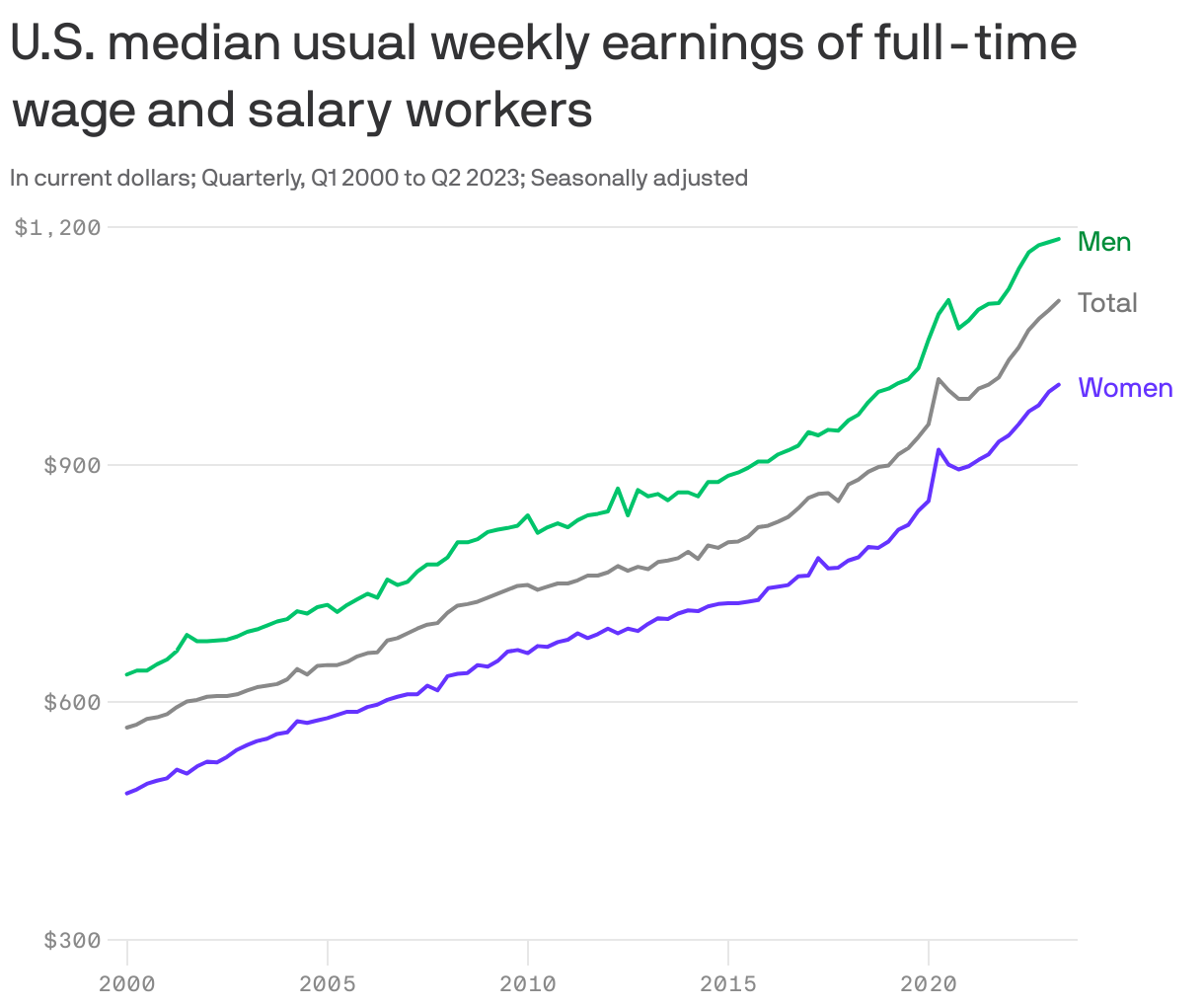
Another measure just came out showing that wages are beating inflation, Emily writes.
Why it matters: Paychecks are a crucial way Americans experience the economy, and for a while there inflation was shrinking people's real wages — making them feel pretty miserable.
Driving the news: Median weekly earnings for full-time workers in the U.S. reached $1,107 in the second quarter of the year — up 5.6% from the same quarter in 2022, according to fresh government data out yesterday.
- The consumer price index rose 4% during the same period, the Labor Department notes in its release. (By June, of course, the CPI had fallen to 3%.)
By the numbers: The data breaks down earnings by race and gender, too. Women's median weekly earnings were 84% of what men earned.
- Black Americans' median earnings were $913 a week, compared to $851 for Hispanic Americans, $1,126 for whites and $1,449 for Asian Americans.
- Of note: The gender wage gap is wider for higher earners: The highest earning tenth of male workers made $4,715 or more per week, per the BLS, compared with $3,447 or more for their female counterparts.
5. Today's the day to come to the office


Wednesdays are starting to look downright crowded in Manhattan workplaces, with office visitation rates at 73% of where they were in 2019, per a new report, Emily writes.
- Friday visits, meanwhile, are at 43% of their 2019 levels, according to Placer.ai data analyzed by the Real Estate Board of New York (REBNY).
Why it matters: The data exemplifies the hybrid work world that's emerged in the wake of the pandemic, where offices are at their most crowded Tuesdays through Thursdays.
- This "mid-week gap" first appeared in the spring of 2022, after the Omicron wave of COVID subsided, REBNY highlights in its report.
- The report uses data from Placer.ai that tracks employee visits from a sample of 50 Manhattan office buildings.
Axios Markets
Stay on top of the latest market trends and economic insights