
Axios Markets

August 17, 2023
👋 Welcome back! Today's newsletter is 1,189 words, 4.5 minutes.
1 big thing: Home prices defy gravity

Illustration: Brendan Lynch/Axios
Goldman Sachs is revising its call on home prices, Emily writes.
- In a new note, its credit strategy research team forecasts prices will rise 1.8% this year — previously they'd predicted a drop of 2.2%.
Why it matters: With home prices going up — and mortgage rates at a stunning 22-year-high — the situation is looking increasingly bleak for Americans looking to buy a house.
State of play: Prognosticators had believed that rising mortgage rates would force home prices lower — and they did fall by 13% from their 2022 peak. But prices are still 26% higher than they were in the first quarter of 2020.
- And now, even with mortgage rates hitting new highs, home prices are heading back up again. That's largely because there are not that many houses on the market, as homeowners cling to their low mortgage rates and don't want, or can't afford, to move.
- The inventory of available single-family homes for sale is at about 1 million — the lowest level, by far, going back to 1999, per National Association of Realtors data and Goldman research. (Before the pandemic, there were closer to 2 million homes.)
Catch up fast: Case-Shiller's national price index rose 1.2% in May, the third month of increases, according to data out last month.
- The data suggests that the final month of home price declines was January 2023, Craig J. Lazzara, managing director at S&P DJI, said in a note at the time.
The result: Housing affordability in the U.S. is at a record low dating back to 1997, according to an index tracked by Goldman that incorporates mortgage rates, home prices and household incomes.
Zoom out: Homeownership is by far the most important pathway to building wealth in the U.S., and low affordability puts it increasingly out of reach for those who haven't yet bought.
- Plus, those who are locked out of buying a house increasingly turn to the rental market, keeping prices elevated there. On a macro level, that's all keeping inflation levels higher than the Fed would like.
On the other hand: Rising home prices are great news for millions of homeowners who have seen incredible gains in equity in recent years — all the while sitting on ultra-low mortgage rates that act as a tidy buffer against inflation.
💭 Our thought bubble: That tension — between homeowners who like rising prices, and potential homebuyers, who'd like to afford something to buy — means affordability in the homebuying market isn't likely an issue you'll hear politicians railing about very often. Instead, much of the affordability rhetoric tends to focus on rent prices.
Bonus chart: 22-year high


Why is housing affordability so bleak right now? This here chart tells the story, Emily writes.
Driving the news: The rate on the 30-year mortgage ticked up to 7.16% this week — back to the high last reached in October of last year. Before that, you'd have to go back to 2001 to find mortgage rates this high.
Zoom in: A calculation from ING's chief international economist, James Knightley, illustrates the issue.
- With a 7.16% mortgage rate, the monthly payment on a $417,200 loan (that's the average mortgage amount taken out last week) works out to $2,820, he says. But at the prevailing mortgage rate back in 2021, you'd pay that amount for a $670,000 loan.
- Households that would like to move "are trapped right now," he writes.
💭 Our thought bubble, via Axios' Felix Salmon: At this point, mortgage rates are so high they're almost a reason to buy, on the grounds that they have to come down at some point — and when mortgage rates come down, prices go up.
3. Recession prep fades
Illustration: Allie Carl/Axios
Investors increasingly want companies to pull back from recession prep — and instead focus on building their businesses, Axios' Kate Marino writes.
- In BofA Global Research's latest Fund Manager Survey, the share of investors who want companies to prioritize capital expenditures rose, while those who favor balance sheet improvement (i.e. paying off debt) went down — continuing the directional trend of the past few months.
Why it matters: "That makes sense, as the call for stronger balance sheets was driven by recession fears, which are now rapidly declining," wrote BofA analysts.
By the numbers: A larger share of investors still favor improving balance sheets (44%) over increasing capital spending (32%) — but the gap is narrowing quickly. Just three months ago, it was 56% and 20%, respectively.
- The last time investors were this focused on seeing companies increase their spending was back in May 2022, BofA writes.
4. Race to tap the Moon's immense value

Illustration: Natalie Peeples/Axios
Nations of the world want to unlock the Moon's economic, scientific and geopolitical value, Axios' Miriam Kramer writes.
Why it matters: The Moon could be valuable high ground for the U.S., China and other space powers that see it as a crucial place to further assert dominance in space.
State of play: India and others view the Moon as a place to test technology and vault themselves into the rarified air of the established space powers.
- Once there, countries and companies that can access water and other resources on the Moon could use them to create more rocket fuel and travel deeper into the solar system, to destinations like Mars and beyond.
- It's possible whoever "gets to the Moon and 'controls' the Moon is going to have a massive political, economic, military power advantage — and it's going to propel them to dominate the next century," the Secure World Foundation's Brian Weeden tells Axios.
What to watch: The economic benefits may not be assured, but a new industry in space is already being built up around the Moon, lending more credence to nations that are aiming for the lunar surface.
- Private companies are investing in the tech to get payloads to the Moon with the hope that once they're there, countries will act as their customers when they establish a human presence on the Moon.
Read on ... and sign up for Axios Space.
5. No, Janet Yellen did not trip on magic mushrooms
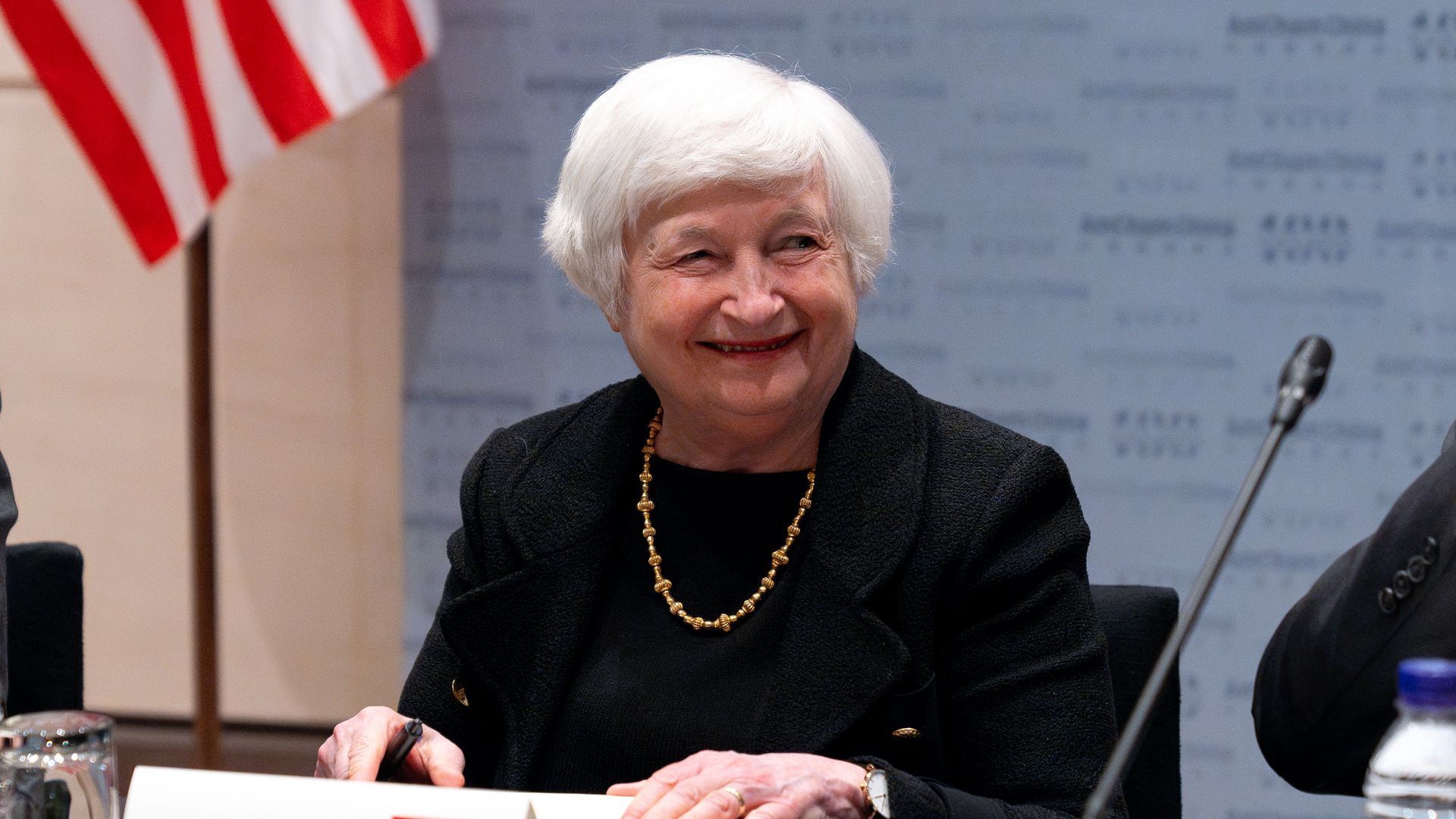
Yellen smiling on her trip to Beijing. Photo: Andrea Verdelli/ Bloomberg
"There was this delicious mushroom dish. I was not aware that these mushrooms had hallucinogenic properties. I learned that later."— Treasury Secretary Janet Yellen on CNN's "OutFront" on Monday
Janet Yellen did take a trip, but not a psychedelic one, Emily writes.
What happened: On her visit to Beijing last month, the Treasury secretary dined at a restaurant called Yi Zuo Yi Wang (In and Out) — not the burger chain — and was served a dish containing a type of wild mushroom that can be hallucinogenic.
- "[I]f the mushrooms are cooked properly, which I'm sure they were," a smiling Yellen explained to CNN's Erin Burnett. "They have no impact." (Burnett asked if she had "visions.")
- "All of us enjoyed the mushrooms, the restaurant, and none of us felt any ill effects," Yellen said.
The bottom line: Yellen didn't hallucinate but she did drive a lot of sales of these specific mushrooms in China.
Was this email forwarded to you? Subscribe here.
Today's Axios Markets was edited by Kate Marino and copy edited by Mickey Meece.
Sign up for Axios Markets

Stay on top of the latest market trends and economic insights