Axios Markets

April 03, 2025


2. Clothing prices could surge if these tariffs stick
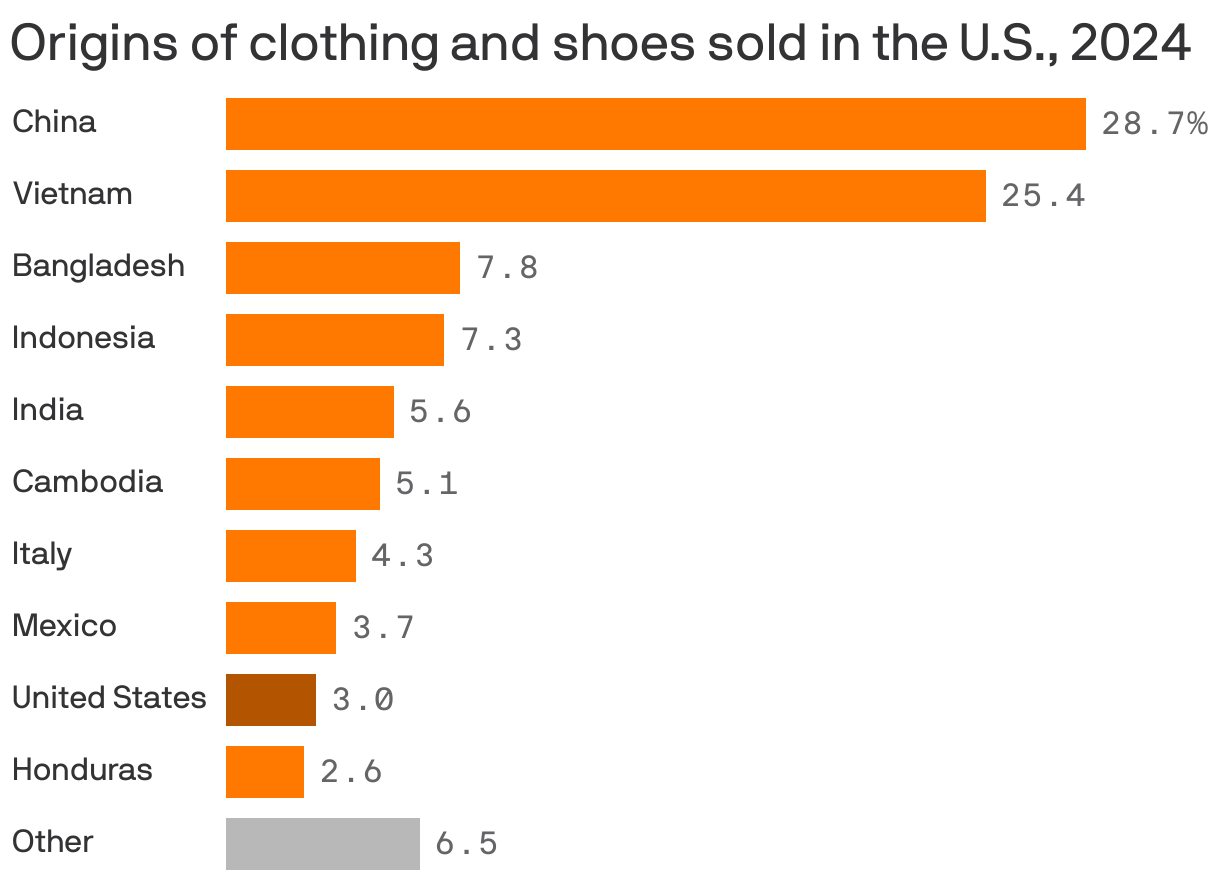
The clothes you buy stand to get a lot more expensive after Trump's sky-high tariffs on imports from around the world, including from China, Vietnam and Bangladesh.
Why it matters: The U.S. imports nearly all of its clothing and shoes, with over half from those three countries alone.
- If these tariffs take effect as planned, the price of apparel would soar.
- Increases will be especially painful for low- and middle-class Americans, who are already set to take a disproportionate hit from these duties.
- Investors are feeling it, too, with shares of apparel companies like Nike and retailers like Walmart plunging on the news.
Zoom out: A big reason for the tariffs is to bring manufacturing jobs back to the U.S. If it becomes prohibitively expensive to import things, companies will decide to make them here, the thinking goes.
- The problem is making clothing in factories isn't at the top of anyone's bring-back list.
- The cost of labor in the U.S. is far higher than it is abroad, and the supply of people willing to do low-wage work is lower with the demographics of the aging population. (A situation that could worsen with an immigration crackdown.)
What they're saying: "If we burden the cost of apparel and the U.S. doesn't really have an interest in building an apparel industry, then the costs are going up," says Jim Kilpatrick, a partner at Deloitte who specializes in supply chains.
- "That doesn't really make sense to me," he says, noting tariffs should protect high-tech industries, like semiconductors, or ones that are a security asset, like pharma or defense. "Where labor isn't as big of a piece of the overall cost component, tariffs will certainly help to shift the playing field."
- The National Retail Federation was also quick to react: "While leaders in Washington may not care about higher prices, hardworking American families do," its chief lobbyist David French said in a statement.
By the numbers: The U.S. gets 97% percent of its apparel and shoes from other countries, per a 2024 report by the American Apparel & Footwear Association.
- One major supplier is Vietnam, which Trump claimed charges the U.S. 90% in tariffs.
Reality check: According to data from the World Trade Organization, Vietnam puts an average tariff of 4.5% on nonagricultural goods from around the world.
- "If you really wanted to do a reciprocal tariff you could do 4.5%, but what they've done is just very far removed from reality," says Ed Gresser, a former assistant U.S. trade representative for policy and economics who is now a director at the Progressive Policy Institute.
Yes, but: "Access to cheap goods is not the essence of the American dream," Treasury Secretary Scott Bessent recently said.
- And many advocates for workers around the world have long railed against the conditions in overseas factories that make clothing.
3. America is now wealthier than it has ever been


Trump presented his sweeping tariffs yesterday as a way to "make America wealthy again," a slogan that implies the nation used to be much wealthier than it is today.
Why it matters: U.S. households are sitting on astonishing levels of wealth, some $169 trillion in total, per recent data from the Federal Reserve.
- That works out to an average of $500,000 per person.
Flashback: Trump Tower, on Fifth Avenue in Manhattan, opened in a blaze of publicity in 1983. For all the glitz and glamor, however, the U.S. back then was much, much poorer than it is today.
- At the time, U.S. household net worth was $12 trillion, just 7% of its current level.
- Adjusting for inflation by converting to 2024 dollars, American families in 1983 had an average net worth of $172,000, a third of where they are today.
The bottom line: There was never a time in decades past when American families were richer than they are today.
Axios Markets