Axios Markets

November 11, 2023
Maybe it's because it's a long weekend, or because I'll be on vacation next week, but I'm feeling upbeat and optimistic about how China is likely to continue operating within the global economy.
- In this week's newsletter, I go into a bit more depth on that, and I also deliver on my promise to write about immersive experiences. The whole thing is 1,071 words, a 4-minute read.
1 big thing: The power of Chinese interdependence
Illustration: Sarah Grillo/Axios
America's relationship with China involves massive tensions between economics, which act to bring the two countries ever closer together, and geopolitics, which is driving them ever further apart. Unusually, there are signs that the economic imperatives are holding their own.
Driving the news: Presidents Biden and Xi Jinping are likely to meet in San Francisco on Wednesday.
- Axios' Hans Nichols and Bethany Allen-Ebrahimian report that U.S.-China military communications are already starting to improve and that both leaders are keen to turn around relations that reached a nadir in the first half of Biden's term in office.
- Xi is planning to meet a large group of U.S. business leaders in San Francisco, reports Bloomberg, in another sign of easing tensions. (If this doesn't seem like a big deal to you, try to imagine Biden meeting with a similar-size group of Chinese CEOs in Shanghai.)
- The Global Financial Leaders' Investment Summit, organized by the Hong Kong Monetary Authority and taking place in Hong Kong this week, featured a slew of U.S. CEOs, including those of Citi, Morgan Stanley, Apollo, Goldman Sachs, Citadel, Fidelity, and many more.
Between the lines: Those CEOs "have a significant presence in China, which they are not abandoning, so they must try to build ties in Beijing," per Kaye Wiggins of the FT.
The big picture: After a decade of investment in the Belt and Road Initiative, China is deeply integrated into the international economy. Per a magnificent new report from AidData, China now has $1.3 trillion invested in developing countries, with nearly all of that investment denominated in dollars.
- Beijing is increasingly using international financial institutions such as the IFC and EBRD, or even banks like Standard Chartered and BNP Paribas, to manage its financial exposure to developing countries. Such "collaborative lending arrangements with Western commercial banks and multilateral institutions" are rising fast, per AidData.
- "China remains the single largest source of international development finance in the world," concludes the report. Its $79 billion of flows in 2021 compare with $53 billion from the World Bank; and while the U.S. invested $319 billion between 2014 and 2021, the equivalent number for China is more than double that, at $680 billion.
- Many of the borrowers are now in financial distress, and China's role as "the world's largest official debt collector" is going to give it an enormous amount of international power for decades to come.
The bottom line: The capitalist integration of China into the global economy is deeply entrenched. Strategic "derisking" is unlikely to derail it.
Bonus: Getting friendlier

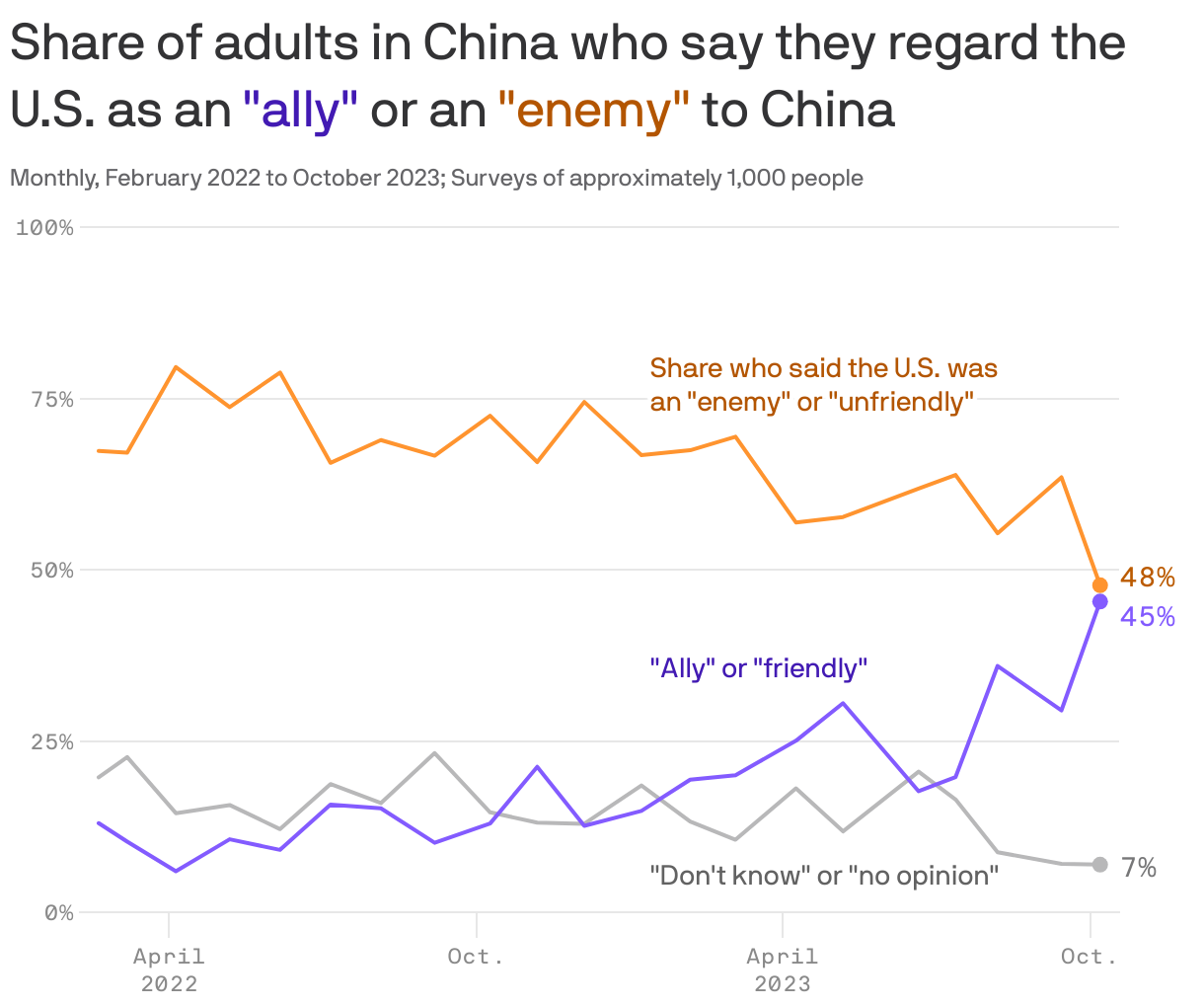
Attitudes in China have become friendlier to the U.S. this year, Axios' Bethany Allen-Ebrahimian reports.
Why it matters: The shift in views could help support a thaw as both U.S. and Chinese leaders work to improve dialogue and stabilize relations.
3. The ephemerality of immersive attractions
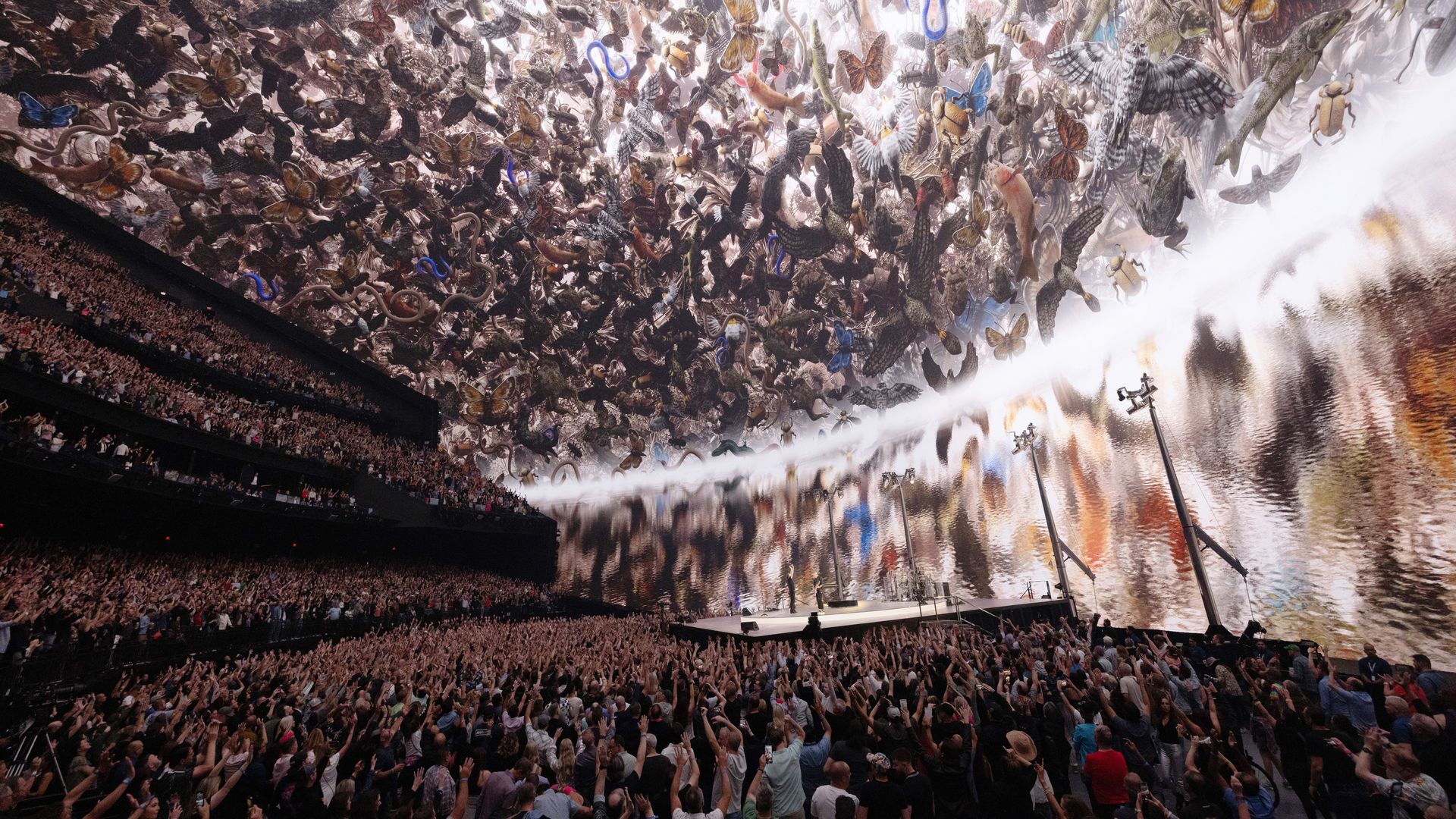
Spot the performer: U2 performing at the Sphere. Photo: Kevin Mazur/Getty Images for Live Nation
The opening of the Sphere in Las Vegas coincides with the closing of "Sleep No More" in New York. Both are expensive and innovative ticketed experiences aimed largely at tourists and designed to elicit a "wow" factor. (See also: Abba Voyage in London.)
Why it matters: These attractions tend to lean heavily on novelty, and their shelf life can be very short — the 2021 flurry of immersive Van Gogh shows already seems to have petered out.
The big picture: There is a long history of using cutting-edge technology to awe the general public. Carolina Miranda's excellent Sphere review in the LAT traces its ancestry back past the IBM Pavilion at the 1964 World's Fair in New York to the Circarama with which Disneyland opened in 1955. All now seem quaint and a little bit janky — much as Abba Voyage will in a few years' time.
Between the lines: As David Littlejohn wrote in his WSJ review of "Peter Pan," another high-tech immersive show, "any potential for moving relationships is pretty well lost amid the mind-boggling spectacle."
Where it stands: Billions of dollars are being invested in physical and virtual spaces designed to inspire and transport individual and collective souls. The Las Vegas Sphere alone cost $2.3 billion; a proposed second sphere, in the same area of London as the $175 million Abba show, will likely cost at least $1 billion if it ever receives planning permission.
- Those up-front costs result in eye-popping ticket prices. Going to see a 50-minute movie at the Sphere, for instance, which is carrying more than $1 billion in long-term debt, can cost as much as $250.
- Experience design generally hasn't kept up with technology. "A lot of these shows are vapid in that they don't have a visceral connection to their customer; there's no emotive way to connect with them," Lionel Ohayon, the founder of Icrave, which designed the Sphere's interiors, tells Axios. "From an entertainment point of view, it's not something people have solved yet."
- "People are just trying to cash in on it," he adds, "and there's a lot of them, and they're mostly bad."
Zoom out: Many technologies, from the opera houses of the 19th century through the theme parks of the 20th and the high-tech nightclubs of the 21st, have proved their staying power in terms of being able to attract crowds of people willing to pay good money for a transporting collective experience.
- In each case, the art of storytelling has had to be reinvented for the new medium. Drops, whether they occur on roller coasters or in techno music, are a key narrative technique that require just the right amount of buildup.
- When a technology is too new, or scarce, or expensive, it becomes inaccessible to most creators and tends to become bombastic and unpleasantly overwhelming.
The bottom line: "The most effective way to sustain neurologic immersion is story structure," says Paul Zak, a Claremont professor who has studied the effect of immersive experiences on the brain.
- All too often, that's an afterthought.
4. Americans' phones still aren't their wallets


Less than two-thirds of Americans used any kind of digital wallet in July, and only 13% used one in the 24 hours before they were polled by Morning Consult.
Why it matters: That's well behind most of the rest of the world, even societies like Japan and Germany, which have historically been much more cash-based.
By the numbers: PayPal is the most popular digital wallet, being used by 69% of Americans who use any such wallet at all. Cash App, Venmo, Zelle, Google Pay and Apple Pay are all competing for distant second place. All of them have a market penetration of between 30% and 39%.
Thanks to Kate Marino for editing this newsletter, and to Jay Bennett for copy editing it.
Sign up for Axios Markets

Stay on top of the latest market trends and economic insights