Axios Markets

February 16, 2024

Happy Friday! There's a long weekend ahead for us — we're out Monday in observance of the holiday, and back in your inbox bright and early Tuesday.
Today's newsletter is 867 words, 3½ minutes.
1 big thing: Employers are nervous about viral layoffs
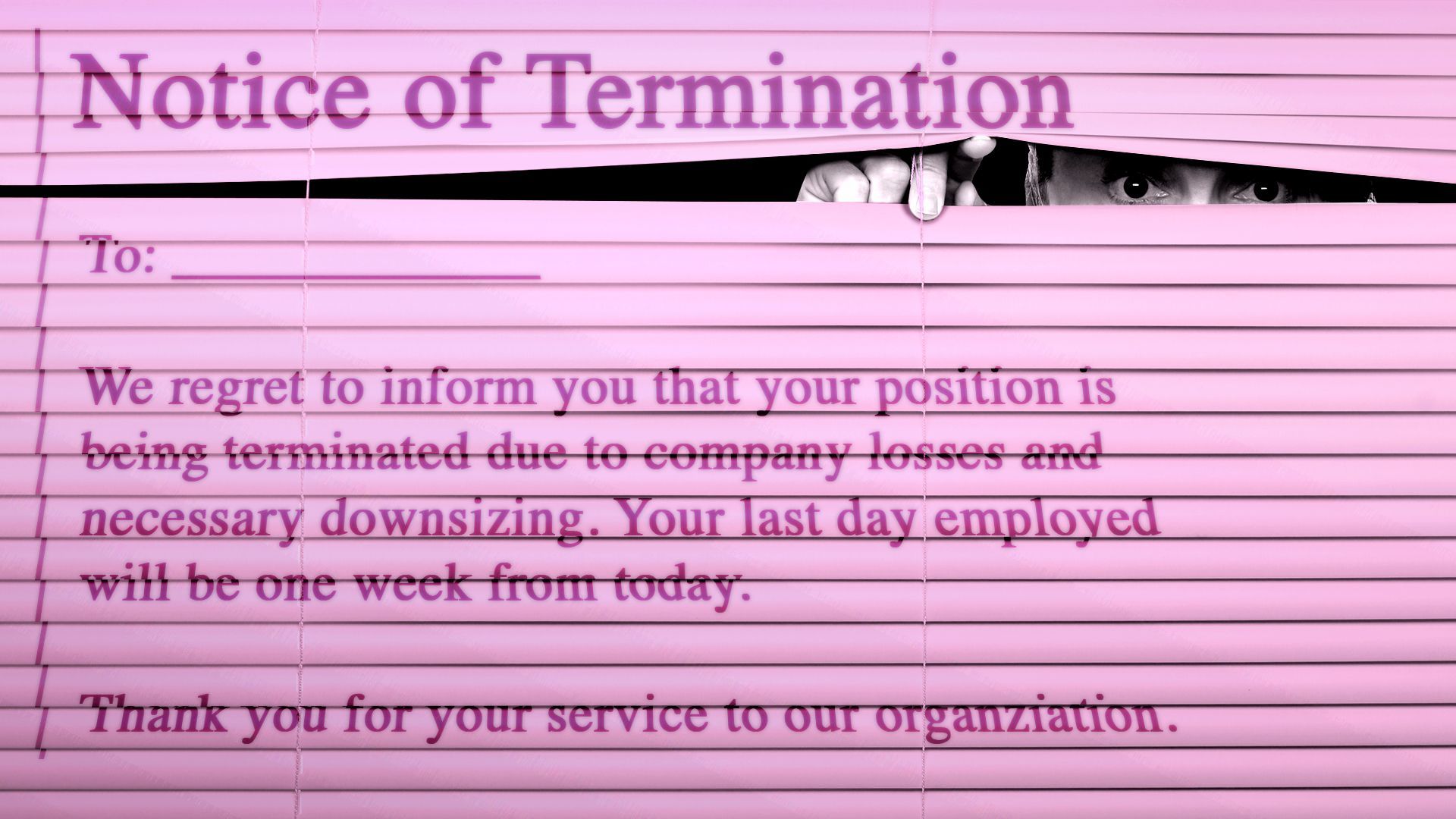
Illustration: Annelise Capossela/Axios
As tech layoffs continue, more employers are worried about firings going viral in TikTok videos, Emily writes.
Why it matters: A little anxiety around conducting firings is a good thing — while cuts may be necessary for the bottom line or to appease shareholders, they also come with internal blowback and other hidden costs.
What they're saying: The videos have "come up with a lot of our clients, actually, they're afraid now to let people go," says Carly Holm, the CEO of Humani HR, a consulting firm that helps employers navigate layoffs.
- The key to managing that fear: Don't botch the job.
How it works: Holm and her colleagues counsel employers to conduct firings as humanely as possible. She works out talking points with executives and urges them to stick to those parameters while also acting "like a human."
- Considering that most humans operate without a bulleted list of things to say, that's a tough line to walk.
- It's also important to talk to the workers who remain. Tell them why this happened, where the company is headed, and explain the reasons for the cuts. And talk to them a lot.
- "No doubt [layoffs] impact productivity in the short term. It's gonna be bumpy for a little bit," she says. "So over-communicating is key."
Plus: Holm advises executives to fire one person at a time. "We always recommend terminations are conducted one-on-one with HR present and ideally in person."
- Those aren't the types of layoffs typically captured in viral videos, which often involve remote workers getting fired in a group.
The big picture: Layoffs — and the way they're handled — can impact a business's reputation and performance, for a while.
- Employees struggle with anxiety and survivor guilt that hinder performance and reduce innovation, sometimes for years, write the authors of a 2022 piece in Harvard Business Review. They're particularly hard on businesses that rely on research and development and high growth.
- Work quality might decline as workers try to amp up productivity with less support — the reputation hit makes it harder to attract the best people.
Zoom in: Employee engagement metrics — those employee surveys that ask how confident and happy you are at work — drop off in the wake of job cuts.
- Engagement only rebounds to pre-layoff levels at companies that start to hire new employees again, per research from Culture Amp, a firm that conducts engagement surveys.
- Even when they do start hiring, the comeback takes time. In new research shared with Axios, Culture Amp examined engagement metrics before and after layoffs conducted from 2020-2023 and found it takes at least 18-24 months to recover.
Emily's thought bubble: For years, I've been advised to write work emails as though they could appear on the front page of the newspaper.
- Employers would be wise to conduct layoffs in the same way.
2. Charted: Tech layoffs


On Wednesday, Cisco said it would lay off 5% of its global workforce — about 4,000 employees. Instacart and Mozilla also announced job cuts this week.
Be smart: Tech companies have laid off 39,496 workers this year, per Layoffs.fyi — levels that so far look a bit better than 2023.
- And layoffs in the economy as a whole are still at relatively low levels.
4. Back in the game

Illustration: Allie Carl/Axios
When it comes to financing leveraged buyouts, "banks are back in the game," says Christina Padgett, Moody's head of private credit research.
Why it matters: After the Fed's rate hiking campaign effectively froze the market, Wall Street's big investment banks all but went dark on funding buyouts. Unregulated private credit funds stepped up in a big way to fill the gap, Axios' Kate Marino writes.
State of play: Now, the overall market's in better shape.
- There's loads of demand from the loan and bond investors that banks typically place the debt with. The economy hasn't hit a recession (as many expected it would), and the Fed may actually cut interest rates this year.
- In a nutshell: "Banks have plenty of capacity on their balance sheets to lend again," as Ted Swimmer, head of corporate finance and capital markets at Citizens Financial Group, told Axios' Kimberly Chin.
The latest: A pretty large deal was announced this week — and it marks a "turning point" for banks, Padgett wrote in a note yesterday.
- Private equity giant KKR is buying a stake in Cotiviti, a health care tech and data company, for $10.5 billion. Investment banks including JPMorgan and Goldman Sachs are providing $5 billion in loans to back the acquisition.
- The Cotiviti deal shows that banks "will be running neck to neck with private credit peers as the LBO market heats up in coming months," Padgett wrote. That's a "decided shift" from 2023, when LBOs were almost exclusively financed by private lenders, she added.
The bottom line: Funding leveraged buyouts is a pretty lucrative business to be in — as long as you don't get stuck holding debt at below-market rates. Wall Street's banks have largely moved past the dislocations of 2022, and are ready to get back in the game.
Was this email forwarded to you? Subscribe here.
Axios Markets is edited by Kate Marino and copy edited by Carolyn DiPaolo.
Sign up for Axios Markets

Stay on top of the latest market trends and economic insights