Axios Markets

June 14, 2023

1 big thing: 🇻🇪 Remember Venezuela?


A troubled South American oil giant may be shaking off a decades-long production slump, Matt writes.
Why it matters: Venezuela has the largest volume of proven oil reserves on earth — besting even Saudi Arabia. More Venezuelan crude on global markets could help ease the tight supply that led to last year's energy shocks, and help bring down inflation.
State of play: U.S. crude oil prices — West Texas Intermediate is now just under $70 a barrel — are down roughly 40% over the last year, sending the cost of refined products like gasoline sharply lower, too.
- The collapse in energy prices helped pull U.S. headline annual inflation down to 4% in May, its slowest pace since March 2021.
The big picture: Most analysts say the fall in oil prices stems largely from economic weakness in China — the world's largest source of oil demand — which is still struggling to conclusively put COVID-era disruptions behind it.
Between the lines: But others add that increased supply — including from Venezuela — is playing a role, too.
- In a recent research note, Goldman Sachs oil analysts said they see a reduced upside ahead for oil prices because of growing supply, citing more production from heavily sanctioned producers like Iran, Russia and Venezuela.
- And the International Energy Agency says that "Venezuela appears to have finally stemmed a long-running decline, with crude oil production rising." The comments were in a report published Wednesday on the medium-term outlook for the oil market.
Backstory: Thanks to the politicization of the state-owned oil company, Venezuelan oil production had already been on a decades-long decline when global crude prices plunged in 2014.
- The crash prompted the state oil giant, known as PDVSA, to default on its debt, crippling its ability to invest in production and setting off an economic crisis.
- In early 2019, the Trump administration imposed painful sanctions aimed at weakening the leftist authoritarian regime of President Nicolás Maduro, sending production to record-low levels.
- But amid last year's oil price shock, the Biden administration began to tentatively loosen some strictures on Venezuelan oil, including granting a license to Chevron to resume pumping in the country.
- The deal followed progress in talks between Maduro and the political opposition, a key political hurdle the U.S. wanted to meet before agreeing to ease some pressure on the regime.
What they're saying: "We've been relatively optimistic on Venezuelan production for a little while now," Fernando Ferreira, an analyst at D.C.-based consulting firm Rapidan Energy Group, tells Axios.
- Venezuela appears to be climbing back toward producing 1 million barrels per day this year, in part due to that first round of easing the sanctions, Ferreira says.
Yes, but: That's still a shadow of Venezuela's former pumping power, which topped out at about 3.5 million barrels per day in 1997.
- It's also a pretty modest contribution to a global economy that gulps about 100 million barrels per day, and some say not worth making concessions to what is effectively a brutal dictatorship.
- "It feels a little better to me to try to look at democracies — to see if we can trade Putin the dictator for a democracy, as opposed to trading one dictator for another," said Ryan Berg, director of the Americas Program at the Center for Strategic and International Studies.
- He suggests strengthening ties with energy-rich nations like Brazil and Colombia as a route to boosting U.S. energy security.
What to watch: News on talks between the regime and opposition figures on establishing ground rules for elections due to be held next year.
- Venezuela's ability to meet the million-barrel-per-day projection is contingent on progress on that front, since it may result in the U.S. further easing sanctions, Ferreira said.
2. 📉 Charted: Energy deflation


Fresh Consumer Price Index data released yesterday showed energy prices — a critical component of overall inflation — have declined nearly 12% from last year.
- Consumer gasoline prices dropped roughly 20% over the last 12 months.
3. Catch up quick
4. 🍳 Egg-cellent news


You no longer need to bring home extra bacon to afford eggs, Emily writes.
- A dozen large cost $2.67 on average in May, down from $3.27 in April — and way below the January peak of $4.82, per the latest Consumer Price Index data out yesterday.
- The government index that tracks egg prices fell 13.8% in May, the largest monthly drop since January 1951.
Why it matters: Each phase of the COVID economy gets its iconic commodity: Sky-high egg prices, a result of an Avian flu epidemic, symbolized the 2023 inflation — much as gas prices were emblematic of Ukraine war-driven inflation last year.
- And we'll never forget the sky-high lumber prices that defined the earliest phase of inflation in 2021.
The bottom line: Eggs are back, baby! This reporter is ready to, erm, get crackin' on all sorts of custardy recipes.
5. Apple tiptoes toward $3 trillion valuation
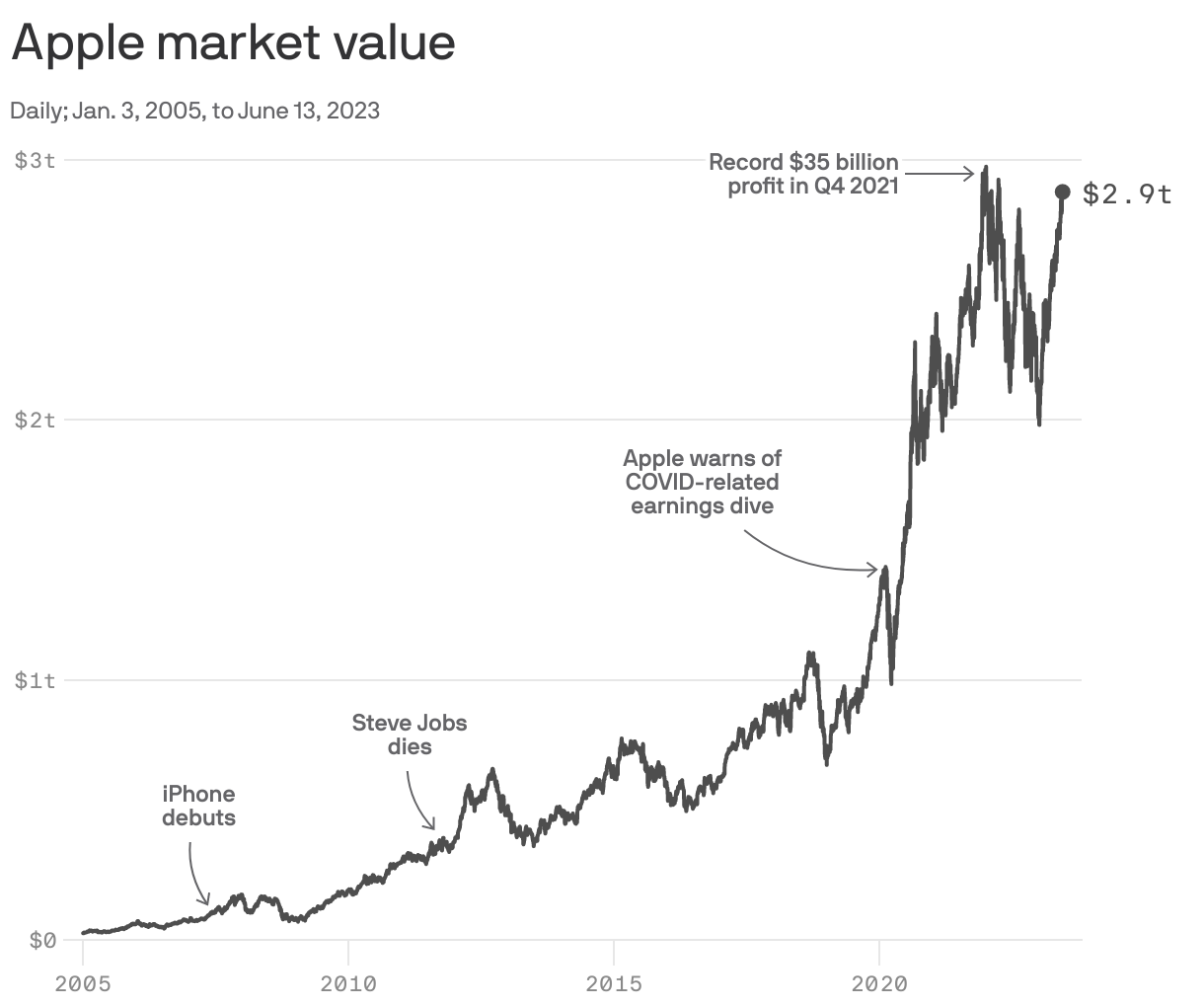
The world's largest private sector company — the first to hit the $1 trillion and the $2 trillion valuation marks — may soon make history again, Matt writes.
The big picture: Apple's stock price is up 41% this year, on strong earnings, excitement about AI opportunities for tech giants, and hope that the Fed is nearly done hoisting interest rates.
Why it matters: Apple's massive market cap gives it the heaviest weighting in the capitalization-weighted S&P 500, the most important gauge of the U.S. stock market that is the basis for roughly $7 trillion in index fund assets.
The bottom line: For anyone who has a plain vanilla S&P 500 index fund in their portfolios, Apple is your largest holding.
- That means some of that nearly $3 trillion in market wealth is yours. Congrats.
Axios Markets

Stay on top of the latest market trends and economic insights