
Axios Markets

July 29, 2023
Why haven't the Fed's rate hikes plunged us into recession? I try to answer that question in this week's newsletter.
- Also: College capitalism; a glimpse inside the JPMorgan private bank; what happened to NatWest Group's CEO; and more. All in 1,446 words, a 5.5-minute read.
1 big thing: Why the U.S. is so immune to rate hikes

Illustration: Shoshana Gordon/Axios
The U.S. economy continues on its glide path to the elusive "soft landing," even in the face of 11 rate hikes and counting. That's in large part because we spent the 15 years before the rate hikes steadily deleveraging and ensuring that debtors couldn't easily fall victim to a credit crunch.
Why it matters: Rate hikes in many other countries, especially the UK, hurt most of the population very rapidly, thanks to their high homeownership rate and how short-term their mortgages are.
Be smart: The U.S. has positioned itself to be able to withstand rate shocks much more easily.
- Household and corporate debt is mostly fixed-rate rather than floating-rate, meaning that debt payments don't immediately rise when rates go up.
- There's also less debt, overall, than there has been historically (more on that below) — a surprising fact, given that more than a decade of zero interest rates gave many businesses a strong incentive to borrow a lot of money.
How it works: Rate hikes have an effect in two ways: By raising the cost of debt for existing borrowers, and by discouraging new borrowing.
- U.S. rate hikes are definitely doing the latter. With mortgage rates back above 7%, and house prices back up near all-time highs, buying a home is more expensive than ever. That's one reason home sales are down, hurting the industries that rely on such things (sofa makers, realtors, etc.)
- Corporations, on the other hand, seem to be borrowing as much as ever, just at higher rates.
- The big exception is the least creditworthy companies — the ones rated as high-yield, or junk. They are borrowing less, borrowing for shorter time periods, and putting up collateral to lower their borrowing costs.
Between the lines: The loan market is generally floating-rate, which means that companies that have issued loans rather than bonds are now feeling the pinch.
- The two industries with the highest degree of leverage are finance and commercial real estate. Rising rates brought down Silicon Valley Bank and other banks; they're also causing real estate bankruptcies to rise, as building owners find it impossible to refinance their mortgages at an affordable rate.
- Outside those rate-sensitive industries, however, higher interest rates have caused relatively little pain.
- Meanwhile, savers are receiving interest rates on their money that they could barely have dreamed of a year ago.
The bottom line: The good news is that the U.S. economy has shown that it can remain strong — certainly thus far — in the face of an ultra-aggressive rate-hiking cycle by the Fed.
- The bad news, at least for borrowers, is that rates might have to remain high for some time before the Fed feels comfortable bringing them back down to a more neutral level.
2. The U.S. deleveraging, in four charts
U.S. corporations had debt-to-equity ratios above 100% as recently as the final quarter of 2019. Now that number has fallen to 82%.


U.S. household debt, similarly, has come down from more than 100% of GDP in 2008 to just 76%.


The amount households are paying to service their debt is also down. It was over 13% of disposable income in 2008; it's now 9.6%. The Fed hikes are barely visible.


Even highly indebted companies who fund themselves with junk bonds (as opposed to leveraged loans) aren't too worried for the time being — their debt mostly isn't coming due for years.


3. Where market solutions are no solution at all
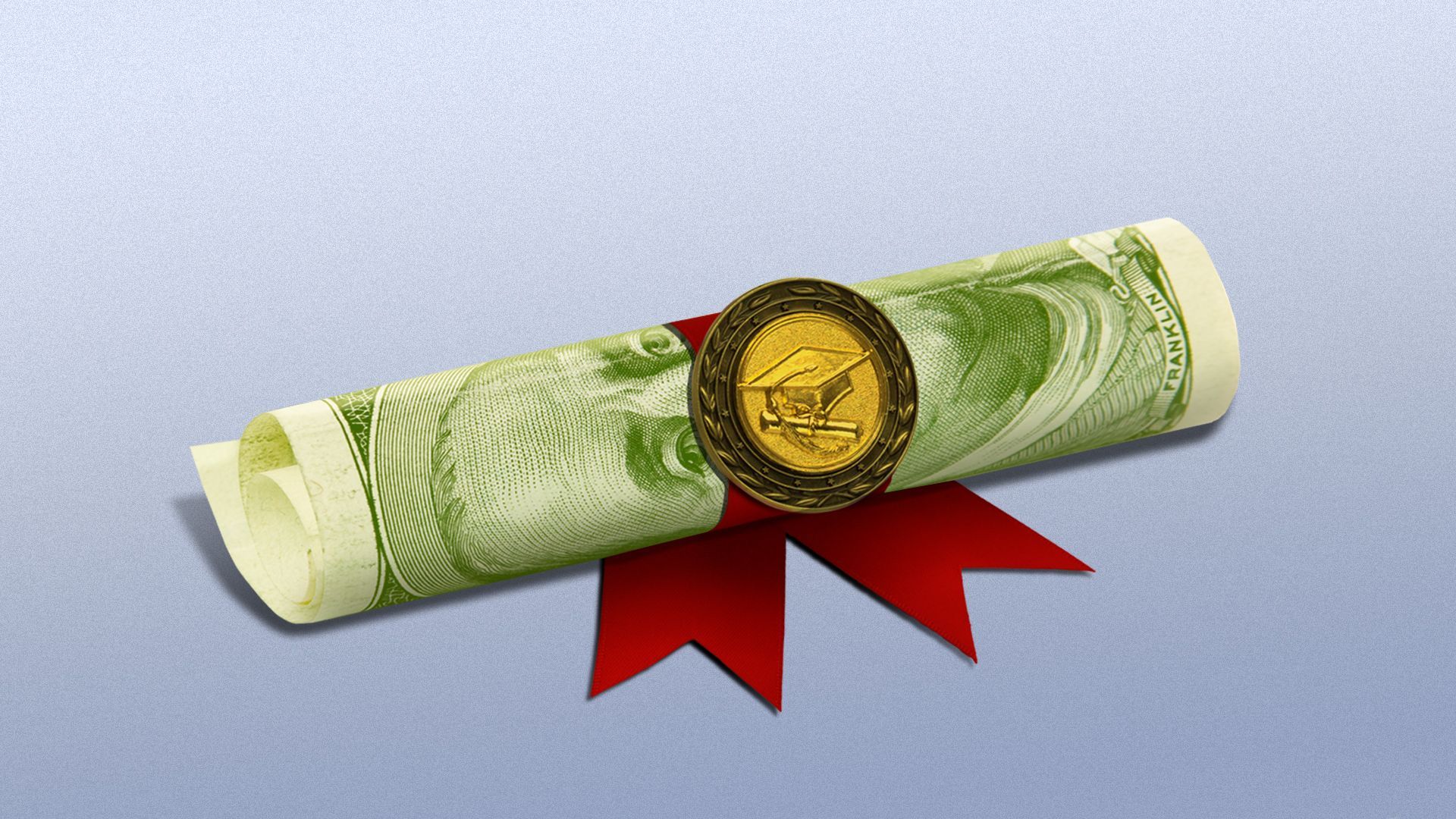
Illustration: Sarah Grillo/Axios
When is capitalism illegal? According to the Biden administration, the answer might be found in college admissions.
Why it matters: Allocating scarce resources to the rich is unremarkable elsewhere in the economy, but is increasingly anathema in the Ivy League.
Driving the news: The U.S. government is investigating whether legacy admissions — a preference that disproportionately benefits the white and wealthy — are a civil rights violation.
- The news comes after not-particularly-surprising revelations that the children of the 1% are much more likely to get into top schools than mere members of the upper middle classes.
- Be smart: Even if the rich kid pays exactly the same tuition fee as the middle-class kid, her expected total lifetime value to the university — including all future donations — can be an order of magnitude higher.
The big picture: Capitalism has a standard solution for allocating anything that is both highly desirable and extremely scarce (a Harvard diploma, say) — it goes to the people who can afford to spend the most money trying to procure it.
- That's uncontroversially true in secondary education, where attendance at elite and expensive "feeder" schools is dominated by the children of the ultra-wealthy — in itself, a way to try to buy admission to top colleges.
- Similarly, money buys a head start in everything from golf to foreign-language development — skills that top colleges like to see in applicants.
The other side: Even as the rich try to get into the best universities, the best universities also want to attract the rich. After all, their main source of donations is rich alumni, and especially alumni with multi-generational wealth.
- Cultivating those alumni across decades and generations is a very effective way to raise the kind of money that allows a university to stay at the top of the rankings.
Between the lines: The argument around legacy admissions, like the recent Supreme Court affirmative-action case, is fundamentally centered on questions of fairness and equality of opportunity.
- If universities cannot actively shape their student bodies for reasons of diversity, then it stands to reason that they shouldn't be able to do so for financial reasons, either — especially when they receive government funding for their research.
The bottom line: The attack on legacy admissions comes as college finances are more precarious than ever.
- While elite institutions hog the spotlight, the competing imperatives of fairness and solvency will be much more existentially important for those lower down the pecking order.
4. How Jeffrey Epstein peddled influence to JPMorgan
Jes Staley (left) and Jeffrey Epstein (center) in 2011, with (left to right) Larry Summers, Bill Gates and Boris Nikolic, all of whom Staley says were introduced to JPMorgan by Epstein and became clients of the bank. Photo obtained by the New York Times.
A fascinating glimpse behind the curtain of private-bank wealth management is offered in a deposition that became available online this week.
Why it matters: It's the sworn testimony of Jes Staley, the former head of JPMorgan's head of wealth management and friend of Jeffrey Epstein.
- We have only 33 pages of the full deposition, which runs to over 800 pages, but those alone are eye-opening.
The big picture: Probably the hardest thing that any wealth manager does is customer acquisition. The rich not only tend to be loyal to their existing advisors; they also tend to be suspicious of private bankers' sales pitches, all of which tend to sound very similar.
- The best way to acquire a new client is to be vouched for by an existing client who has a reputation for being rich, perspicacious, and sophisticated.
Between the lines: Epstein was the private bank's most valuable client, bringing in more than $8 million per year in revenues for JPMorgan. Even more important than that, he was the premier conduit for the bank, introducing a slew of big-name clients including:
- Elon Musk
- Bill Gates
- Sergey Brin
- Larry Summers
- The Sultan of Brunei
- Mort Zuckerman
Epstein was astonishingly successful at persuading these men and many others to become JPMorgan clients. (He also introduced Prince Andrew to the bank, but Staley isn't sure whether Andrew became a client.)
The bottom line: JPMorgan bent over backwards to retain Epstein as a client — and accommodate his enormous cash withdrawals — even after he was indicted on child sex offenses. Staley's deposition helps us understand why the bank did so, and just how valuable Epstein was to the private bank.
- JPMorgan has since received preliminary approval to pay $290 million to settle a lawsuit brought against the bank by Epstein's victims.
5. The scariest chart of the year

July 2023 will wind up being the hottest month the world has seen in over 100,000 years. It will be much less time than that, however, before this record is broken.
6. When the board can't protect the CEO

Illustration: Natalie Peeples/Axios
How long is a bank CEO likely to last in the wake of a public statement that the board "retains full confidence" in her, that she's an "an outstanding leader," and that "it is clearly in the interest of all the bank’s shareholders and customers that she continues" in her position?
The answer, in the case of the UK's NatWest Group, embroiled in a scandal surrounding one politician's account being closed: about eight hours.
Between the lines: The UK government remains NatWest's largest shareholder, after the bank was nationalized during the 2008-9 financial crisis. The board chair, Howard Davies, was supportive of the CEO, Alison Rose — but the prime minster and finance minister were not.
- One political source told the Financial Times that Rose's 1:30am resignation was "a case of handing the board a loaded revolver and leaving them to it.”
Many thanks to Kate Marino for editing this newsletter and to Jay Bennett for copy editing it.
Sign up for Axios Markets

Stay on top of the latest market trends and economic insights