Axios Markets

February 07, 2025

🏝️ Happy Friday! Another week finished, or is it survived, really? We are looking forward to Super Bowl snacks on Sunday. But before Emily tries "frachos" for the first time (IYKYK), we have business:
Today we take a look at the massive changes happening at the Equal Employment Opportunity Commission, and how they impact the way Washington regulates the workplace.
- Plus: The heyday of sustainable investing is over, and a coffee crisis looms.
All in 1,150 words, a 4-minute read.
1 big thing: Trump's EEOC takes a new view
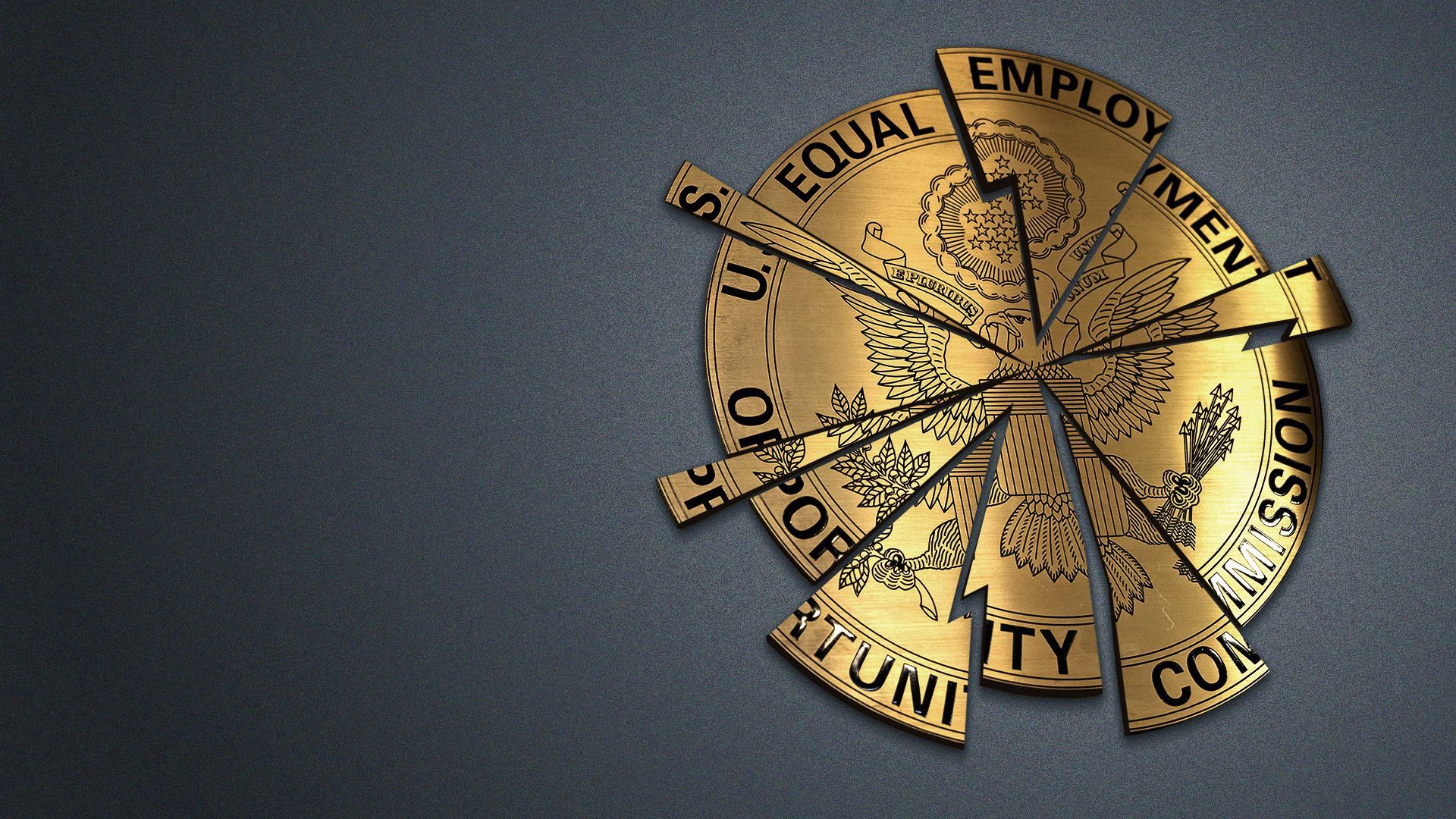
The independent federal agency in charge of enforcing workplace anti-discrimination laws is caught in a bind under President Trump.
Why it matters: The White House crackdown — on transgender people, diversity, equity, inclusion and accessibility, and the independence of federal agencies — all comes to a head at the the Equal Employment Opportunity Commission.
- The civil rights of Americans are at stake, according to advocates for workers and former EEOC officials.
- Staff are "in revolt" over concerns that fulfilling Trump's anti-DEI and anti-transgender orders would break the law, as the Wall Street Journal reported this week.
The big picture: The situation is a big change from the fairly hands-off way Trump treated the agency in his first term.
- In fact, it was a Trump Supreme Court appointee, Neil Gorsuch, who authored the landmark Bostock opinion, which found that discrimination against workers based on their sexual orientation or gender identity is prohibited under Title VII of the Civil Rights Act, the law that the EEOC enforces.
Where it stands: The agency is now treating gender identity cases differently, which will likely slow the process for those facing harassment at work.
- Any cases that "implicate" Trump's executive order on "Gender Ideology Extremism" are getting reviewed at EEOC headquarters, an agency spokesman told Axios in an email.
- Typically, cases are handled by local offices, and workers who bring charges to the EEOC are issued a "right to sue" letter to file a lawsuit in federal court.
- The agency said it will continue to issue these letters, but didn't offer more about what the headquarter review process would entail.
- The White House did not respond to a request for comment on the agency's new approach.
Also unclear: What happens to the cases brought by the agency that are already underway?
- These include one, filed on behalf of a housekeeper at a Holiday Inn Express in New York, who was fired after complaining about harassment from a supervisor who referred to them as "it," misgendered them, and made multiple offensive derogatory comments.
- Such harassment is a violation of the way the agency has interpreted the Supreme Court ruling, but that interpretation is opposed by EEOC acting chair Andrea Lucas.
- "Sex is binary (male and female) and immutable," Lucas, an outspoken DEI opponent, said in a statement about Trump's executive order.
Context: Trump also fired two Democratic EEOC commissioners, including Jocelyn Samuels, who he placed in that role during his first administration.
- While it's not unusual for a new administration to replace an agency's general counsel, terminating commissioners with defined terms is highly unusual.
- The firings leave the agency without the quorum it needs to do much of its work, and the moves have been criticized as part of a broader attack on the independence of federal agencies.
What's next: Once new commissioners are in place, Lucas has said she'd like to update the guidelines around enforcing sex-based discrimination and roll back what she's called "the Biden administration's gender identity agenda."
- It's likely those changes will face court challenges.
The bottom line: The agency tasked with protecting the rights of transgender workers may no longer be focused on fulfilling that mission.
2. Sustainable investing's heyday is over


The party is over for U.S. sustainable fund managers, who saw record outflows from the asset class in 2024.
Why it matters: The outflows coincide with fund managers withdrawing from environmentally focused investor groups, opening the question of whether they're doing so because of increased political scrutiny, or just because the business isn't growing any more.
The big picture: Big fund managers seem to have given up on making a stand when it comes to environmental, social and governance issues.
- Even within their sustainable funds, BlackRock backed only 11% of key ESG resolutions in 2024, as calculated by Morningstar, while Vanguard backed an astonishing 0%.
- One company that still backed 100% of the resolutions, Parnassus, also saw the biggest outflows: $1.8 billion left its Core Equity Fund in the fourth quarter.
Where it stands: Sustainable funds are still growing in Europe, where inflows totaled $18.5 billion in the fourth quarter and $52.4 billion for the year.
- Even there, however, that number is down sharply from more than $500 billion in 2021.
Follow the money: In the U.S., sustainable funds have now seen outflows for nine successive quarters. That's in stark contrast to conventional funds, which saw some $300 billion of inflows in the fourth quarter alone.
- A similar trend is visible in the number of sustainable funds: 10 new U.S. funds were launched in 2024, well below the triple-digit numbers seen in 2021 and 2022.
- 60 were liquidated, 11 were merged into other funds, and 24 dropped ESG mandates. (What used to be the Abrdn International Sustainable Leaders fund, for instance, is now simply Abrdn Emerging Markets Dividend.)
The other side: The preference of investors, as seen in outflows from ESG funds, goes against their stated preferences in sustainable investing.
- A Morgan Stanley survey last year found 54% of investors intending to increase their ESG investments in 2024, with 77% of them interested in the asset class broadly.
The bottom line: While investing sustainably is considered a core part of fiduciary duty in Europe, it's increasingly seen as a violation of fiduciary duty in the U.S.
- As such, investing even in a passive sustainable fund feels like an active choice. Right now it's not a choice many people seem to want to make.
3. The big winner of a Chiefs "three-peat"

NBA legend Pat Riley is rooting for a Kansas City Chiefs "three-peat" on Super Bowl Sunday, because if it happens, the Miami Heat president will be cashing in.
Zoom in: Riley owns six different trademarks tied to the term "Three-Peat," which he first filed for in 1988 while coaching the Los Angeles Lakers. And he just inked a deal with the Chiefs to use it.
- That means that for every "three-peat" hat, shirt, jewelry, sunglasses, backpack or beverage that the Chiefs sell, Riley gets a cut.
The intrigue: Riley didn't actually come up with the term. One of his players did as the Lakers were preparing to go for three straight championships.
- They didn't succeed. And despite all his success in the NBA as a player, head coach and exec, Riley has never actually three-peated himself.
The big picture: If the Chiefs win, he plans to donate the bulk of his haul to the Pat Riley Family Foundation.
4. Charted: The brewing coffee crisis


While everyone worries about their eggs for breakfast, there's a crisis brewing in the coffee pot too.
Why it matters: Coffee futures, which have more than doubled over the last year, touched new record highs yesterday, foreshadowing significant retail pain in the months ahead.
Driving the news: Leading producer Brazil is coming off a bad crop, and Trump's tariff threat on Colombia scared the market as well.
Yes, but: Pork bellies are well off the record highs they hit in the summer of 2021, so at least you can keep bacon on the menu.
Thanks to Ben Berkowitz for editing and Anjelica Tan for copy editing. Have a nice weekend!
Sign up for Axios Markets