Axios Markets

November 10, 2022
☀️ Good morning! It's inflation day. The October CPI is out at 8:30am ET.
- The consensus forecast is for prices to be up 8% year over year.
But first, more on that crypto debacle ... Today's newsletter is 1,165 words, 4.5 minutes.
🇺🇸 Programming note: We will not publish Markets tomorrow in observance of Veterans Day.
1 big thing: FTX collapse has echoes of Lehman

Illustration: Natalie Peeples/Axios
If Tuesday was crypto's Bear Stearns moment — the day that a central player in a financial ecosystem collapsed into the arms of a much bigger rival — then Wednesday was its Lehman Brothers moment, with that same central player simply imploding into a balance-sheet hole of unknowable size, Axios' Felix Salmon writes.
Why it matters: The collapse of FTX is the most consequential failure the crypto world has seen since Mt. Gox disappeared overnight in 2014.
- "It looks likely that a new cascade of margin calls, deleveraging and crypto company/platform failures is starting," JPMorgan analysts wrote in a research note yesterday.
Driving the news: Crypto exchange Binance late yesterday backed out of a plan to rescue FTX, its smaller rival, after due diligence revealed problems it said were “beyond our ability to help.”
By the numbers: FTX has received withdrawal requests totaling $8 billion, according to a communication from its founder Sam Bankman-Fried, universally known as SBF, that was first reported by the WSJ.
- If the window for withdrawals reopens, then that number is almost certain to rise. FTX has not allowed any withdrawals since about 6am ET on Tuesday.
Between the lines: The big difference between the crypto world today and the real world in 2008 is that there are no lenders of last resort in crypto who can shore up the system with bailouts.
- It now seems highly likely that FTX will end up filing for bankruptcy, probably in the Bahamas. If that's what happens, anybody with money on the platform faces a long and highly uncertain road to any recovery.
The big picture: FTX, along with its sister company Alameda Research, was ultimately brought down by the exact same thing that killed Lehman Brothers — excess leverage.
- Crypto prices are plummeting. Bitcoin is at its lowest level since November 2020.
- The good news for U.S. individual investors is that they weren't allowed to use FTX. Unless you were adept with a VPN or own an offshore trading entity, you probably don't have any direct exposure to the exchange.
Where it stands: FTX US, the U.S. arm of the troubled empire, looks like it's the only part of the empire that might still hold any value. But it's tiny compared to FTX proper — and U.S. regulators are very unlikely to let it be used as some kind of bargaining chip.
The bottom line: For the time being, there's relatively little contagion from the crypto world into the real economy. But the contagion within the crypto world is only getting started.
3. Real estate returns to (kinda) normal
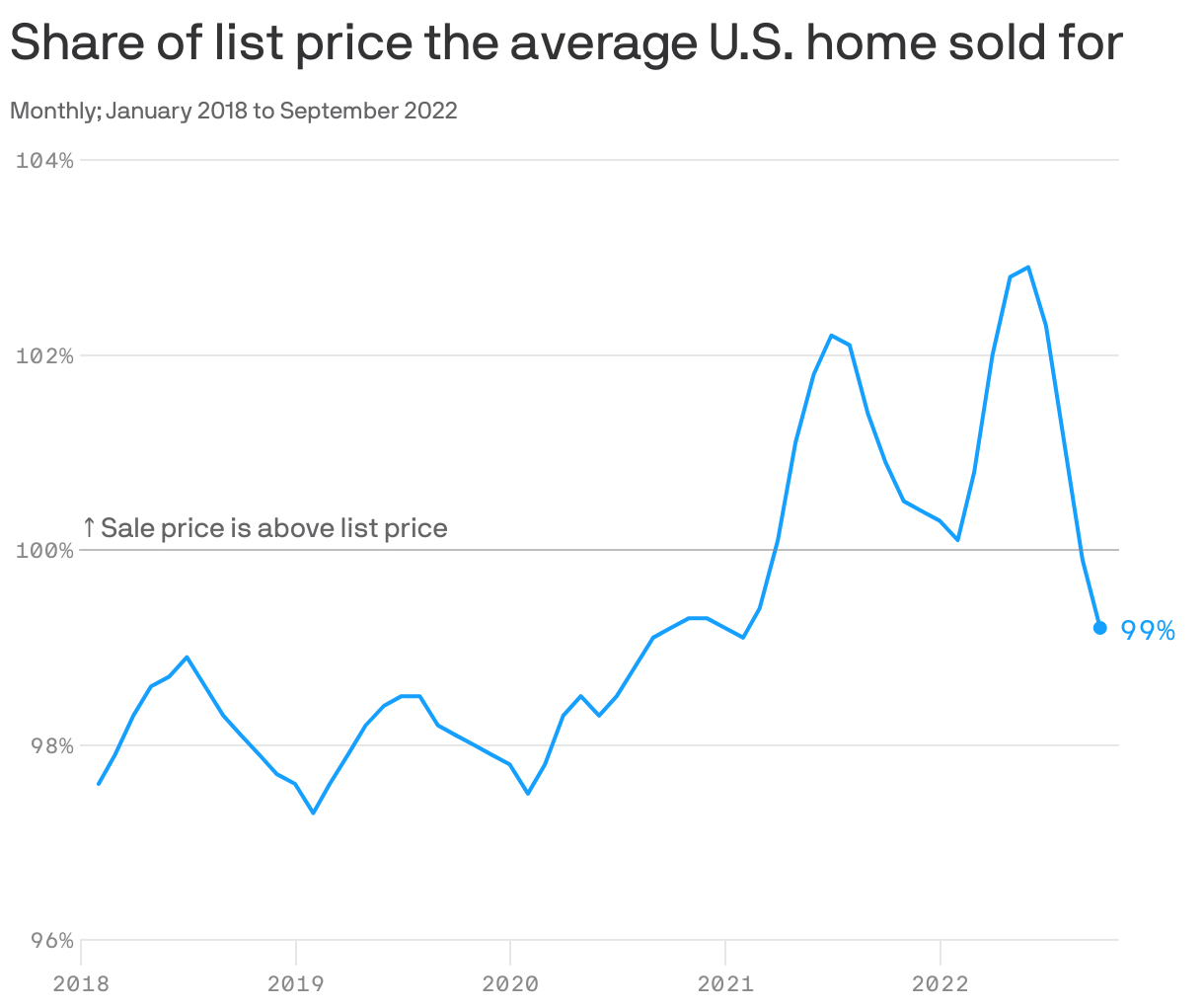
The housing market has returned to earth. Home sellers can't just name a price and expect buyers to pay; meanwhile, over a trillion dollars in wealth in the form of home equity has evaporated, Emily writes.
Why it matters: Think of this less as a crash and more as a correction. The pandemic-driven housing boom was a bonkers moment of real estate demand.
- The Federal Reserve raised rates and crushed that demand, as intended.
State of play: During the pandemic boom, houses were selling for more than list price. A "historically unusual" situation, says Nicole Bachaud, senior economist at Zillow.
- Sellers are now accepting less than list prices, on average, to make sales, a return to pre-COVID trends.
- Experts say this is a return to normal in a lot of ways, even though 7% mortgages feel abnormal. "It's a really awkward phase of the market because we're coming off of this pandemic frenzy," says Bachaud.
Reality check: Mortgage holders in the U.S. still have a lot more equity in their homes now than they did before the COVID-induced housing boom.
- The average borrower has, on paper, lost about $30,000 in equity from earlier this year, but still has $92,000 more than in February 2020, according to calculations by mortgage technology firm Black Knight (see the chart below).
- Unless you need to sell your house or borrow against it, its value is more of a vibe than a practical problem.
- Most homeowners are sitting on low-cost mortgages, with a large amount of equity.
- "If you close your eyes at the beginning of the pandemic and just kind of live there, and then look at [your home valuation today], I think you'd be very happy," says Andy Walden, vice president of enterprise research at Black Knight.
What to watch: Those that bought homes in 2021 or this year are most at risk of winding up "underwater" on their mortgage — owing more than their home is worth, Black Knight finds. That's a risky place, as those who recall the Great Recession know.
- That crop of recent buyers included a larger than typical number of Black and Latino borrowers, as I recently reported.
- And more home price declines are likely on the way, though Bachaud says that relatively low inventory will put a floor under those drops for now.
Editor's note: This story has been corrected to state that over a trillion dollars in home equity value has evaporated, rather than over a billion.
4. Charted: Poof goes the equity


A whopping $1.37 trillion in mortgage holder equity vanished in the third quarter, thanks to falling home prices, according to calculations by mortgage technology firm Black Knight, Emily writes.
It's the sharpest single-quarter decline, by dollar value, since 2000. On a percentage basis, it's the steepest drop since 2009.
- This is real estate, so there are big variations depending on location. The most significant drops in equity are in San Jose (24%), Seattle (21%) and San Francisco (20%).
5. Rude!
Illustration: Brendan Lynch/Axios
Rude behavior is on the rise, according to a new study published in the Harvard Business Review, Emily writes.
Why it matters: Not only does incivility harm those on the front lines of health care, education, transportation, and retail, to name a few industries, but it also hurts the businesses and institutions where it happens, writes Christine Porath, a professor of management at Georgetown University who's long studied incivility.
- She defines incivility as ignoring people, intentionally undermining them, or mocking, teasing and belittling them.
By the numbers: Porath surveyed 2,000 workers and customers across more than 25 industries globally.
- 73% said it was not unusual for customers to behave badly; up from 61% in 2012 when she did a similar survey.
- In this year's survey, 66% of respondents said bad customer behavior toward other customers is more common than it was five years ago. In 2012, just under half of the respondents said this.
What's happening: Porath points to higher stress levels, weakening community and workplace connections; as well as the greater disconnects wrought by technology.
What they're saying: “Research shows that rudeness is like the common cold: It’s contagious, it spreads quickly, anyone can be a carrier — at work, at home, online, or in our communities — and getting infected doesn’t take much.”
The bottom line: The rise of incivility ultimately comes back to bite us all.
Was this email forwarded to you? Sign up here to get Axios Markets in your inbox.
Today's newsletter was edited by Kate Marino and copy edited by Mickey Meece.
Sign up for Axios Markets

Stay on top of the latest market trends and economic insights