Axios Markets

March 06, 2023

1 big thing: Companies flood the bond market


Company executives are starting to believe the “higher for longer” story about interest rates, Axios' Kate Marino writes.
- The evidence: They’re scrambling to tap the debt market now before borrowing costs go up even more. Call it a capitulation to the new reality.
Why it matters: It’s a behavior shift from last year when rising rates had many companies sitting on the capital markets' sidelines.
What’s happening: The investment grade bond market, where companies with higher credit ratings borrow, saw a record February for new bond placements — despite the fact that yields were soaring.
- The month's final deal tally of $147 billion was fairly surprising, considering estimates heading into it had been in the $90-to-$100 billion range, Blair Shwedo, head of investment grade trading at U.S. Bank, tells Axios.
- Executives wanted to "get a lot of their issuance out of the way, for fear that they could run into higher rates if they were to delay issuance," he adds. "I think there may be some nerves about whether corporate yields go back out to 6%."
- (A key index measuring the market went from yielding 4.9% on Feb. 2 to 5.56% at the end of the month.)
The big picture: The recent string of hot economic data, which started with the Feb. 3 jobs report, jolted investors and market watchers out of the theory that a pause in Fed tightening was close at hand.
Flashback: Bond issuance slowed drastically last year.
- That's because rate volatility made it difficult for bankers to place deals with investors — and companies balked at yields that were vastly higher than anything they'd seen over the last decade.
The bottom line: Companies are now coming around to the idea that we may not be returning to the low-rate world of the 2010s any time soon.
2. Put it in perspective
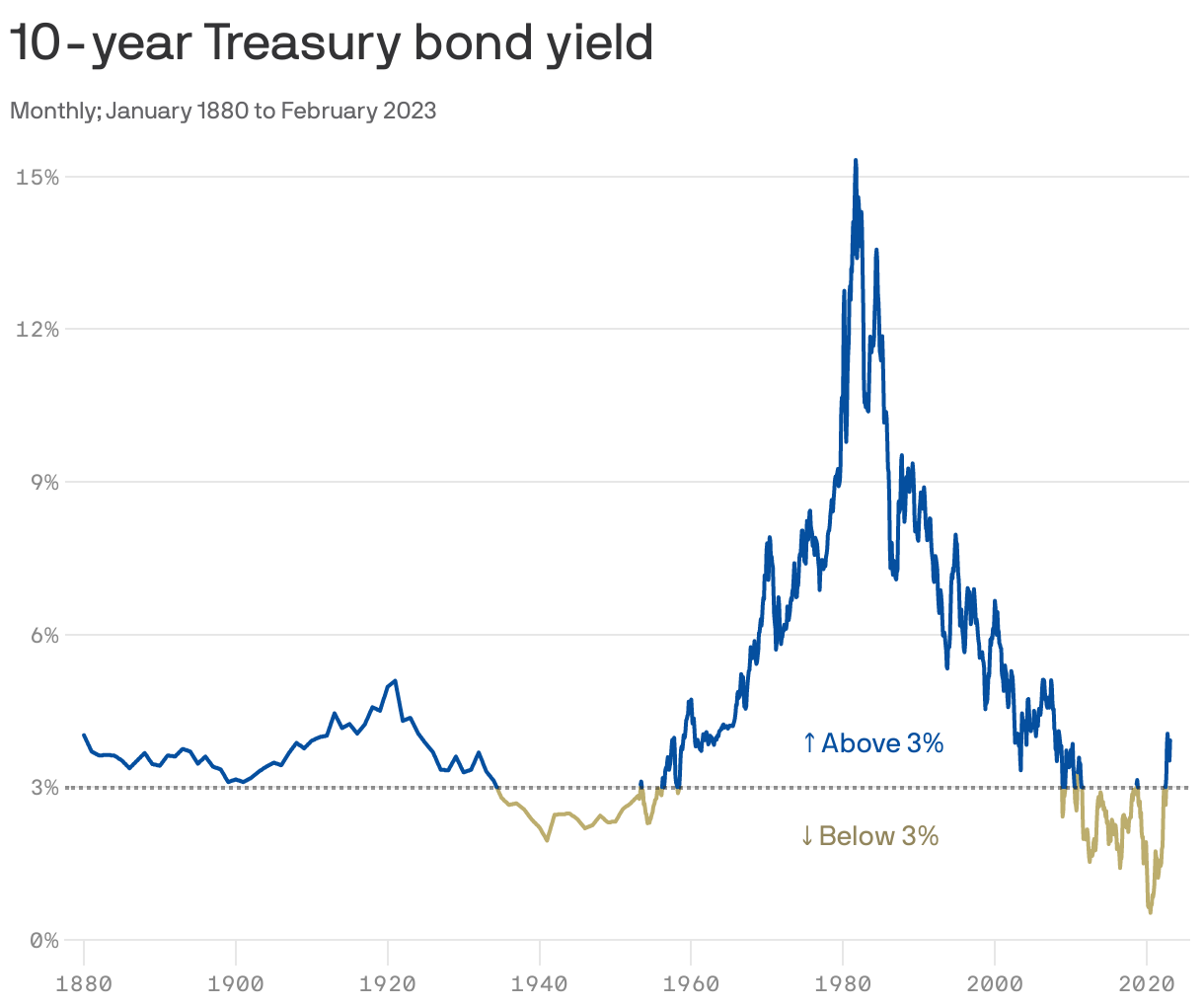
For those who’ve been hoping rates would eventually return to before-times levels once inflation is under control, it’s helpful to decide just what — or when — the before-times were, Kate writes.
The big picture: The 10-year Treasury, the main benchmark for corporate borrowing, sat below 3% for only two periods in modern U.S. financial history — the post-Great Depression and post-financial crisis eras. The latter is the one that started to feel normal for many who work in the markets now.
- “The level of rates that we had from 2012 to 2022, we've never seen that before except after the Great Depression and World War II,” says Robert Tipp, chief investment strategist at PGIM Fixed Income.
The intrigue: Tipp says all that recent data pointing to the strength of the economy and labor market amid the rapid rate hikes means the neutral interest rate may very well have moved up.
The bottom line: If the 10-year settles into a range that’s more in line with historical norms than the post-financial crisis decade, it could reshape borrowing strategies across corporate America, which got pretty accustomed to ultra-cheap money.
3. Catch up quick
4. Survival of the fanciest
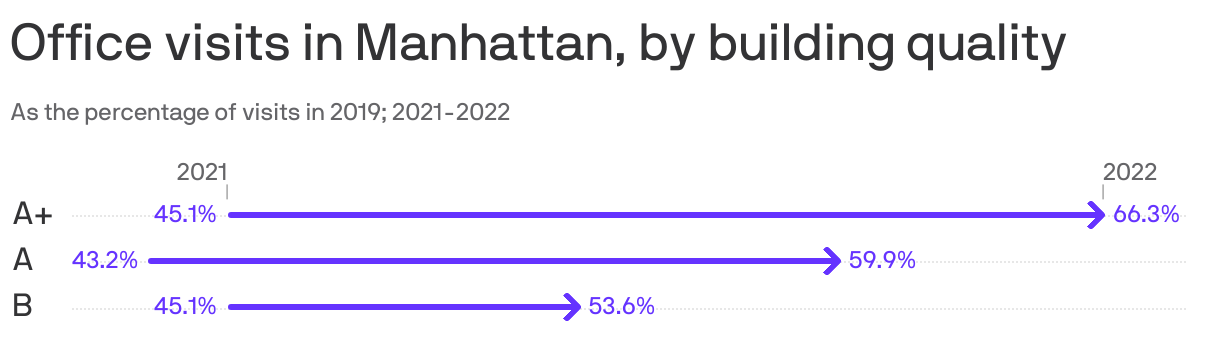
Some companies are going all out to entice workers back to the office, and, as new data on New York City shows, a super-fancy office might help do the trick, Emily writes.
Driving the news: Visits to Class A+ buildings in Manhattan, i.e. the swankiest places to work, far outpaced visits to Class B buildings, or the less flashy locales, according to an innovative new dataset from the Real Estate Board of New York (REBNY).
Zoom out: This so-called flight to quality had been underway before the pandemic, said Keith DeCoster, director of market data and policy for REBNY. But the transition to remote work sped up the trend.
- Being at a prime location with great amenities "is going to give you at least a leg up in getting folks back to the office," he said.
Case in point: Occupants of SL Green's One Madison, a massive renovated office building in midtown south, for example, will have access to an in-house catering service attached to celebrity chef Daniel Boulud — among a host of other amenities.
Details: REBNY's new report looks at location analytics — from randomized Placer.ai cellphone data — to assess how many visits were made to 250 office buildings across midtown, midtown south and downtown Manhattan in 2019, 2021 and 2022.
- It found a big difference between visits to Class A+ buildings and the lower grades. And overall, average building visitation rates surpassed 60% of pre-pandemic baselines in 2022, compared to 48% in 2021.
Worth noting: A 10% increase in office occupancy could represent a potential return of 100,000-200,000 workers to the city’s office districts — each spending about $6,000 a year on everything from clothes to chopped salads, according to data cited by REBNY.
5. 🌁 The pivotal week ahead

Fed chair Jerome Powell. Photo: Julia Nikhinson/Getty Images
Axios Markets

Stay on top of the latest market trends and economic insights