Axios Markets

September 07, 2023

1 big thing: Home equity borrowing plunges


With interest rates so high, Americans are far less inclined to tap into their home equity this year via cash-out refinances or home equity loans, Emily writes.
Why it matters: For homeowners, this is a bummer — folks are putting off kitchen renovations, and other home improvements. On the macro level, it's holding back hundreds of billions in consumer spending.
By the numbers: In the second quarter, mortgage holders withdrew $39 billion in equity from their homes — via home equity loans, lines of credit and cash-out refinances, per Black Knight data out yesterday.
- That's about half of what folks withdrew in 2022, a year that started off with rates close to rock-bottom levels.
The intrigue: The withdrawal numbers have returned to where they were pre-pandemic — but keep in mind that homeowners have a lot more home equity now.
- Back in February 2020, the amount of "tappable equity" held by mortgage owners was around $6 trillion; by June of this year, that had grown to $10.5 trillion, per Black Knight. Tappable equity is what a mortgage holder can borrow while still hanging on to a 20% equity cushion.
- From 2010 to 2021, mortgage holders withdrew a little less than 1% of all tappable equity.
- But over the last three quarters that rate has fallen to 0.4% — a decline of more than half.
Eye-popping stat: Black Knight estimates that nearly $200 billion in equity was left untouched over the past 15 months, as interest rates began to rise. "It's starting to become pretty significant," says Andy Walden, the firm's vice president of enterprise research strategy.
The big picture: The cooldown in home equity borrowing is one way the Fed's rate hikes are doing what they're supposed to — chilling the economy to tamp down inflation.
- Home equity lines of credit — or HELOCs — were a hot way for homeowners to tap their home equity well into last year. That's partly because rates on lines of credit didn't adjust as quickly to the rate-hiking cycle.
- There was a point last year when you could get a lower rate on a HELOC than a refinance, notes Walden. But that advantage has dissipated.
The bottom line: Not only are mortgage holders locked into the golden handcuffs of a low rate that keeps them from selling their home, but they're also increasingly locked out of borrowing to tap into all their shiny new equity.
2. Catch up quick
3. 🏆 New European champ


Excitement over obesity drugs has made Novo Nordisk the new heavyweight champion in the European stock market, Matt writes.
Why it matters: The surge in Novo's shares this year propelled it past luxury goods giant LVMH and Swiss food conglomerate Nestlé to become the largest company by market cap in Europe.
- The fresh title reflects growing excitement about the potential for Novo's drugs, Ozempic and Wegovy, to revolutionize the treatment of obesity.
The latest: Last month Denmark-based Novo Nordisk reported that profits surged 43% in the first half, to 39.24 billion Danish krone — or roughly $5.6 billion.
- The profits are so large, relative to the size of the Danish economy, that they have been skewing key economic statistics, the New York Times reported.
What to watch: How long Novo Nordisk's lead will last.
- The pharmaceuticals at the heart of the boom mimic a hormone that's secreted in the gut and helps regulate blood sugars and appetite.
- Eli Lilly's fast-selling Mounjaro — a diabetes drug that also mimics the appetite hormone, and is being used off-label for obesity treatment — may get official FDA approval for use for obesity this year.
4. 📈 Charted: U.S. service sector still strong


The services side of the U.S. economy continues to look solid, Matt writes.
Why it matters: Services account for roughly 75% of the U.S. economy, employing 4 out of every 5 workers.
The latest: A real-time survey on the health of the U.S. services sector for August arrived better than expected yesterday.
- The ISM services index registered 54.5 for the month; analysts had expected a slightly softer 52.4.
How it works: ISM index readings above 50 indicate growth or economic expansion. Readings below 50 signal contraction.
Yes, but: A separate reading on the manufacturing sector was below 50 again, marking the 10th straight month of industrial contraction.
- Manufacturers have been whipsawed as the COVID-era boom in demand for manufactured goods from consumers quickly shifted to demand for activities and services — movies, restaurants, vacations, etc. — as the pandemic ebbed.
The bottom line: The engine of the American economy, services, is still purring.
5. Apartment construction is soaring


New apartment construction is on track to top a 50-year high, with nearly 461,000 units expected to be built across the U.S. this year, according to a new report, Axios' Sami Sparber writes.
Why it matters: A housing shortage in the U.S. has contributed to the rising cost of both renting and buying.
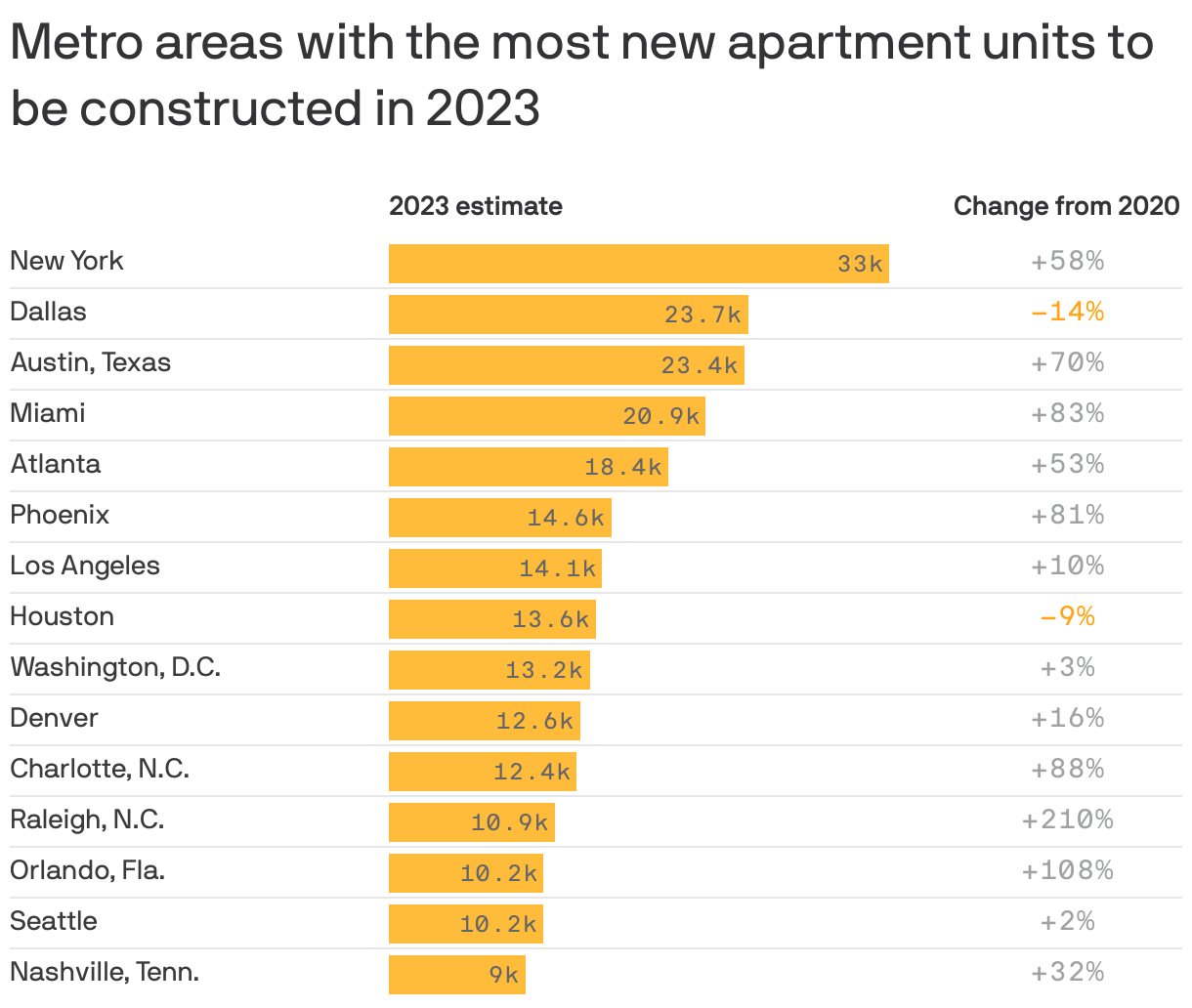
What's happening: A surge in new apartment supply — 1.2 million units were completed during the pandemic — helped slow rent growth nationwide, but some parts of the country saw more housing being built than others.
- The bulk of those new apartments are located in 20 metro areas where roughly 41% of U.S. renters live, per the report by RentCafe, which analyzed data from real estate intelligence service Yardi Matrix.
Yes, but: Around 89% of the units completed from 2020 through 2022 are high-end, per the report — not the type of affordable apartments many renters want.
What's next: 1 million rental units are slated for completion through 2025, but higher costs and other headwinds could slow developers' breakneck pace in future years.
- "Tightening of bank lending standards — combined with rising costs of construction materials, labor and land — has made new projects harder to pencil," senior analyst Doug Ressler at Yardi Matrix says in the RentCafe report.
Bonus chart: Where the new apartments are
Axios Markets

Stay on top of the latest market trends and economic insights