Axios Markets

April 20, 2023

1 big thing: Laying low on ESG


Companies don't want to talk about their environmental, social and governance goals anymore, experts in ESG and communications tell Axios, Emily writes.
Why it matters: Promoting ESG policies was once an easy layup to score good press — and theoretically move toward bettering society — but now it's a way to court controversy, the ire of politicians, and attention from well-funded anti-ESG groups.
- A dozen financial companies, including BlackRock, Blackstone and KKR, now list anti-ESG efforts as a risk in their annual reports, the Financial Times recently reported.
State of play: Anti-ESG forces are in full swing this proxy season — the time of year when public companies host their annual meetings, and shareholders vote on a slate of investor proposals.
- Investors have filed 68 anti-ESG proposals this year to date — compared to 45 in all of 2022, per data from the Sustainable Investments Institute, a nonprofit.
- About one-third of the anti-ESG proposals this year are focused on diversity — asking companies, including Apple, JPMorgan, Coca-Cola and McDonald's, to report on the "risks" that their anti-discrimination or racial justice efforts pose to their business.
- Two proposals ask companies to avoid public policy positions unless there's a business justification. And a handful are asking public companies to report the risks posed by attempting to achieve net zero or decarbonization goals.
What they're saying: "Companies should be prepared to deal with ESG backlash," the Conference Board warned in its recent proxy season preview.
The big picture: Historically, anti-ESG proposals like these have failed. "There's a lot of attention and noise but nobody supports this stuff," said Heidi Welsh, executive director of the Sustainable Investments Institute.
Zoom in: Financial services companies, in particular, are in retreat. "I think all of them are a lot more careful since the Republicans are so vocal about this," a source who is close to the financial industry tells Axios.
- "Whenever there is a possible conflict coming, the shutters go down," the source said.
- For example, BlackRock CEO Larry Fink didn't mention the term ESG anywhere in his most recent investor letter, a departure from those of the past several years, as Axios' Andrew Freedman reported.
- Vanguard dropped out of a global climate initiative at the end of 2022.
- BP earlier this year backed off some of its more ambitious climate goals, the Washington Post reported.
Between the lines: Companies are soldiering on with diversity or climate initiatives they think are important — or good for business — but they're just less willing to talk about it.
- Worth noting: The retreat isn't simply about anti-ESG efforts. Businesses are also more inclined to stay mum as regulators like the SEC start paying more attention to companies' ESG-related claims.
The bottom line: ESG efforts aren't going away, but you might see fewer press releases and puff pieces about the issue.
2. Catch up quick
3. Tesla's price cuts eat into profits
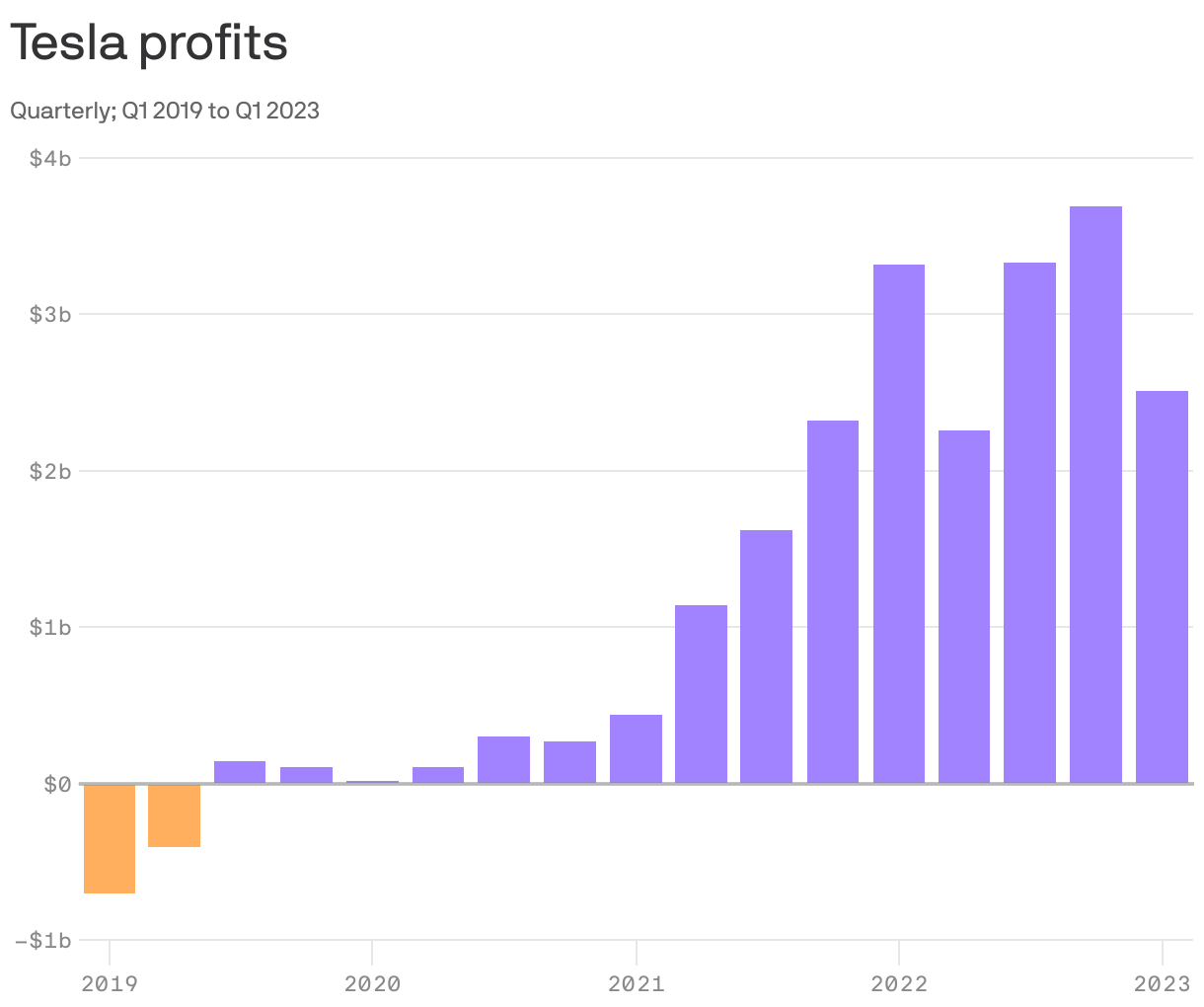
Tesla's plan to cut car prices is taking a toll on the bottom line, Matt writes.
Driving the news: Last night, Elon Musk's electric vehicle company reported that profits fell 24% in Q1, compared with the same quarter last year.
- The earnings were worse than Wall Street analysts had expected, sending the stock down 3% in the after-hours trading session.
The big picture: Amid growing competition in the EV space, market leader Tesla is trying to cling to the pole position, recently turning to price cuts as a means to boost — or at least preserve — its shrinking market share.
- Vehicle sales did rise, with Tesla delivering 422,875 vehicles during the first quarter, or 36% more than the prior year.
What they're saying: "We're taking a view that pushing for higher volumes and a larger fleet is the right choice here versus the lower volume and higher margin. However, we expect our vehicles over time will be able to generate significant profit," CEO Musk said on the post-earnings conference call.
4. Putin's energy weapon is looking punier


European natural gas prices have collapsed dramatically, Matt writes.
Why it matters: The decline in prices shows that with a bit of luck, and a global scramble for supplies from sources like the U.S. and the United Arab Emirates, Europe has found a way to live without Russian gas.
- Prior to Russia's invasion of Ukraine last year, Moscow's status as the main supplier of natural gas was seen as a major source of leverage that would prevent unified pushback.
By the numbers: Benchmark prices are down nearly 90% from the peak of nearly €350 per megawatt hour in late August.
- That's even though Russia cut off gas flows to Europe via its Nordstream 1 pipeline the following month.
- The reason: A combination of warm weather and surging global stockpiles.
Yes, but: European gas is still quite expensive compared to just a few years ago.
- In 2019, it averaged €15 per megawatt hour, about a third as much as today.
What they're saying: "Concern around Europe’s ability to survive a cold winter in the absence of Russian pipeline gas helped drive [European benchmark prices] to unthinkable levels during the summer of 2022, but winter weather in the region turned out to be rather mild," Bank of America analysts wrote in a note published Tuesday.
The bottom line: With ballooning European stockpiles, BofA analysts expect gas prices to grind lower at least until next winter, which, if it's a cold one, could prompt a rapid drawdown of those reserves.
5. Home price thud


Home prices continued their downward tumble in March. Median sale prices were 3.3% lower than a year ago — the biggest annual drop since 2012, per Redfin, Emily writes.
- It's the second month in a row of negative year-over-year prices.
The big picture: You know the drill, mortgage rates are high and homeowners don't want to sell and lose their low-rate loans.
- Meanwhile, pandemic trends are fading. Home prices in Boise, Idaho — the iconic Zoom boom town — fell 15.4% from last year, the most of any U.S. metro.
Axios Markets

Stay on top of the latest market trends and economic insights