Axios Markets

May 29, 2025

☕️ Welcome back! Never a dull moment. Last night, an obscure federal court dealt a massive blow to President Trump's tariff agenda, throwing out all the levies he imposed under the International Emergency Economic Powers Act.
- We are all braced for the reaction, as well as likely another wild day in the markets. At a minimum, the ruling sets the stage for a lot of confusion.
🏫 If you're in need of a diversion, we also have some news about how AI is changing the job market. It's sobering. Honestly, you might want another cup of coffee, or something stronger. Let's do this.
All in 1,080 words, a 4-minute read.
1 big thing: Tariff ruling creates new chaos

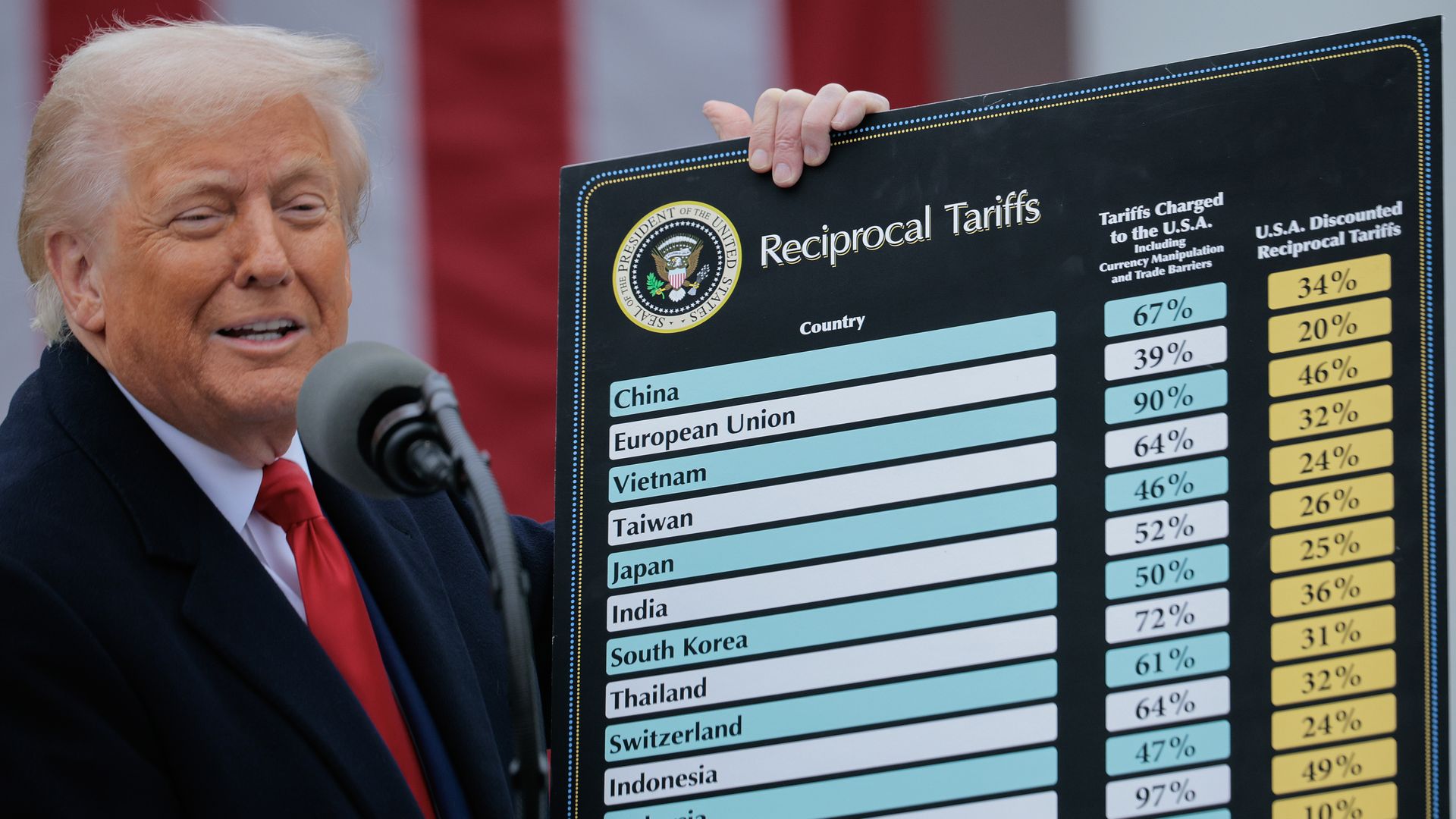
An obscure federal court blew up the cornerstone of President Trump's economic agenda last night, all but wiping out his leverage with trading partners and throwing more chaos into the global economy.
Why it matters: In the end, it turns out the legal system — not the bond market nor weak economic indicators — may be the biggest restraint on Trump's trade agenda.
The big picture: Tens of thousands of containers full of goods enter the United States every day.
- Whether (or what) levies to assess on their contents today, versus yesterday, is a mess that could snarl commerce across the country for days to come.
Catch up quick: A three-judge panel of the Court of International Trade — Reagan, Obama and Trump appointees — ruled that Trump did not have the authority under 1970s-era emergency legislation to impose sweeping tariffs.
- In fact, the judges said an injunction wasn't enough, issuing a summary judgment invalidating and blocking almost all of Trump's trade levies.
- Those levies were vast, from a 10% global baseline tariff, to fentanyl-related tariffs on China, Canada and Mexico, to (paused) reciprocal tariffs on dozens of other countries.
- The levies effectively raised U.S. tariff rates to their highest levels since the 1930s and threatened to cost American households thousands of dollars in higher goods costs.
Follow the money: The tariffs, which cause huge economic strain, were also generating significant revenue for the government, almost $23 billion so far this month.
- They were set to be a cornerstone of the administration's fiscal plans. Trade adviser Peter Navarro wrote in an opinion piece in The Hill yesterday that tariffs would generate up to $3.3 trillion in revenue over the next decade.
- Not all the income will disappear, though. Tariffs imposed under a different legal authority called Section 232 — including on imports of autos, steel and aluminum — are unaffected by the ruling.
What they're saying: "This really *is* Liberation Day: The court's decision striking down Trump's mass tariffs as unlawful is a tremendous triumph for the rule of law, human freedom, and prosperity, and a deserved rebuke for arbitrary one-man rule over our livelihoods," Walter Olsen, senior fellow in constitutional studies at the Cato Institute, said of the ruling.
For the record: "It is not for unelected judges to decide how to properly address a national emergency. President Trump pledged to put America First, and the Administration is committed to using every lever of executive power to address this crisis and restore American Greatness," White House spokesperson Kush Desai said in a statement.
- The administration filed a notice of appeal just minutes after the ruling. Reuters reported.
- "The judicial coup is out of control," White House deputy chief of staff Stephen Miller posted on X.
The bottom line: Trump previously declared the U.S. is like a department store, and he set the prices.
- Three little-known judges just put him out of business and upended global commerce in the process.
2. College grads have a job market problem
College graduates are having a tough time landing jobs this year, and AI may be playing a role, finds a new report that parses federal unemployment data.
Why it matters: The analysis from Oxford Economics adds hard evidence to anecdotal reports — and scary warnings — that AI is displacing white-collar workers.
What they're saying: "There's a lot of concern that AI is eliminating entry level white-collar positions, and I think this is just some of the first evidence that we're seeing," says Matthew Martin, senior economist at Oxford Economics, who wrote the report.
How it works: While it's risen over the past few months, the unemployment rate in the U.S. has stayed relatively low. But the jobless rate for recent college grads has risen faster and is now higher than the overall rate.
- The Oxford Economics report studies the unemployment rate for those ages 22 to 27 with a bachelor's degree, i.e., recent college grads.
- Looking at a three-month moving average, their jobless rate was close to 6% in April, compared to just above 4% for the overall workforce.
The intrigue: This is new. Before the pandemic, the jobless rate for recent college grads was generally lower than, or about the same as, the national unemployment rate.
The big picture: Hiring has slowed considerably in the tech sector, particularly at the entry level, thanks in part to AI, plus a rise in interest rates and a course correction from pandemic overhiring.
- "A lot of these entry level, or kind of lower totem pole jobs, are likely being displaced as the workers above them become more productive," Martin says.
Reality check: For as long as technology has progressed, there have been worries that the robots will come for people's jobs.
- Typically, however, advancements in tech have created many more jobs, usually of a different sort.
The bottom line: For years, a computer science degree was viewed as a hot ticket to a great job. Now as that promise fades, the supply of tech grads will likely fall along with demand, Martin says.
- That will take a while to play out.
3. Grads are losing their employment edge


With AI or not, college grads are losing their employment edge.
The big picture: For decades, young college grads have had lower jobless rates than young adults without a bachelor's degree.
- But in recent years, the gap between the two groups has narrowed.
By the numbers: In April, the unemployment rate for college grads ages 22 to 27 was 5.27%, per an analysis conducted by Oxford Economics.
- For those the same age, with less than a bachelor's degree, the rate was 6.91%, which is a gap of about 1.6 points.
Zoom out: Compare that relatively slim difference to the gap of more than 8 points coming out of the 2008 financial crisis.
- That recession hit all kinds of non-college jobs, notably in the construction business, while at the same time the 2010s tech boom created plenty more jobs for those with college degrees.
- The gap blew out past 8 points again in 2020, when the pandemic hit and service sector jobs got wiped off the map. Restaurants, hotels and casinos let workers go, while white-collar jobs held steady thanks to Zoom.
State of play: We're in a new world today. AI is eating tech roles and leading to what some call a white-collar recession.
- Meanwhile, the administration is pulling back on funding for universities and education.
The bottom line: College grads still have a long-term lead when it comes to pay and overall unemployment rates.
- At least for now, anyway.
Thanks to Ben Berkowitz for editing and Anjelica Tan for copy editing. See you tomorrow!
Sign up for Axios Markets