Axios Markets

September 15, 2026


1 big thing: Fear is ... bullish, actually


Fear is splitting the AI trade — the same technology advances that are raising alarms about rogue agents, cyberattacks and apocalypse are creating a bull case for the companies paid to protect against those threats.
Why it matters: Investors are, in a way, leaning into the scary AI talk, betting that companies and governments will increase cybersecurity spending to deal with rapidly advancing threats.
The big picture: The mood around AI is darkening as long-simmering doomer fears are gaining more attention.
Catch up quick: Over the weekend, Anthropic's Dario Amodei, OpenAI's Sam Altman and SpaceX's Elon Musk called for a slowdown in advancement of the most sophisticated models to effectively deal with safety risks, calling it "pacing the frontier."
State of play: That seemed to spook investors yesterday, pushing down stocks in sectors connected to the AI trade, like chip and memory companies. Surging oil prices and the rise in the 10-year Treasury yield were also a factor.
- At the same time, stocks rose for cybersecurity companies.
By the numbers: CrowdStrike and Palo Alto Networks — two of the largest cybersecurity companies — were up roughly 14% and 13%, respectively, yesterday.
- Both stocks have basically doubled over the past six months, sharply outperforming chipmakers Nvidia and Broadcom. (See chart above).
Zoom in: The scary AI headlines this weekend and earlier have been a useful marketing tool. "I spent eight years trying to convince people cybersecurity is important. Dario did it in one week — better than me, clearly," Palo Alto Networks CEO Nikesh Arora told a Goldman Sachs conference last week, per an AlphaSense transcript.
- Earlier this month, Arora said on an earnings call that "AI represents a significant long-term tailwind that is expanding our total addressable market in network security."
- Even if the frontier labs Anthropic and OpenAI slow down development, there are still risks from Chinese AI models, which are gaining ground.
What to watch: This is all moving at breakneck speed, and the AI cybersecurity market is still getting built.
Flashback: The cybersecurity industry shifted earlier this year — after Axios reported that Anthropic's new model Mythos would make it far easier for cybercriminals to exploit software vulnerabilities.
- This "Mythos moment" made clear how quickly cybersecurity threats can erupt now, Palo Alto Networks' Arora said on the earnings call.
- Flaws that used to take months for humans to uncover can now be exploited in minutes, he said. That's driving spending for companies and revenue for cybersecurity businesses.
Zoom out: Gartner estimated in January that spending on AI cybersecurity will total $51.3 billion worldwide this year, and grow to $86 billion in 2027.
Yes, but: That's a small fraction of the more than $2.5 trillion in total AI spend for 2026.
Between the lines: AI may or may not end humanity, but in the meantime it's accelerating risks that governments and businesses need to manage — and that costs money.
Reality check: It also raises risks for businesses. "As an investor, I'm far less worried about AI ending humanity than about it causing operational or security failures with real financial consequences," Mark Malek, chief investment officer at Siebert, told Axios recently.
- Malek pointed to the example of CrowdStrike, which released a flawed software update a few years ago that wiped out a good chunk of its market cap.
- "That's the more realistic template for how an AI stumble — not a doomsday scenario, but an operational one — would actually hit a portfolio."
2. Trump's postings may still move the needle
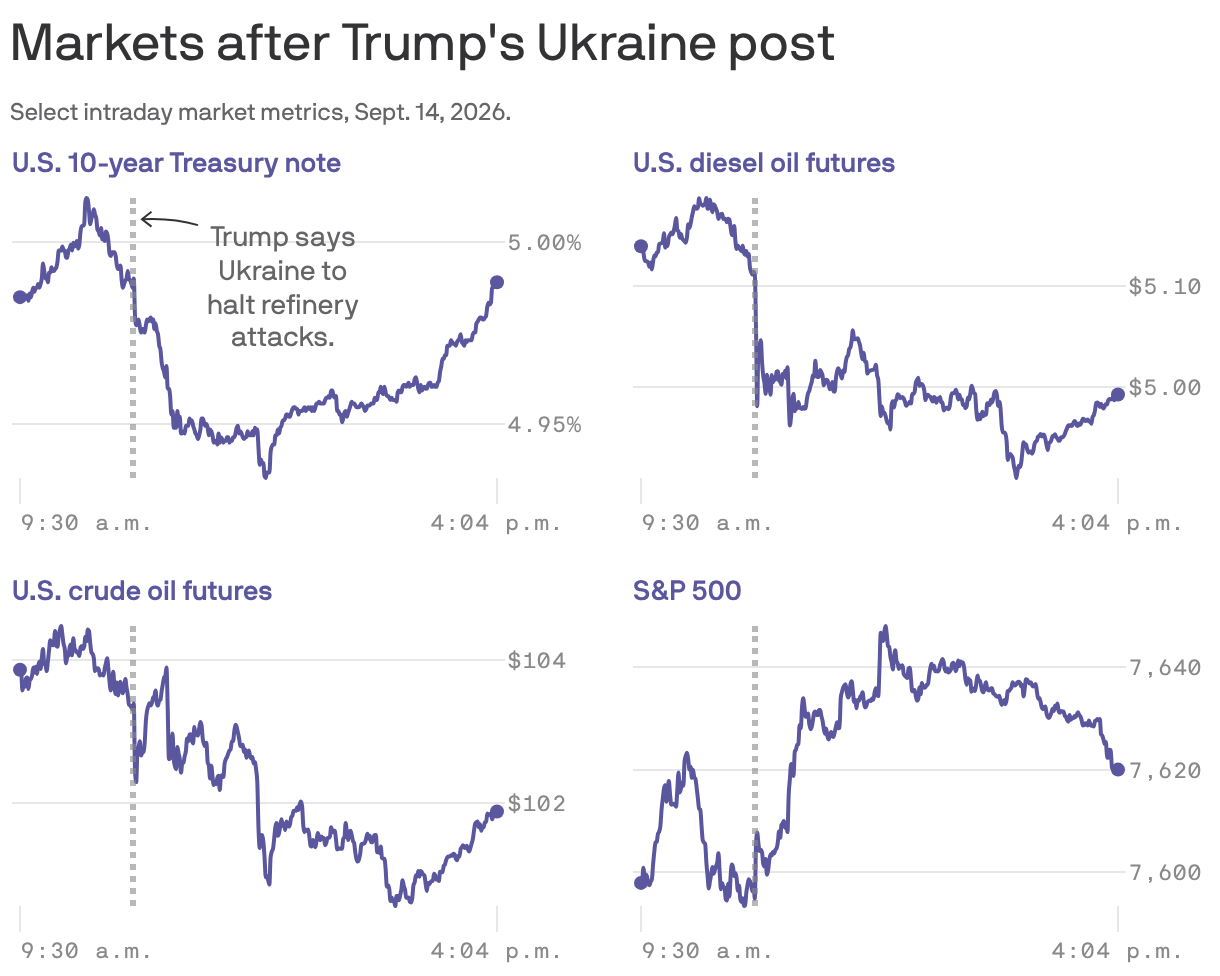
President Trump's claim that Ukraine agreed to halt strikes on Russian energy targets coincided with a pullback in oil prices and Treasury yields yesterday.
Why it matters: Ukrainian drone strikes on Russia have crippled large swaths of the country's refining capacity, creating embarrassing shortages and prompting Russian officials to curtail exports to shore up domestic supplies.
- Russia has long been one of the world's largest exporters of diesel, and its export ban contributed to a worldwide ripple of diesel fuel shortages and price spikes, including in the U.S., where the national average price for diesel jumped to $6 per gallon in recent days.
What they're saying: "Ukraine has agreed not to hit Russian Energy targets. Russia has agreed to do, likewise! The World's Diesel price rise is mostly caused by the Russia/Ukraine War, not Iran. President DJT," Trump posted.
The other side: The Ukrainians sounded somewhat skeptical, with President Volodymyr Zelensky stating that "Ukraine is not convinced that Russia is willing to abide by any agreement."
- "If our partners are ready to ensure that Russia genuinely refrains from striking our electricity system, other energy facilities, critical infrastructure, and food supply routes, then, of course, we are ready to ensure a corresponding halt to our strikes."
The bottom line: In any case, diesel prices, crude oil and Treasury bond yields declined after Trump's message.
Zoom out: The market moves were a potent reminder that Trump's online pronouncements can still matter for investors.
- That's at the heart of the Trump Media & Technology Group's decision to launch its Truth API data feed product this summer.
- The product offers access — the cost is between $60,000 and $100,000 per month — to a data feed of "published and publicly available posts fractionally faster," according to Trump Media CEO Kevin McGurn, including those of the president and other top accounts on Truth Social.
- Trump owns roughly 41% of the outstanding shares in Trump Media.
Friction point: The product is the focus of a lawsuit filed last month by the Freedom of the Press Foundation and nonprofit news organization The Intercept, which accuses the president and the administration of violating the First Amendment and profiting from selling government information.
- "This scheme is profoundly corrupt. The President stands to gain financially by giving 'market-moving' government information to those who are willing and able to pay his personal company," the plaintiffs wrote in their complaint.
- A Trump Media spokesperson said: "Information from President Trump is disseminated by countless platforms and news outlets, many of which offer subscription APIs. One of those channels is Truth Social, which was founded as an uncancellable haven for free speech after the President was deplatformed. Now, left-wing activists are trying to wrongfully weaponize the courts to censor him again and harm our shareholders."
- The White House did not respond to a request for comment.
Disclosure: In 2023, TMTG sued 20 media organizations, including Axios, for defamation. Litigation is ongoing.
Axios Markets
