Axios Markets

September 29, 2026

🎳 It's Tuesday. We're lining 'em up and knocking 'em down.
🚨 IPO sirens: Oura, the smart ring maker, announced this morning that it is postponing its planned initial public offering "due to uncertainty in the IPO market." AI giant Anthropic, meanwhile, which could be the largest IPO ever, had a net loss of nearly $42 billion last year (most of it from an accounting charge) and plans to spend $518 billion on computing and infrastructure, according to Reuters, which says it has seen its prospectus.
🗓️ Today, Matt checks in on one of his fave topics — yield curve discourse! (In other bond market action, the yield on the 10-year Treasury note topped 5.25% overnight.)
👨‍💼 Plus, a new analysis finds that AI will transform everyone's jobs. Just last year, folks said AI would eliminate the need for humans entirely — so perhaps that's a bit of relief.
Let's do this! 1,198 words, a 4.5-minute read.
1 big thing: 🗣️ Yield curve reenters the chat
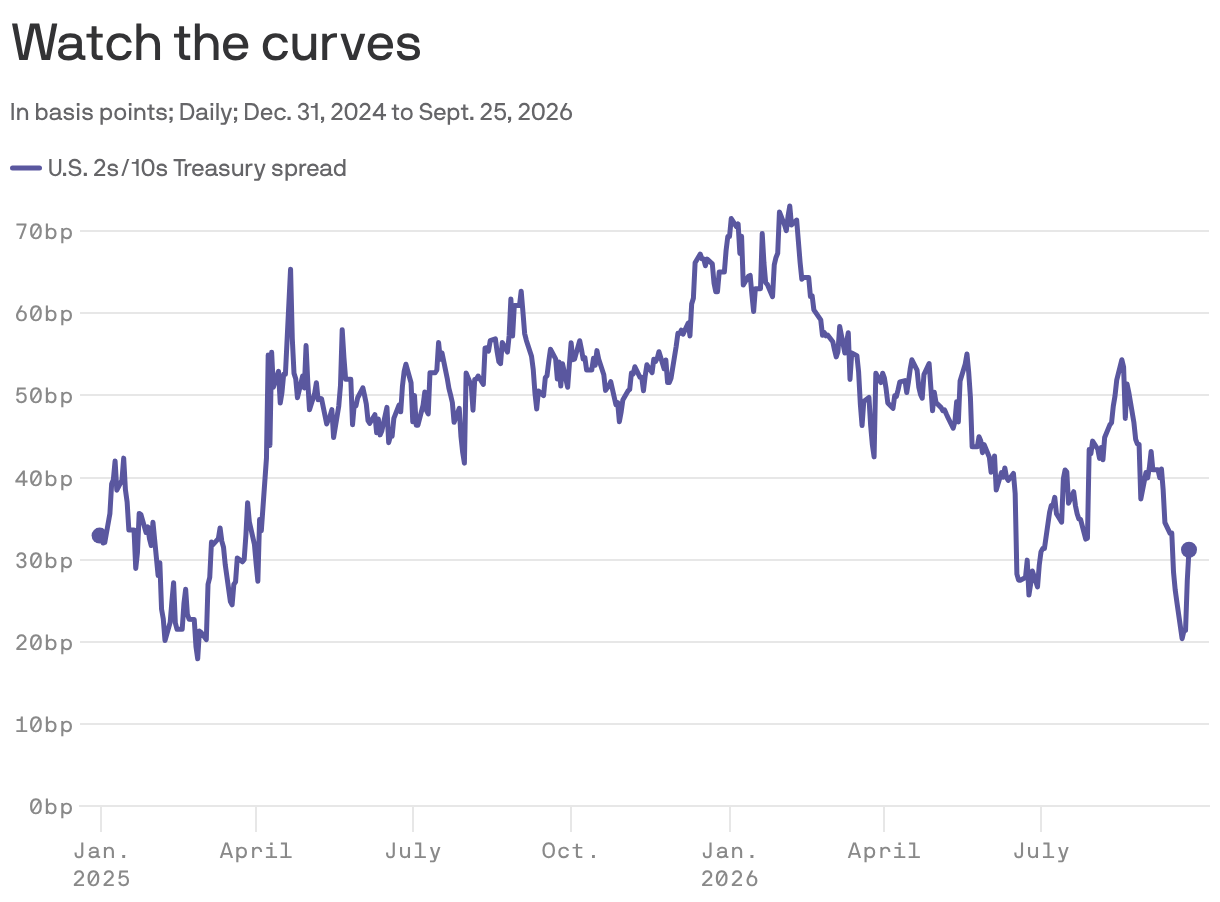
The Treasury yield curve has reentered the financial chat, as investors and traders remain mindful of its strong record of forecasting recessions.
Why it matters: In the past, when certain segments of the yield curve have inverted, or turned negative, it has been one of the most reliable signals that a recession would follow.
Driving the news: Over the last few weeks, the difference between yields on two-year Treasury notes and yields on the 10-year Treasury note tumbled to roughly 0.20 percentage points (20 basis points).
- It has bounced somewhat since then, but the sharp move raised the prospect that this part of the Treasury curve could soon invert.
What they're saying: UBS Global Wealth Management noted yesterday that the compression of this 2s/10s spread — as it's known on Wall Street —"raises the possibility that 10-year Treasuries could soon yield less than shorter maturities, creating an inversion that has historically preceded U.S. recessions."
The big picture: There are a few theories about why inversions have front-run recessions in the past. Here's one: Banks borrow at shorter maturities and use that money to make longer-term loans at higher rates — and the yield curve mirrors that spread, which is, effectively, a lender's profit margin.
- The wider that gap is, the bigger the incentive for banks to lend.
- But when the curve shrinks or inverts, the incentive to lend evaporates.
- And since bank credit is vital to economic growth, if bank lending falls, a recession more often than not is in the offing.
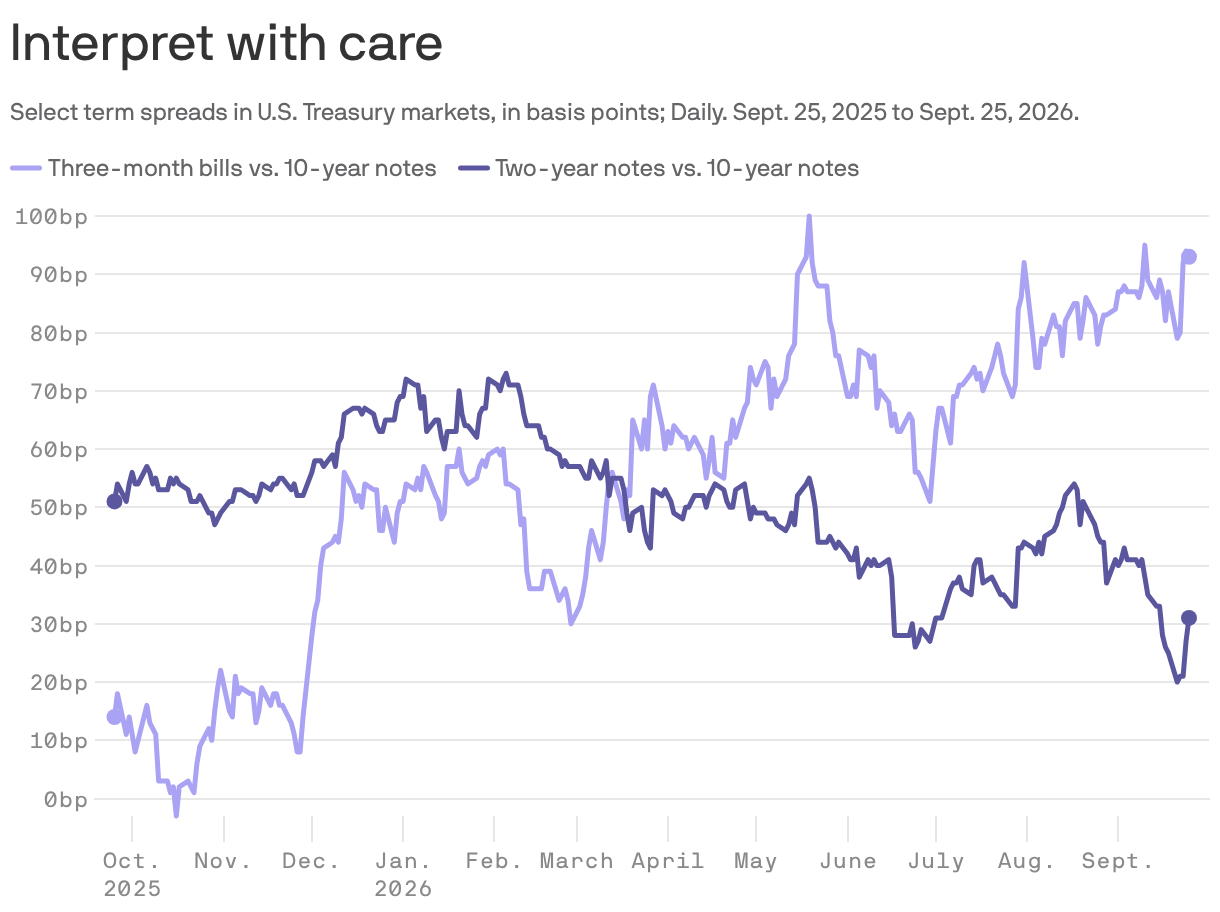
Zoom in: When we talk about the "yield curve," we usually mean the difference — or spread — in yields between Treasury securities of different maturities.
- For instance, the spread between yields on two-year Treasury and 10-year Treasury notes is one of the most closely watched.
- But there's another stretch of the curve that has been even more accurate as a predictor: the spread between three-month Treasury bills and the yield on the 10-year note.
Stunning stat: Between 1969 and 2020, every time this segment of the yield curve inverted — that is, turned negative — a recession followed.
- In all, it correctly called eight straight recessions without a single false positive.
Reality check: The three-month/10-year's streak as an economic Cassandra came to an abrupt end in November 2022, as the Federal Reserve jacked up short-term interest rates to counter the post-COVID inflation.
- The curve remained persistently inverted until 2025.
- Yet, no recession followed.
More importantly, that segment of the curve remains safely in positive territory now.
- Indeed, while the spread between two-year and 10-year notes has been falling, the spread between three-month bills and 10-year notes has been rising and is now roughly 1 percentage point (100 basis points).
- In other words, the most reliable part of the yield curve when it comes to predicting recessions seems to be getting further away from indicating any risk of an economic downturn.
The bottom line: As we wrote yesterday, the signal that bond markets seem to be sending is that the economy is much stronger than many may have been expecting lately.
- As a result, investors are ratcheting up their rate expectations for the next couple years, essentially a bet that the Fed will have to keep the short-term rates it controls higher for longer.
- And that's why the two-year note is up so much, resulting in a sharp decline in the 2s/10s segment of the curve.
2. 🦾 You might need a different job
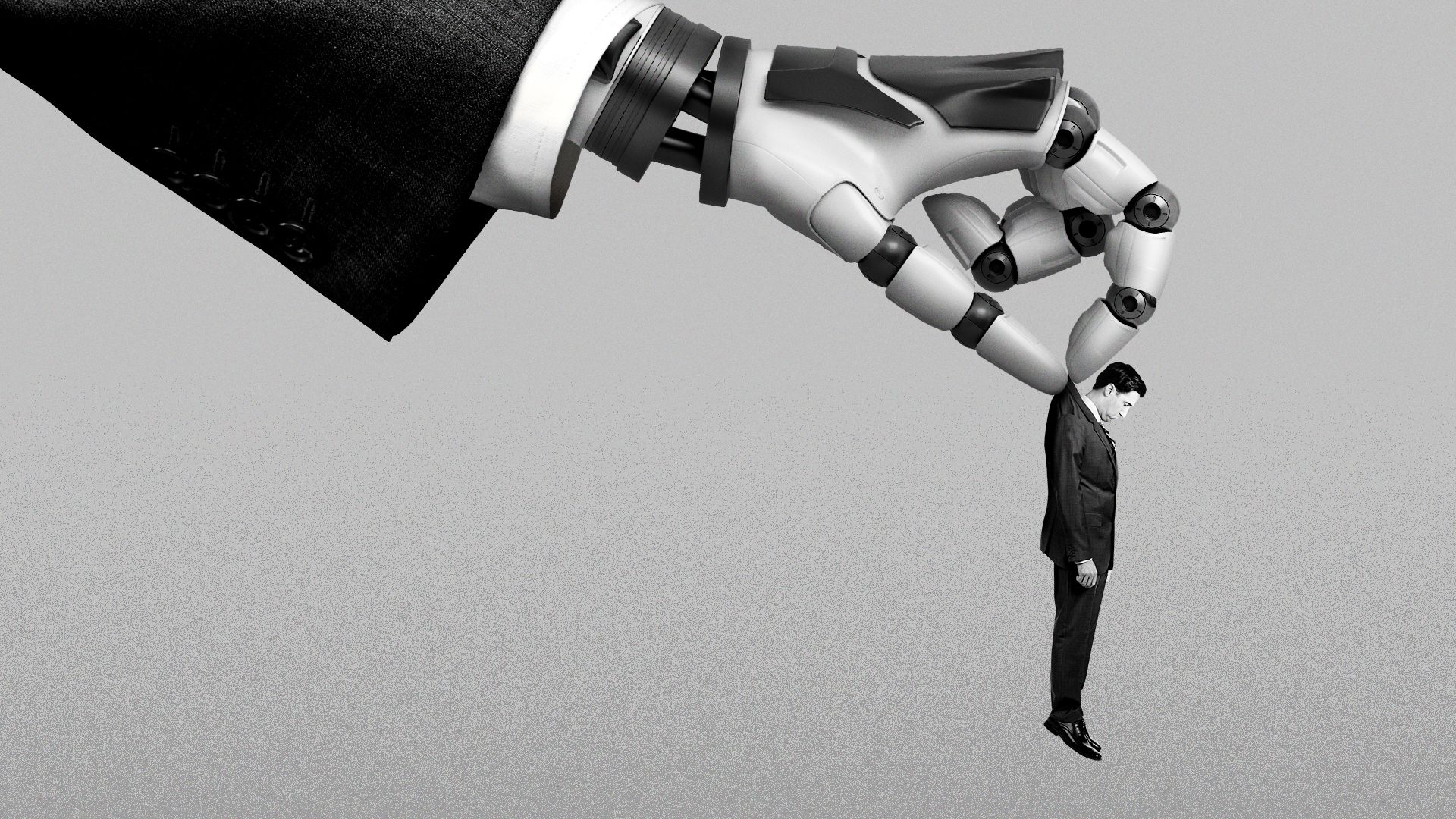
Roughly 11 million American workers — about 7% of the current labor force — might need to change occupations over the next decade, as the economy adapts to the AI era, per a new analysis from the McKinsey Global Institute out today.
The big picture: New technologies have always transformed the way people work, but the AI workforce transition could happen at three to four times the historical pace, they write.
By the numbers: The analysis estimates that 770,000 workers per year might need to switch their occupations — the long-run average is about 215,000.
- The U.S. got a little taste of what that was like in the pandemic years, the researchers point out — the rate then was about 788,000.
- Those who don't switch jobs will see their work transformed by AI: About 70% of U.S. workers will have to do some level of role reinvention, the report finds. (Anyone who lived through the rise of the internet might recall what that's like.)
Zoom out: "We will see new jobs and new roles and a reshaping of roles that emerges, just like other general-purpose technologies did in the past," Anna Kortis, a partner at McKinsey who coauthored the report, tells Axios.
- "But this will happen faster and at a bigger scale than in the past."
Between the lines: Fast, disruptive technological changes can spill out beyond the workplace, triggering political and cultural changes with far-reaching consequences.
- You can draw a line from the Industrial Revolution to widespread labor unrest and union organizing.
Where it stands: Workers are anxious about the changes coming — employee confidence fell to a new record low in September, according to Glassdoor data out yesterday.
- AI was a common source of that worsening anxiety. Mentions of AI in employee reviews were up 164% from last year.
Flashback: More than a year ago, Anthropic CEO Dario Amodei predicted that half of all entry-level white-collar jobs would vanish in the wake of AI transformation within one to five years and drive the unemployment rate to between 10% and 20%.
- So far, nothing like that broad collapse has happened.
What to watch: The unemployment rate was 4.1% in August — we'll get fresh data on the job market this Friday.
The bottom line: Instead of an all-out job apocalypse, a more nuanced picture is emerging: There may be enough jobs, but millions of workers could have a difficult path to landing them.
We here at Markets remember back when the dot-com gold rush messed with our jobs, too — turning us into bloggers, posters and 24/7 news junkies. How has technology changed the way you worked over the years?
- We'd love to hear about that and what you're thinking about the AI shifts to come.
Drop us a line at [email protected] and [email protected] or just reply to this email.
Thanks to Jeffrey Cane for editing and Carlin Becker for copy editing this edition.
Tell your friends to sign up here.
Sign up for Axios Markets