Why the surge in bond yields could be a positive

Add Axios as your preferred source to
see more of our stories on Google.
Memes and the diesel shock aside, maybe the recent bond yield surge is simply telling us to kick back and enjoy a revving U.S. economy.
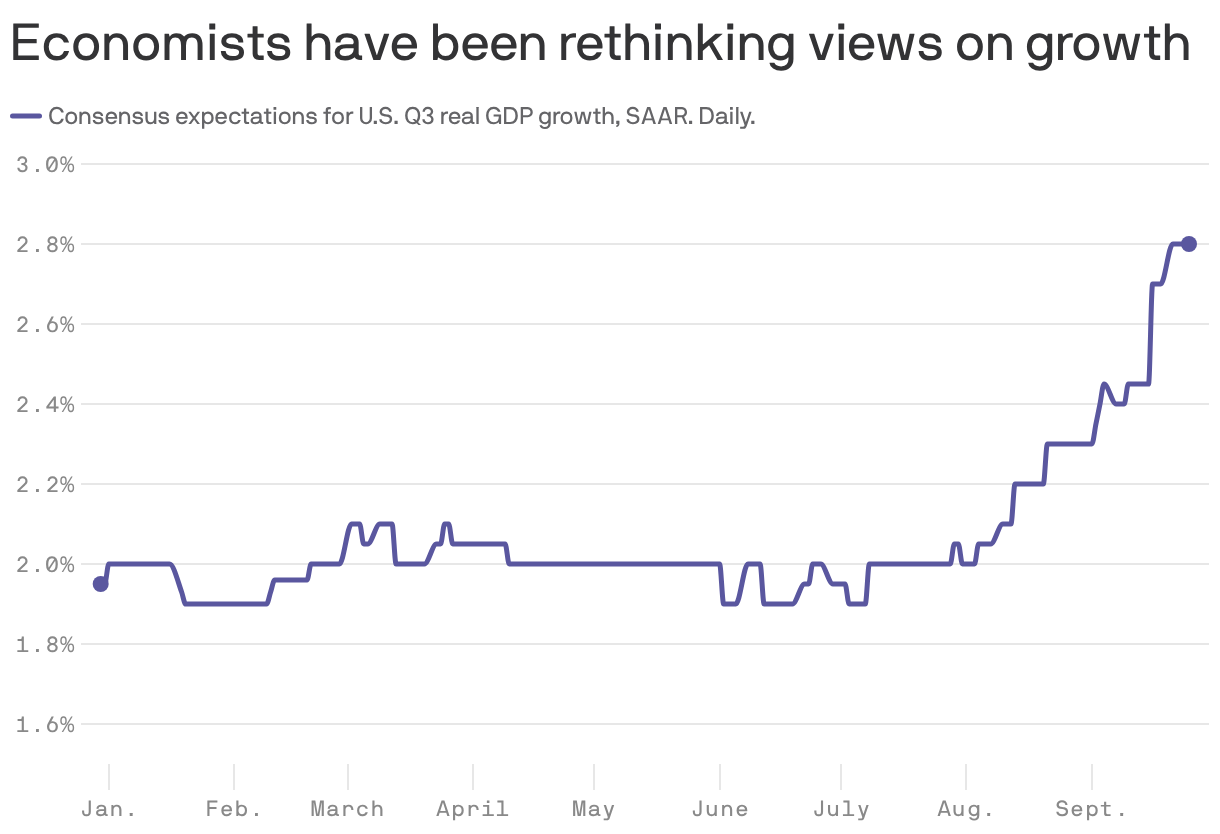
Why it matters: While the energy spike caused by the Iran war is a big deal, some analysts stress that the main takeaway of the bond market's recent turn should be that the U.S. economy is simply far stronger than many previously thought.
Zoom in: Get out your slide rule and pop in your pocket protector: This view hangs on a slightly technical analysis of the recent rise in Treasury yields.
- Let's get bond geeky!
How it works: One way analysts think about Treasury yields is as a kind of layered cake composed of two distinct financial flavors.
- The first layer, "real yields," reflects, in part, the market's expectations for the strength of the underlying economy. It's usually measured by taking the quoted rate on U.S. inflation-protected Treasurys (TIPS).
- The second layer is "inflation expectations," which is measured by the difference between yields on TIPS and regular Treasury securities that mature at roughly the same time.
- The gap between these two is basically the market's ballpark estimate of the average annual inflation rate over the period in question.
The big picture: By this analysis, if the change in real yields accounts for a larger chunk of the overall change in Treasury yields, the move is said to be driven by expectations of stronger economic growth — and vice versa if changes in inflation expectations are the bigger component of the yield change.
It seems clear that real yields have been the key driver this year.
- For instance, over the one-month period that ended Friday, the five-year real yield (up 0.66 percentage points) over the last month, accounts for the overwhelming bulk of the increase of 0.72 percentage points in the five-year Treasury note. Inflation expectations account for just 0.06 percentage points.
What they're saying: "Given that Brent is up around 73% so far in 2026, and US CPI has risen from 2.4% in January to an expected 3.60% in September, anyone outside bond markets could be forgiven for assuming the bond market is becoming increasingly concerned about inflation," Deutsche Bank analysts wrote. "This couldn't be further from the truth."
Between the lines: It might be hard to believe, given the level of consternation about rising energy costs in the U.S. and the overall sour sentiment among consumers. But there is plenty of data corroborating the view that the U.S. economy — in the aggregate — is remarkably strong right now.
- Weekly claims for U.S. unemployment insurance remain near 57-year lows.
- The S&P 500 finished Friday less than 1% from its record high.
- Fresh data on capital goods orders Friday suggested the AI infrastructure boom — arguably one of the largest investment binges in U.S. history — is very much alive and well.
- And Wall Street analysts are expecting Q3 corporate profits for S&P 500 companies to rise 29% versus the same quarter last year, according to FactSet data.
The other side: That's not to say the economy is perfect. Even aside from surging energy costs, abysmal housing affordability and real declines in wages, there are plenty of reasons to be cranky.
- By some measures, American workers are getting the tiniest share of the benefits of the economy — in terms of income — on record.
The bottom line: But be that as it may, maybe the bond market is simply telling us that, actually, the economy is pretty strong.
