Axios Markets

May 04, 2023
Greetings! And, to all you Star Wars fans, May the 4th be with you.
๐ Today we're watching bank stocks again โ especially PacWest. The California-based lender put out a statement early this morning confirming that it's exploring "strategic options," after a Bloomberg report said a possible sale was in the offing. Its stock price was down double-digits this morning in pre-market trading.
- But first, we've got some debunking to do, and a look at oil prices.
Today's newsletter is 1,044 words, 4 minutes.
1 big thing: Housing hullabaloo
Illustration: Aรฏda Amer/Axios
You may have heard something in the news lately about homebuyers with good credit scores paying more for mortgages in order to subsidize those with lower credit scores.
- It's not true, Emily writes.
Why it matters: This year, the fee structure around mortgages set by housing regulators did change, but rest assured those with good credit scores still pay less than those with worse ones.
What happened: Fannie Mae and Freddie Mac's regulators at the Federal Housing Finance Agency (FHFA) changed the fees they charge on mortgages โ Fannie and Freddie buy up about half of all single-family mortgages in the U.S., keeping the housing market working.
How it works: The fees at issue are charged in exchange for taking on the credit risk of the loans: higher risk = higher fees. Risk is determined by credit score and down-payment size relative to home value.
- The average fee was 0.56 percentage points in 2021.
Zoom in: Last year, the FHFA announced increased fees on second-home loans, high-balance loans, cash-out refinances and investor property loans โ all of which aren't really core to the agency's mission.
- Later in 2022, with the help of the higher fees on non-mission critical loans, they eliminated fees for certain first-time borrowers, including lower-income borrowers and those in underserved communities (like folks in rural housing, and manufactured housing). These borrowers still needed high credit ratings to secure mortgages.
At the start of 2023, the FHFA announced changes to the overall fee pricing structure, based on credit ratings and down-payment amounts.
- Under the new structure, borrowers with better credit and higher down payments still pay lower fees. An Urban Institute analysis shows this โ by taking into account both the new fee structure, and the extra points tacked on to borrowers with smaller down payments.
- Lenders started using the new fee structure after the announcement, and ahead of a May 1 deadline for when the agencies would start purchasing loans with the new pricing.
- Then, media coverage heated up in April.
What they're saying: With misinformation swirling, even industry insiders who oppose the new structure have made statements to debunk these reports.
- โBorrowers with higher credit scores will still pay less than those with a lower credit score and the same down payment,โ Mortgage Bankers Association spokesperson Adam DeSanctis said in a video statement Tuesday.
- None of the changes are "about penalizing borrowers with good credit scores to subsidize borrowers with bad credit scores. That simply doesn't happen," Mickey Shemi, a principal adviser at FHFA told Axios this week.
In a letter, Patrick McHenry, the Republican chair of the house financial services committee, called on FHFA director Sandra Thompson to reverse the fees.
- She responded with a detailed statement the same day, debunking the claims circulating โย some included the suggestion you should deliberately try to lower your credit score to get a better mortgage rate. (Don't do that.)
The bottom line: No one paid much attention to Fannie and Freddie when mortgage rates were low. Now that the rate on the 30-year is over 6%, the spotlight is shining.
3. ๐ Charted: Crude tumbles

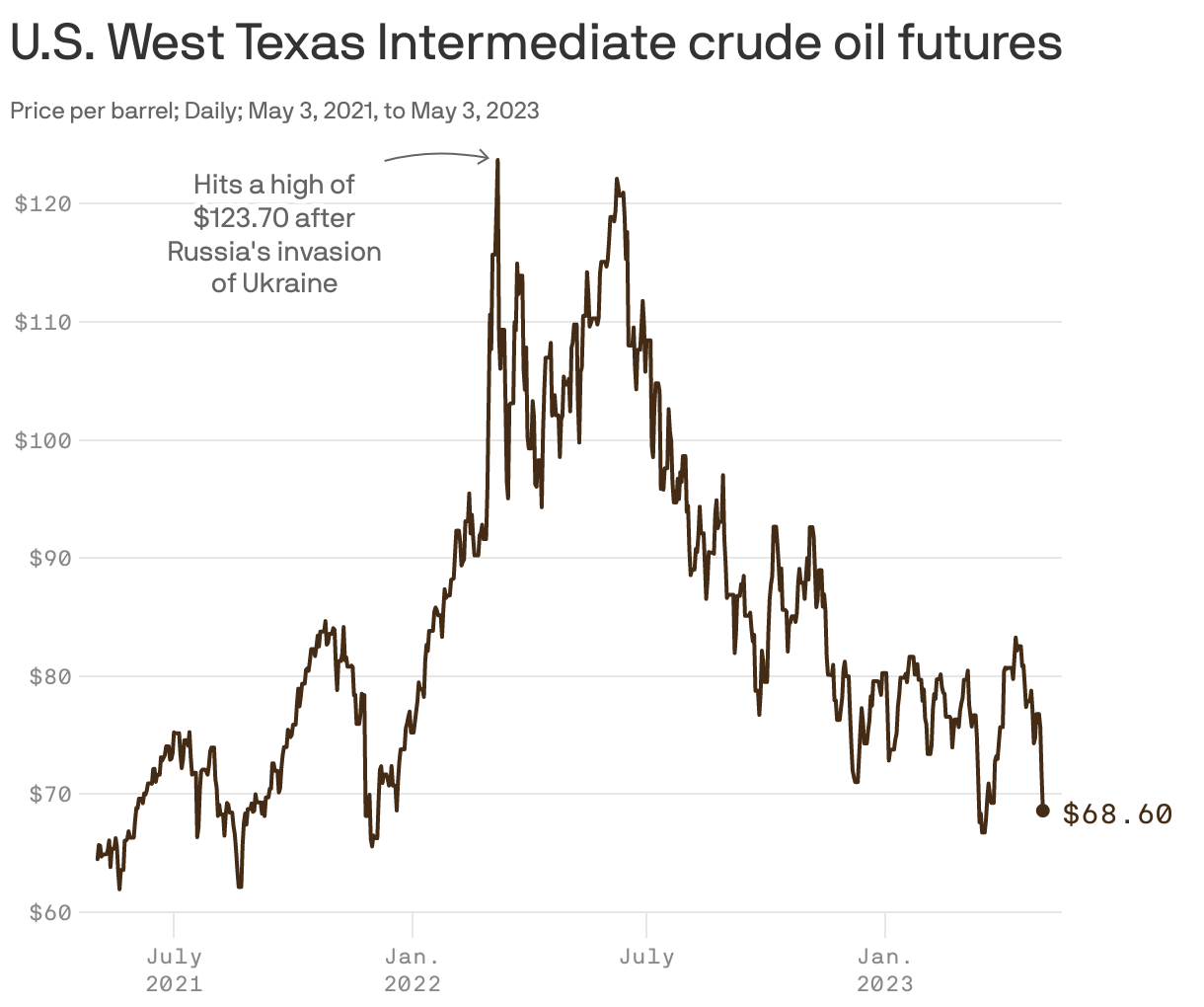
U.S. oil prices fell more than 4% to less than $69 a barrel yesterday, amid what seems to be growing concern about the outlook for global growth, Matt writes.
Why it matters: Oil is a key input into the world economy. Big price moves for crude can signal a shift in investor expectations.
- The downturn in oil prices may mean they expect the economy to weaken.
What they're saying: "Investors seem to be getting increasingly nervous about the macro outlook and its implications for oil demand," ING analysts wrote in a client note Tuesday.
- Prices are down more than 10% this week.
Between the lines: Basically, investors think China's recovery from its disastrous Zero-COVID policies has been pretty lackluster.
- At the same time, they think banking jitters could crimp U.S. growth.
The bottom line: The selloff in crude is consistent with other evidence that the global industrial economy โ or the goods-producing part โ of the world economy is suffering. But that may not be the end of the world...
4. โ๏ธ Goods vs. services

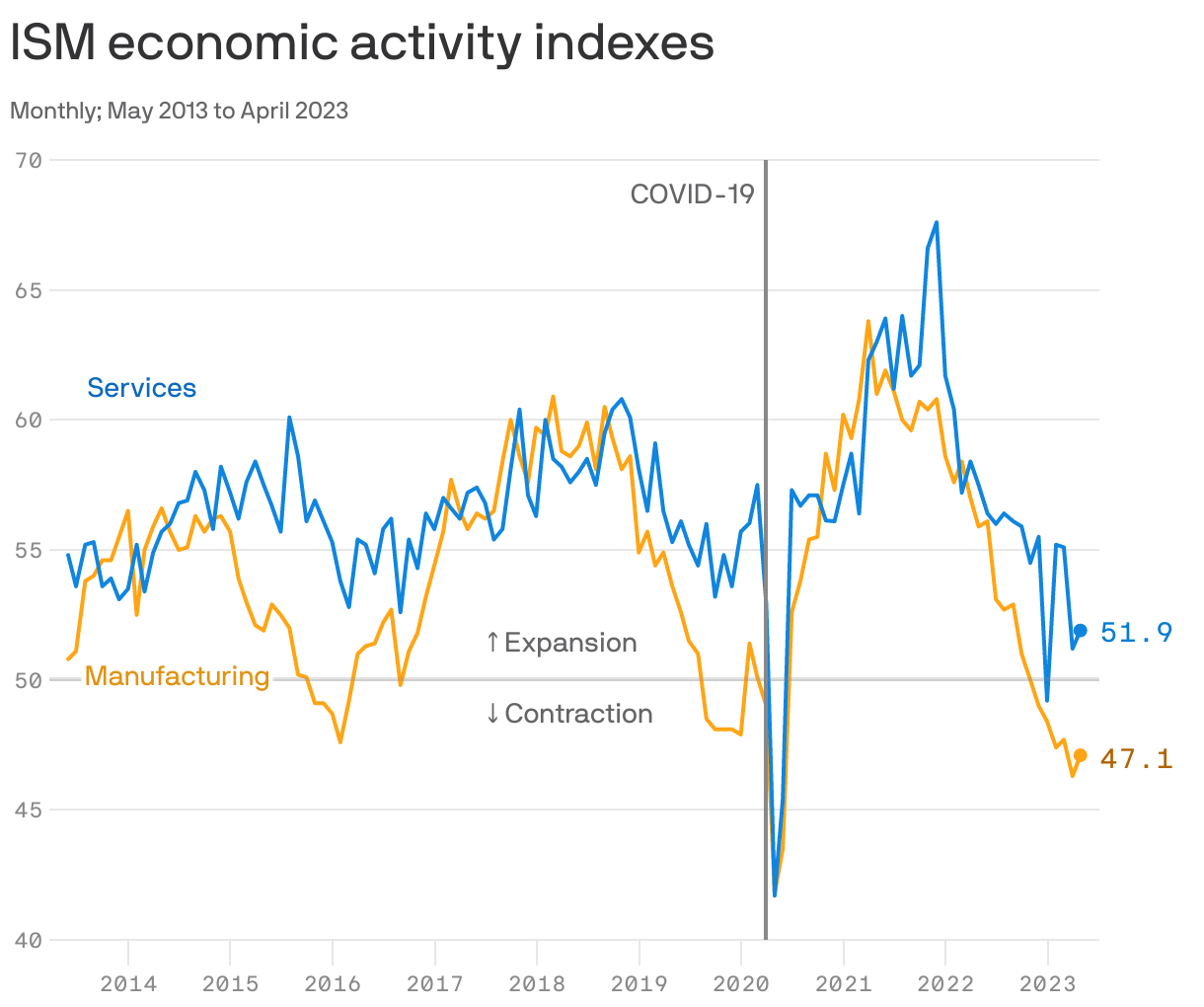
The economy continues to shift away from buying and selling goods โ which was big during and after the pandemic โ and back toward services, traditionally the driver of the U.S. economy, Matt writes.
Why it matters: Focusing on the slowdown in manufacturing, or falling commodities prices โ such as crude oil, above โ may obscure the importance of the service sector, and could give a false impression of how the economy is doing overall.
Be smart: Services โ haircuts, restaurant meals, IT consulting, lending money and a vast swath of other activities in which people pay other people to do things for them โ accounts for over 70% of the U.S. economy.
The latest: Updates this week from the Institute for Supply Management's surveys of manufacturing and services activity in April confirm the growing divergence between these two parts of the economy.
- Manufacturing is clearly shrinking, while services activity remains above the threshold โ 50 โthat separates contraction from expansion.
The bottom line: The uptick in services, since it's such a large part of the economy, could outweigh the downward momentum we're seeing in goods.
5. Quoted: Uncharted territory
"We shouldn't even be talking about a world in which the U.S. doesn't pay its bills. It just shouldn't be a thing."โ Jerome Powell
At the press conference yesterday, the Fed chair said raising the debt ceiling in a timely manner is essential. Failure to do so would put the economy into "uncharted territory."
Why it matters: The Fed's had to deal with quite a number of economic crises during Powell's tenure โ from COVID to the war in Ukraine, and now the spate of bank failures. The prospect of a debt ceiling breach would be the first crisis created by the U.S. government.
- "No one should assume that the Fed can really protect the economy and the financial system and our reputation globally from the damage that such an event might inflict," Powell added.
Was this email forwarded to you? We'd happily send it directly to your inbox. Subscribe here.
Axios Markets is edited by Javier E. David and copy edited by Carolyn DiPaolo.
Sign up for Axios Markets

Stay on top of the latest market trends and economic insights