Axios Markets
November 03, 2026


1 big thing: Can't stop, won't stop


Big Tech just can't quit the bond market — Alphabet, Microsoft, Meta and Oracle are all lining up billions more in debt as the borrowing frenzy around the AI buildout shows little sign of cooling off.
Why it matters: They're having to pony up to borrow more. The AI buildout powering the markets and economy increasingly runs on borrowed money — and lenders are starting to charge more for it.
- That doesn't seem to have stopped anyone from asking for more.
The latest: Google parent Alphabet is set to raise 6 billion euros, or about $6.7 billion, from its second euro-denominated bond sale this year, according to Bloomberg — offering higher yields than back in May, when it last issued in euros.
- Meta, meanwhile, is reportedly considering floating another $20 billion in debt, Bloomberg also reported. Just last week, the company said it plans to issue up to nearly $100 billion in equity.
- Last week, Microsoft said it expects to raise $25 billion in a bond sale, Reuters reported.
- Oracle has filed to raise $20 billion, half in stock and half in bonds. Oracle says that, along with cash on hand, the money should carry it until its AI business funds itself, by May 2029 if not sooner.
- Moody's yesterday kept its rating of Oracle at two notches above junk, with a negative outlook — meaning that it's more likely to cut the rating than to raise it going forward.
By the numbers: Credit default swaps, a kind of insurance against default, on Alphabet's bonds have nearly tripled over the past year.
- Alphabet CDS rose to 91.6 basis points last week. That means insuring $10 million of Alphabet debt over the next five years costs $91,600 a year.
- Microsoft CDS has nearly doubled.
Yes, but: Those numbers are still pretty low — especially compared with Oracle CDS, sitting at 294.4 basis points from below 100 last year.
Catch up quick: Just last week, Oracle told investors it would cap new capital-markets funding at $20 billion through fiscal 2030.
- It filed to raise all of it yesterday.
Zoom out: "I'm not trying to scold anybody, but they did say that was the end," says John Atkins, who covers corporate bonds at PitchBook, "I think it's indicative of an AI buildout phase that's happening in real time instead of based on predetermined plans."
- The cost of capital for Oracle is getting high already. Atkins notes that when the company issued bonds back in February — the coupon on its debt was 6.7%. Now those same bonds are trading at an 8.3% coupon.
- With the results of the midterm elections still undetermined and the outlook for interest rates looking murky, it's not unreasonable to borrow while you can, Atkins says.
Zoom in: For the biggest companies with the best credit ratings, higher borrowing costs mean paying higher coupons on debt to entice investors.
- For smaller companies in the AI buildout — like the neoclouds — higher costs can be more consequential.
Case in point: Convertible bonds — a popular way to borrow for riskier AI players — just had their worst October since 2008, falling 6.4%, per a Barclays note yesterday.
- Strategists blamed concerns over AI infrastructure financing, with "highly leveraged neocloud and data-center issuers particularly vulnerable."
Between the lines: Borrowing got cheaper for almost everyone else in October, per Barclays, when the yield on 10-year Treasury notes fell.
The bottom line: The bond market is pushing back on the AI trade, but the AI trade pushes on.
2. Crude oil tumbles aren't helping diesel
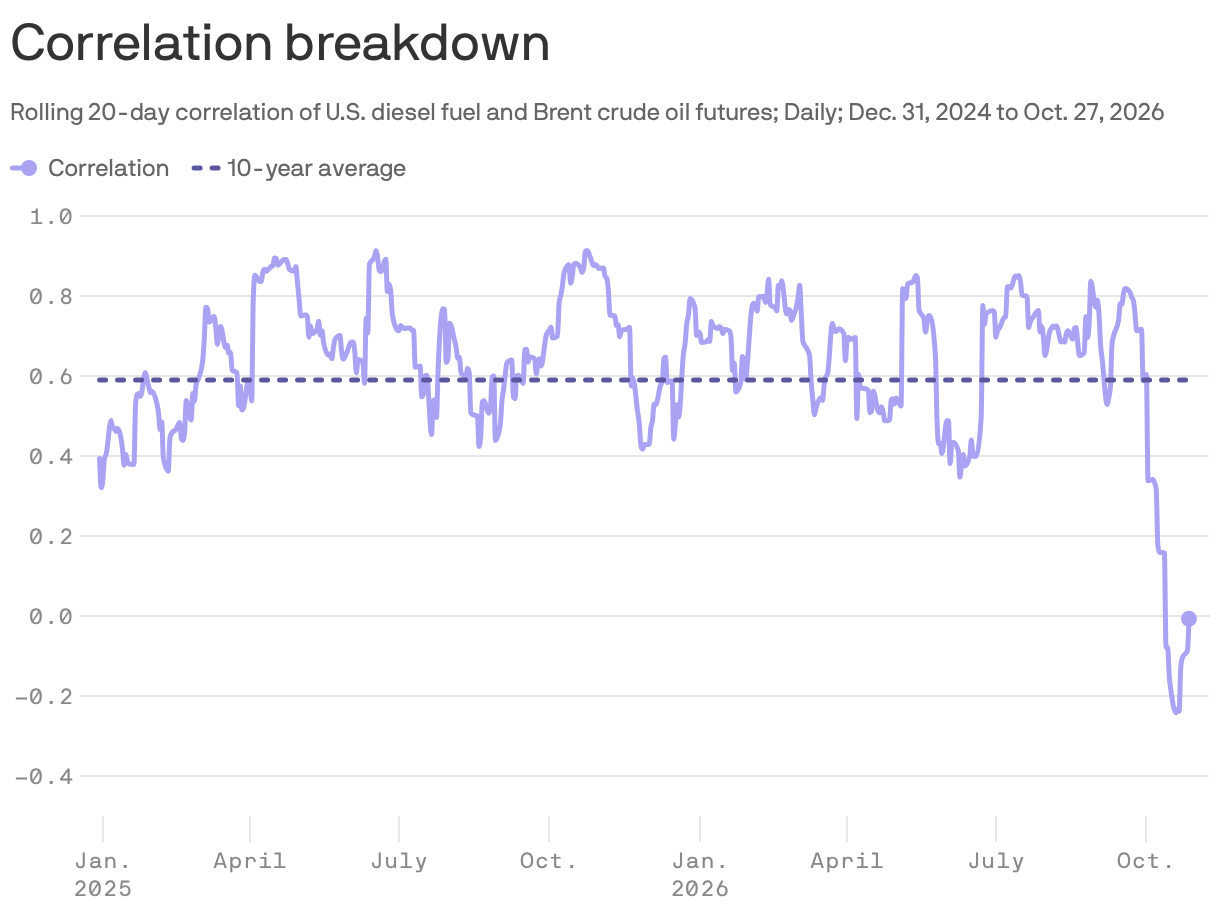
U.S. diesel futures registered a muted response to yesterday's tumble in global crude oil prices, with the suddenly politically salient price of the industrial fuel still up more than 100% from the end of 2025.
Why it matters: It shows that the destruction of global refining infrastructure, rather than shortages of crude oil, is driving sky-high diesel prices.
By the numbers: Analysts often examine the relationships between different market prices by looking at changes in their correlations: that is, the tendency of the prices of certain assets to rise or fall in lockstep.
- A correlation reading of 1 indicates that the prices always move the same way, while a correlation of -1 indicates that they always move in the opposite direction.
- You can see in the chart above that the short-term (20-day) rolling correlation of benchmark U.S. diesel futures to futures prices on Brent crude oil — the global petroleum benchmark — has vanished over the last couple months.
Catch up quick: Iran's attacks on refining infrastructure around the Persian Gulf in response to the joint U.S.-Israeli attacks and Ukraine's campaign of drone strikes against Russian refineries.
- Both have sharply reduced the ability of these two regions to ship diesel to the global market, driving up prices worldwide.
What they're saying: "While global diesel prices have eased from the all-time highs of more than $200 per barrel reached in September, benchmarks remain nearly double the price of crude oil and their pre-crisis levels," International Energy Agency analysts wrote in their October oil market report.
- "Record diesel prices are already having broad economic consequences by raising the cost of goods and impacting real incomes, economic activity, and inflation."
What we're watching: The headlines, for any indications about the odds of fierce fighting between the U.S. and Iran to start once again.
Axios Markets