
Axios Markets

October 07, 2022
👋 Oh hey. It's Jobs Friday! Later this morning, we'll get the September report. Will it be the dream scenario our friends at the Axios Macro newsletter outlined? Stay tuned. But first, let's talk taxes...
Heads up, we're off on Monday but back in your inbox on Tuesday. Today's newsletter is 1,063 words, 4 minutes.
1 big thing: Inflation could lower your taxes

Illustration: Natalie Peeples/Axios
Inflation adjustments are kind of sexy again, after years of not mattering much. The cost of living adjustments the IRS makes for 2023 are expected to be higher than they've been in decades — and could lower your taxes next year, Emily writes.
Why it matters: Cost of living adjustments, or COLAs, on taxes, Social Security payments and wages were barely noticed in the era before high inflation, but are now crucial for Americans coping with record price increases.
- Yes, but: Not all salaries get COLA'd, and many taxes and deductions aren’t inflation adjusted. The tax code is a bit of a mishmash.
- "These inflation adjustments can hardly be called a silver lining, as Americans are paying more for everything from housing to food and energy," the WSJ pointed out in a story about the changes.
What's happening: The IRS adjusts tax brackets every year to ward off "bracket creep" — when your salary rises to keep up with inflation, propelling you into a higher tax bracket.
- This is easy to understand if you go back and look at salaries from decades ago. Say the IRS tax brackets were still set at a 1980 level, then someone earning $34,000 a year — a tidy sum at the time — would face a 49% tax rate. That would be considered extremely regressive in 2022.
- Congress codified the annual inflation adjustments as part of the Reagan tax cuts in 1981. Before then, a period when inflation was high, brackets weren't adjusted.
State of play: Likely at the end of October or in early November, the IRS will announce the 2023 adjustments. Kyle Pomerleau, a senior fellow at the American Enterprise Institute, has already put out his estimates:
- The upper limits on tax brackets should go up by about 7%, he estimates. For example, in 2022, the 24% tax bracket maxed out at $89,075 — but in 2023, that should adjust to $95,375, he estimates.
- Separately, the IRS will also inflation adjust the withholding tables used by employers to calculate payroll deductions.
The impact: Taken together, these changes could mean more take-home pay even if your salary doesn't change from December 2022 to January 2023, (assuming no other changes to their withholding).
Other inflation adjustments of note: The standard deduction is expected to rise to $13,850 for single tax filers, up from $12,950, according to Pomerleau's math. The gift tax exemption moves to $17,000 from $16,000. The amount you can put into your retirement accounts will also increase.
- Not adjusted: The $10,000 cap on the popular state and local tax deduction won't change. Neither will the child tax credit. If Congress doesn't do anything, inflation will slowly erode away those tax breaks.
What to watch: The inflation adjustment on Social Security for next year is expected to be 8.7% — the highest since 1981, according to an estimate from the Senior Citizens League.
- That adjustment is expected to be announced next week after the September consumer price index numbers come out.
2. Catch up quick
3. RIP declining gas prices


Gasoline futures prices have started to rise again after the global oil cartel led by Russia and Saudi Arabia vowed to cut production, Matt writes.
Why it matters: If sustained, wholesale gas prices could lead to an uptick in consumer prices, reinvigorating inflation as a political issue.
Driving the news: A key U.S. wholesale futures price for a fuel known as RBOB — a kind of unfinished gas that's blended with ethanol before being sold to consumers — is up more than 13% this week, to roughly $2.70 a gallon.
- The trajectory implies consumer prices will increase in the weeks to come. The national average is just shy of $3.90 according to AAA.
Yes, but: That's still much lower than the record-high prices of more than $5 a gallon we saw over the summer.
- Still, it's unhelpful to the White House, which has pointed to the decline in consumer gasoline prices as a modest victory in recent months — and to the Federal Reserve, which continues to fight overall inflation with interest rate hikes.
The bottom line: The market reaction to the production cut news has been somewhat muted, amid growing concerns that the global engine of economic growth and oil consumption — China — is struggling mightily, weighing on demand.
- The White House's willingness to tap the Strategic Petroleum Reserve to counter price spikes also appears to have insulated the market.
4. Keep an eye on this index


Economic data points keep telling us that supply chains are loosening up — take the latest edition of a New York Fed index that came out yesterday, Axios’ Kate Marino writes.
The big picture: Using measures like PMI surveys, and shipping and air freight costs, the New York Fed’s Global Supply Chain Pressure Index says pandemic-era bottlenecks have eased to just a fraction of what they were late last year.
- An index created by RSM said so as well, as of August.
What’s next: When Q3 earnings season kicks off in a few weeks, we'll hear from a slew of the large companies that rely on these transport networks.
- Executives will tell us how these conditions are actually playing out on the ground — and in the water and air. Importantly, easing supply shortages could eventually help take some pressure off our red-hot inflation.
5. The trains are half-empty
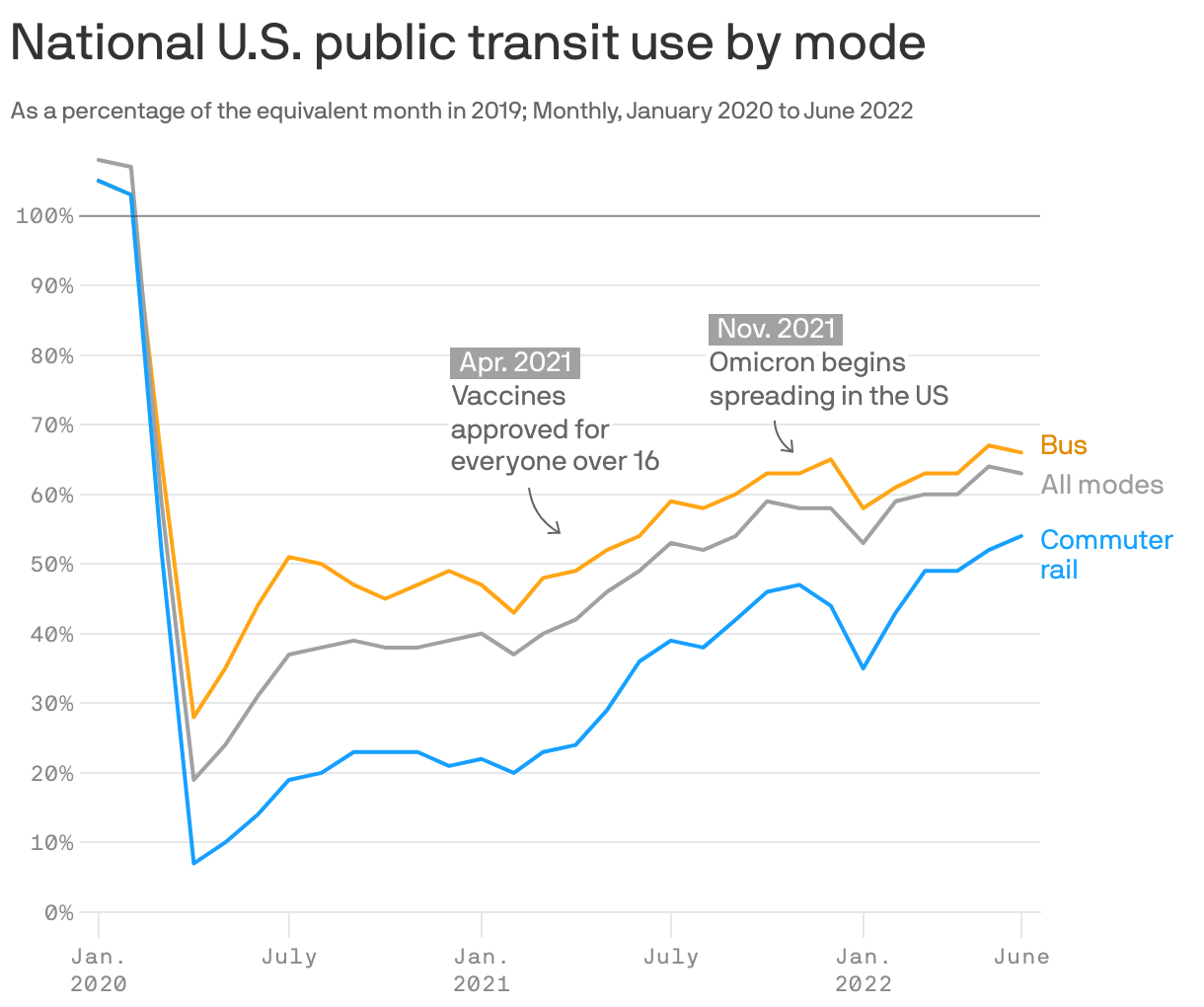
The rise of remote work so far means the fall of the commuter rail.
- Commuter trains are nowhere near back to where they were before COVID, reports Axios' Joann Muller.
- But bus ridership is in better shape, likely because workers who take buses are typically lower-income and less likely to have jobs they can do from home.
💭 Emily's thought bubble: There's a commuter parking lot near my house in Westchester that sits nearly empty now. It was a spillover lot that desperate locals had used as a last resort because the good lot had a waiting list.
- Now that my neighbors and I can work remotely, we don't need to brave it any longer.
- So, it's good for us. But what that will mean for the health of the transit system is an open question.
🎧 Out now: "Musk offers to buy Twitter (again)." This week, Elon Musk again offered to buy Twitter for the same price he originally offered in April. Sara Fischer and Dan Primack break down why it matters on the Axios podcast "How it Happened." Listen.
Was this email forwarded to you? Sign up here!
Today's newsletter was edited by Kate Marino and copy edited by Mickey Meece.
Sign up for Axios Markets

Stay on top of the latest market trends and economic insights
