Axios Markets

November 01, 2022
🍫Oh, hey. It's Emily. Working off a serious candy hangover, but here for you nonetheless, dear readers.
Today's newsletter is 1,079 words, 4 minutes.
1 big thing: Pay transparency is catching on

Illustration: Brendan Lynch/Axios
Get ready to learn a whole lot about how much companies pay their workers. Starting today, New York City employers must disclose salary information in job ads, thanks to a new pay transparency law that will reverberate nationwide, Emily writes.
Why it matters: This isn't just a Big Apple thing. Pay transparency is catching on around the country, as part of a push to shrink gender and racial pay gaps. It's upending the way companies handle compensation, and how employees and job candidates negotiate for more money.
- California's pay transparency law takes effect in January — meaning two of the nation's biggest job markets will also be the most transparent.
What's happening: Employers have spent months getting ready for this. They'll now have to post salary ranges for open roles — but many didn't have any established pay bands at all, says Allan Bloom, a partner at Proskauer who's advising companies.
- Already, firms like American Express, JPMorgan Chase and Macy's have added pay bands to their help-wanted ads, reports the Wall Street Journal.
How it works: Companies with more than four employees must post a salary range for any open role that's performed in the city — or could be performed in the city.
Zoom out: In a world where salary information is secret, employers have the upper hand.
Reality check: It's a pretty squishy requirement. The law requires only that salary ranges be in "good faith" — and there's no penalty for paying someone outside of the range posted.
- It will be difficult for enforcement officials to prove a salary range is in bad faith, Bloom says.
- Many of the ranges posted online now are pretty wide. A senior analyst role advertised on the Macy's jobs site is listed as paying between $85,320 and $142,080 a year. A senior podcast producer role at the WSJ advertises an "NYC pay range" of $50,000 - $180,000.
Meanwhile, there are other, more hidden ways companies can discriminate in compensation — such as the issuance of stock options or bonuses.
💭 Emily's thought bubble: When presented with a range, job candidates often only see the top number, recruiters have long told me. Posting these bands opens the door for higher expectations from candidates and current employees, who will want to earn the max.
The bottom line: More sunlight is a good thing for workers and likely could help reduce pay inequities — especially around lower-level roles that don't involve stock-based pay.
- Employers, meanwhile, should brace for pushback and questions from current employees looking to get a raise.
2. Catch up quick
🏥 Johnson & Johnson in $16.6 billion deal for Abiomed. (CNBC)
📚 Judge blocks $2.2 billion merger of Penguin Random House and Simon & Schuster. (Axios)
⬇️ 2022 is looking unhappily like 2000 for the tech industry. (Axios)
📈 BP posts $8.2 billion profit and expands share buybacks by $2.5 billion. (Reuters)
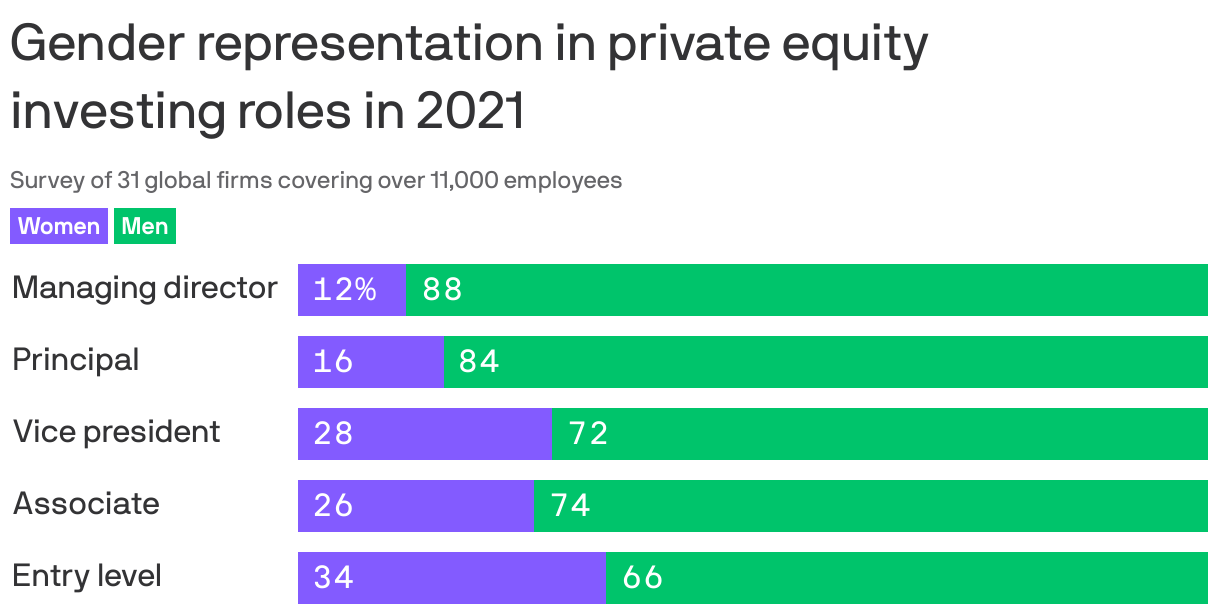
3. Charted: Women in private equity

Women land 48% of entry-level roles in private equity, finds a new report. So you'd think the industry was nearing parity. Think again, Emily writes.
The big picture: The percentage of women in private equity who hold investing roles at these firms is much lower (see the chart above), according to data out this morning from McKinsey & Co.
Why it matters: Investing is where the power lies. Investing staff make the decisions on where firms allocate capital, explains David Baboolall, an associate partner at McKinsey and coauthor of the report.
- "[I]n PE firms — and many other private market firms — an unspoken hierarchy often exists," with investing roles on top, the authors write.
- "These are the people who make the real money," notes Axios' Kia Kokalitcheva. "Senior investors get bigger allocations than junior, and certainly more than non-investor employees."
- The imbalance keeps pay gaps wide (no matter the level of transparency).
Key point: At the top of the PE hierarchy is the investment committee — "the intellectual backbone of PE firms," the report argues.
- Women make up only 9% of investment committee members, McKinsey found. Women of color hold only 1% of those roles.
By the numbers: McKinsey surveyed 31 private equity firms and 11 institutional investors, and more than 300 PE employees answered questions about their workplace experience.
- People of Asian descent hold 28% of all associate-level investing roles, but the number drops to 12% at the managing director level.
- Black and Hispanic investing professionals are at 3% and 4%, respectively, in investing roles. Those numbers are constant across all levels, with no drop-off.
What to watch: Institutional investors, which PE firms raise capital from, told the consultants that they'd be more apt to invest their money with firms that are diverse.
4. Charted: Earnings peak


Wall Street analysts expect profits for companies in the S&P 500 — which grew to record heights in the pandemic era — to slip over the coming year, Matt writes.
Why it matters: Despite a better-than-expected third quarter, executives are not projecting a whole lot of confidence about the coming year.
State of play: About 70% of companies that have reported Q3 numbers have beaten analyst expectations.
- Yes, but: That's below the 77% average over the last five years, according to FactSet.
5. 💭 Quoted: "War profiteering"

Photo by Drew Angerer/Getty Images
"It’s time for these companies to stop war profiteering, meet their responsibilities to this country, give the American people a break and still do very well."— U.S. President Joe Biden
Why it matters: The president's description of the record profits posted by energy companies in recent weeks as "war profiteering" represents a noticeable uptick in rhetorical pressure from the White House, Matt writes.
- Driving the news: At a news conference yesterday afternoon, Biden once again urged oil companies to boost production in order to lower oil prices and floated the idea of a windfall profit tax if they failed to respond.
The big picture: While U.S. companies arguably have the ability to raise oil and gas production, they've been relatively slow to respond to surging prices.
- Instead, they've focused instead on "capital discipline" — that is, not overspending to boost production — and returning cash to shareholders.
- This makes some sense, as the industry has suffered repeated booms and busts over the last decade — including during the early days of the pandemic — leaving investors with pretty rotten returns.
💭 Our thought bubble: The White House seems to think the threat of a tax increase could prod increased output. But carrots — in the form of some sort of government subsidy to incentivize production — may be required in addition to that potential tax-related stick.
🩸1 thing Matt loves: The Anglo-Saxons called November the “blood month,” as it was the time that you’d slaughter animals for the winter food supply. Let’s hope that’s not an apt description of the stock market over the coming weeks.
Was this email forwarded to you? Sign up here!
Today's newsletter was edited by Kate Marino and copy edited by Mickey Meece.
Sign up for Axios Markets

Stay on top of the latest market trends and economic insights