Axios Markets

November 25, 2026


1 big thing: 😑 The bond market never bought it
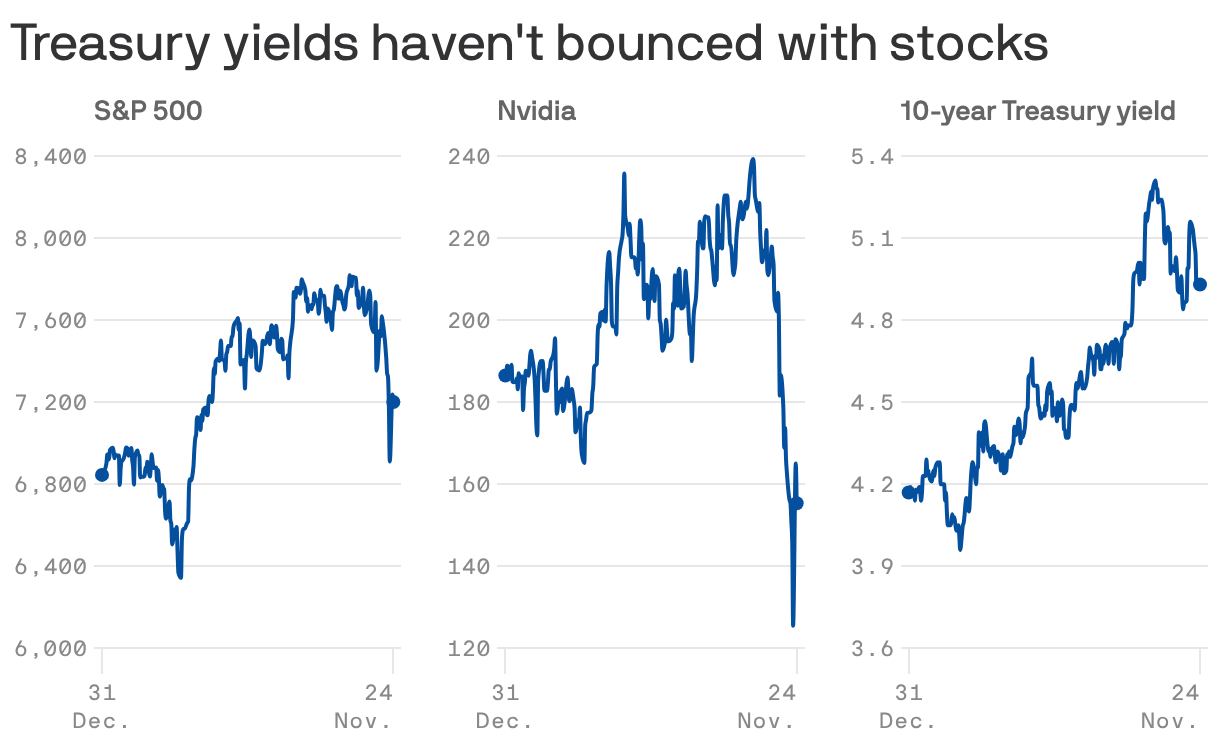
While stock market participants were wildly celebrating the return of Huang to the corner office of Nvidia, bond investors were playing it cool.
Why it matters: That jarring contrast at the start of the week was what poker players might call a "tell" — showing that concerns about the financial realities of the AI boom continue to gnaw at investor confidence.
Catch up quick: AI-related stocks — neoclouds, server makers, optical cable-smiths, memory chip mavericks and hyperscalers — tumbled again yesterday after Monday's remarkable rip.
- Nvidia, which jumped 31.5% Monday, gave back a chunk yesterday with a 5.9% drop.
The big picture: When it becomes difficult to discern a clear signal from such Wimbledon-worthy back-and-forth in stocks, it can be helpful to check how the bond markets see things.
Zoom in: Normally, on a day when the S&P 500 is up almost 5%, as it was Monday, you see money leave the safety of bonds to join the party, pushing bond prices down and bond yields — they move in the opposite direction — up.
- But in the government bond market, the yield on the U.S. 10-year Treasury note, for example, moved higher by less than a single basis point. (That's bondspeak for one one-hundredth of a percentage point.)
- In the corporate bond market, meanwhile, there were no signs that traders were feeling as exultant about Huang's return and what it meant to the AI trade.
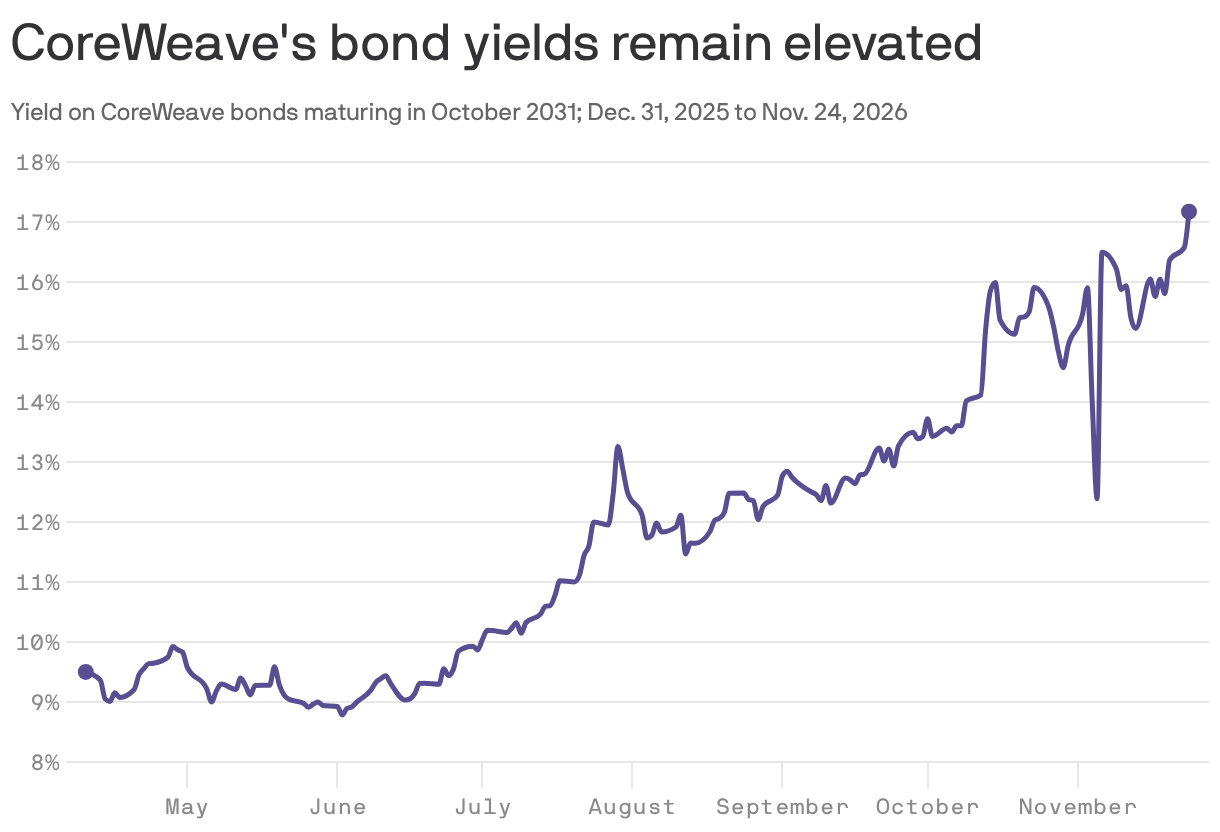
Case in point: Just look at CoreWeave. The troubled neocloud's stock price soared 22.3% Monday, but the price of its bonds coming due in 2031 actually fell, pushing yields up 20 basis points to 16.57%, according to Tradeweb data. (That suggests traders were viewing those bonds as even riskier, despite all the happiness in the stock market.)
- CoreWeave's bond yields continued to push higher yesterday, clearing 17%.
What they're saying: The bond market's concern is specifically about AI and how much more bond market borrowing will be needed to keep the build-out going.
- "Credit investors are paying for diversification away from AI-related debt," wrote Lotfi Karoui, a multi-asset strategist at the giant money management firm Pimco.
How it works: Stocks represent an ownership share in a company. But bond investors own debt, not companies. That is, they effectively lend companies money in the hope of getting paid back with interest.
- This fundamental fact has been said to shape the profoundly different character of the two markets.
- Stock markets are often said to be overly excitable and prone to become enamored with overly rosy visions of the future and of the profits a company could make.
- Bond investors, by contrast, are more concerned with downside risk, that is, what could drive a company into default and keep investors from getting paid back.
- They're not focused on the long-term upside of a company because after they get their interest payments and capital back, they won't benefit from the company's bright future.
The bottom line: The fact that down-to-earth bond investors stayed relatively leery of AI exposure, even as stocks soared to start the week, also helps explain why Monday's big rally fizzled the next day.
- Huang's return as Nvidia CEO does nothing to resolve the questions of financial sustainability and profitability that are increasingly nagging at investors four years into the boom.
2. 👑 All hail the dollar


Behold, the "superdollar!" The U.S. currency has soared back to levels last seen before the "Liberation Day" tariffs last year, when worries about the end of the dollar's dominance were driving the markets.
Why it matters: It's a win for Americans traveling abroad who get more bang for their buck, and it's a sign of American economic strength — even amid the recent turmoil in AI stocks.
The latest: The dollar index — which measures the buck against a basket of other currencies — hit a 20-month high this week.
Catch up quick: The AI boom has driven the dollar higher in two ways: by attracting foreign investors (who need dollars to invest) and by fueling economic growth and inflation, raising expectations for higher interest rates.
- Higher rates make it more attractive for investors to park money in dollars.
The intrigue: Now, even as the AI trade wobbles, investors are still expecting additional rate increases.
- Plus, with stocks weaker, investors are also seeking safety in safe-haven assets like — you guessed it — the dollar.
Reality check: To be sure, a stronger dollar isn't all good. It makes American exports more expensive and cuts against the White House's ambitions to revive manufacturing.
- "A weak dollar makes you a hell of a lot more money," President Trump said last year.
What to watch: The "AI dollar" is alive and well, Deutsche Bank strategists recently wrote. They reversed their earlier prediction that 2026 would be a weak dollar year and said the trend would continue into the first half of next year, titling the research, "2027 Outlook - Superdollar?"
Yes, but: The strong dollar may not last much longer, says Thierry Wizman, global FX and rates strategist at Macquarie Group.
- Eventually the stumbling AI trade is likely to slow the economy overall, and at that point the Fed may back away from its hawkish stance.
- "This is not going to last," Wizman says.
Axios Markets