Axios Markets

December 01, 2023

1 big thing: Women's stunning opt-in revolution
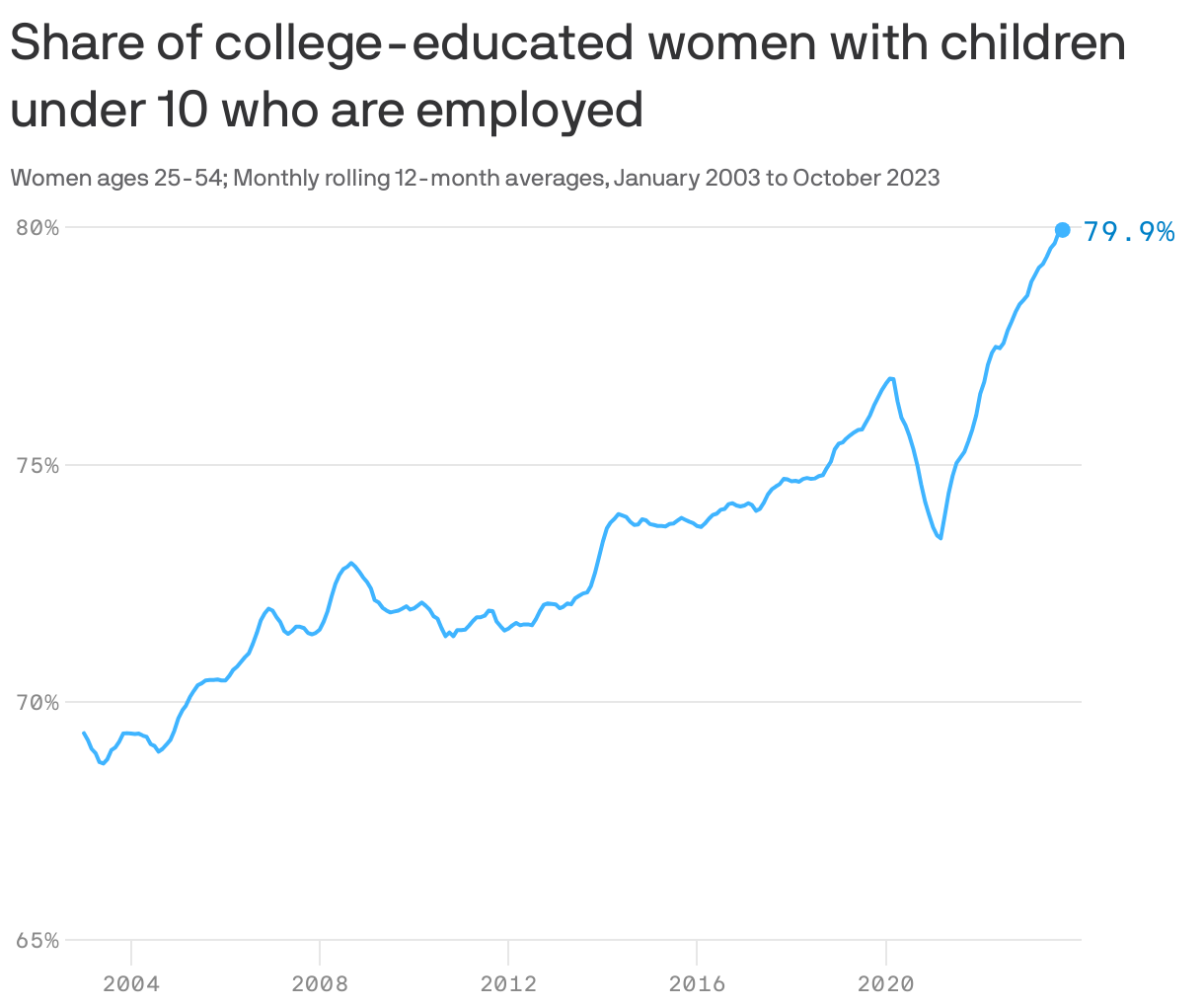
College-educated mothers stampeded into the workforce over the past 20 years, Emily writes from a striking new paper.
Why it matters: No one expected this. Back in the 2000s, the big worry — epitomized in a 2003 New York Times article called "The Opt-Out Revolution" — was that high-achieving women were having kids and leaving the workforce.
- (The mothers in your local Starbucks watching over toddlers? They have MBAs, wrote Lisa Belkin — setting off a wave of early aughts hand-wringing about feminism.)
Driving the news: Since then there's been a 10 percentage point increase in the employment rate of college-educated women with young children, finds research from Penn Wharton Budget Model at the University of Pennsylvania.
- "You don't often see such striking trends in labor data," said lead researcher Alexander Arnon.
State of play: In the current post-pandemic "she-covery," the influx of women into the labor market grabbed a lot of attention (including from your humble newsletter writer), and rightly so — you can see the line surge up and to the right in the above chart.
- But this new research digs deeper and finds that the post-pandemic labor market accelerated a phenomenon already underway for decades — though only for college-educated women.
The big picture: This is about big cultural changes. It's become far more socially acceptable — expected even — for women to keep working after having kids.
- That's one reason the share of prime-age women (age 25-54) with a college degree has soared over the past 20 years to more than 45% from less than 30%.
- Since those with college degrees are more likely to work than those without, this raised the overall employment rate of prime-age women by 2.7 percentage points since 2000, per Penn.
- Meanwhile, Arnon pointed out, even before the pandemic juiced workplace flexibility for office workers to the nth degree, advances in tech made office work far more flexible.
Reality check: Mothers without degrees have seen progress stall out. In part, that's because it's harder to manage children with the kinds of jobs that don't require college — typically less flexible shift work where you can't run out to deal with a kid's doctor appointment or leave early for a soccer game. It could also be a choice to stay home.
- Those jobs are also often without the kind of benefits (maternity leave, sick leave) that keep women attached to the workforce.
- And women still lag behind men, of course: 95.4% of prime-age, college-educated men with young kids were employed in September 2023, compared with 96.6% in 2003.
The bottom line: Turns out some women can have it all — as stressful as that might be.
2. Catch up quick
3. Pending home sales near record low


Pending home sales just hit their lowest point in history, outside the first months of the COVID crisis when the economy nearly ground to a halt, Matt writes.
Why it matters: Pending home sales, or deals that have gone into contract, are a leading indicator for activity in the U.S. housing market.
- The October data means that actual home sales, which are also near record lows, will continue to be sluggish for the next few months.
What we're watching: The 30-year fixed mortgage rate declined sharply in November, so that could entice a few more buyers back into the market.
- The average mortgage is now at about 7.2%, after stretching toward a sky-high 8% in October.
4. 🤷🏽♂️ OPEC+ cuts production, market shrugs


OPEC+, led by Saudi Arabia and Russia, announced new cuts to oil production Thursday, as the cartel seeks to prop up falling prices, Matt writes.
Driving the news: The 13-nation Organization of the Petroleum Exporting Countries and its ally Russia agreed to cut an additional million barrels a day of oil production.
Yes, but: The oil market shrugged off the effort to strengthen prices — oil benchmarks in the U.S. and worldwide fell.
- "The cuts are short-term, for now, and only valid for the first quarter of 2024. Second, and most importantly, the group failed to agree to a strategy unanimously and had to rely on voluntary unilateral cuts instead," wrote analysts with research firm Rystad Energy.
💭 Matt's thought bubble: Both Saudi Arabia and Russia — especially after it started its war against Ukraine — have become increasingly reliant on China as the key buyer for their petroleum exports.
- China's economy appears to be in deep trouble, with expectations for growth, and thus oil consumption, falling fast.
The bottom line: OPEC+'s focus on China — arguably the weakest of the world's major economies — may be limiting its ability to influence global oil prices.
5. The more you have, the more you need
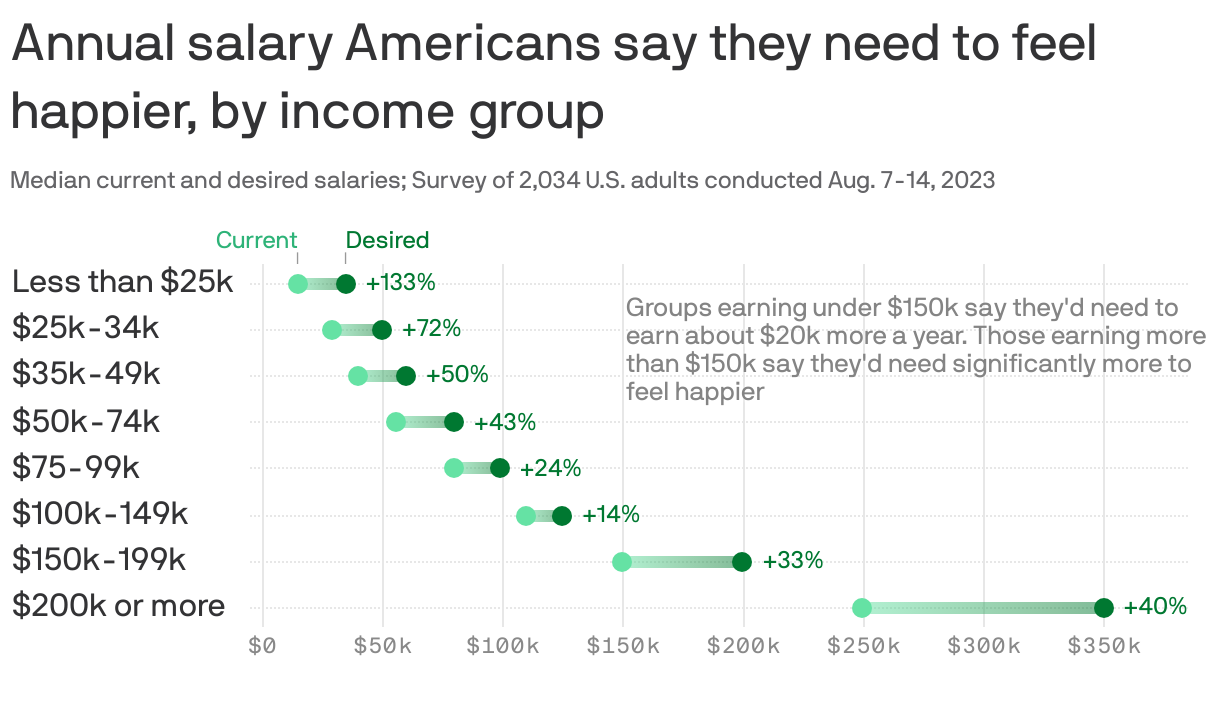
The American mood's been pretty low lately, but you know what might make people happier? Money.
Driving the news: In a recent survey, when asked if money can buy happiness, 59% of respondents said "yes." For millennials, the share was highest at 72%, Emily writes.
Zoom in: Respondents were asked what salary they would need to feel happy and less stressed.
- It's a relative assessment. Those earning more than $200,000 a year needed a salary of $350,000; while folks at the bottom of the income scale said $33,250 a year would do the trick.
Axios Markets

Stay on top of the latest market trends and economic insights