Axios Markets

October 29, 2024

1 big thing: New era of too much oil

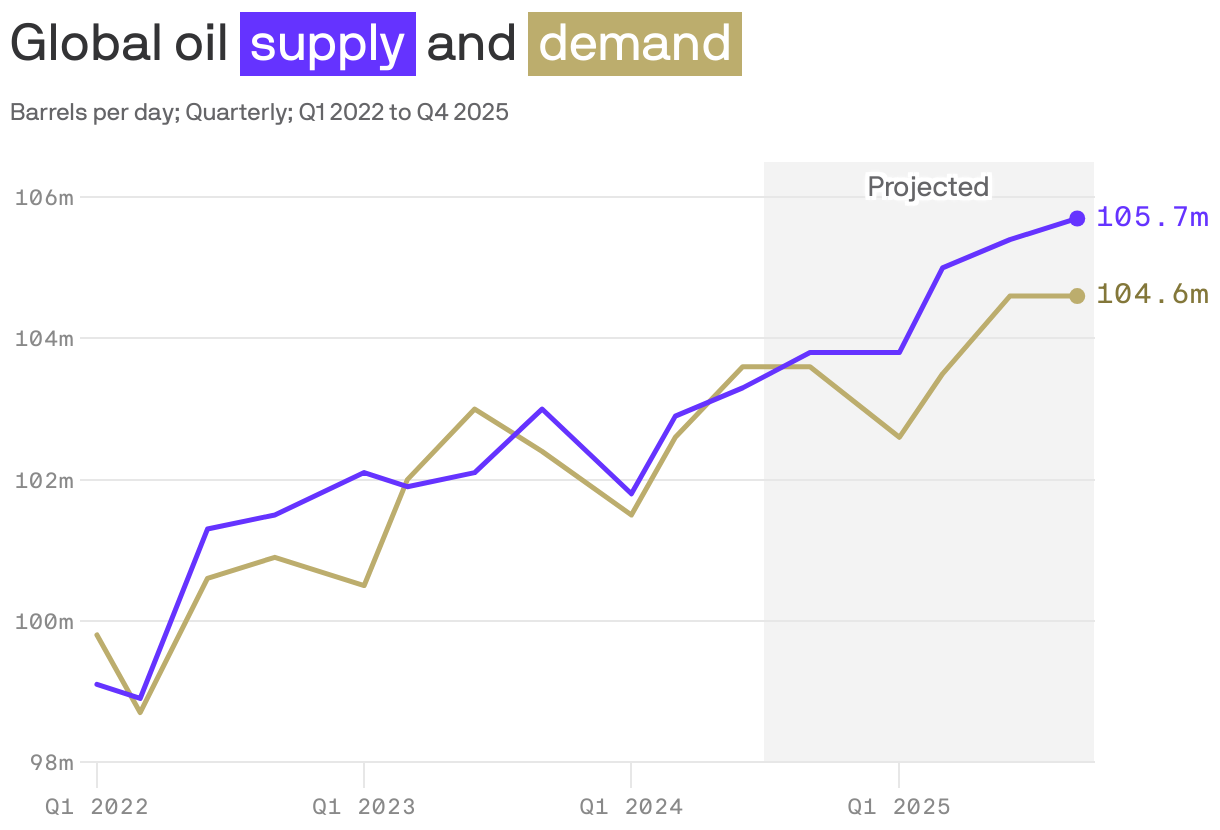
In a world where crucial resources — workers, electricity, housing and more — are in short supply, the globe is expected to have an abundance of at least one commodity: oil.
Why it matters: This new reality might keep a lid on consumer energy prices even as geopolitical strife intensifies. It could also wreak havoc on the longstanding economics that underpin oil production.
The big picture: New forecasts from the World Bank show an oil glut next year with a supply-demand gap that's been this large only twice before. A collision of trends explains why.
Green transition: Once-insatiable appetite for oil is muted as more consumers begin to pivot from gas-powered cars.
- In China, electric and hybrid vehicles made up half of monthly car sales over the summer for the first time.
- Government subsidies make China-produced EVs cheap and more appealing to consumers (though other countries are making them pricier to import).
Slower growth: The global economy is not the growth machine it once was. That blunts oil demand.
- Growth in five years is expected to be 3.1%, the lowest in decades, according to the International Monetary Fund.
- That reflects weak growth outlooks in Latin America and Europe and, perhaps most importantly, China, where a historic growth slowdown is already underway.
U.S. as a top producer: In the past decade, America has emerged as a major oil producer — helping add to global supply. Former President Trump, if elected, has promised to increase oil production further.
- The U.S. produces more crude oil than any nation ever has — last year was the sixth straight period that has been the case, according to government data. Guyana is also a newly significant contributor.
- OPEC+, the cartel of oil-producing nations, does not plan to start unwinding production cuts until December.
By the numbers: Next year, global oil production is expected to exceed demand by an average of 1.2 million barrels per day, according to the World Bank's annual Commodity Markets outlook. That supply-demand mismatch has rarely been exceeded.
- The last time was in 2020 when the world entered pandemic lockdown and economic activity — and, in turn, demand for oil — ground to a halt.
- Before that, there was the oil price crisis of 1998 when demand stagnated on the back of crises around the world.
Yes, but: Conflict in the Middle East has contributed to recent oil price volatility.
- The World Bank modeled what might happen if conflict there escalated and reduced the global oil supply by 2 million barrels per day by the end of 2024 — similar to the disruption seen during the Iraq War in 2003.
- In that case, the researchers say oil prices might initially surge, but that spike might be short-lived: Other countries unaffected by the conflict would step in and boost production.
The bottom line: "The good news is that the global economy appears to be in much better shape than before to cope with a significant oil shock," World Bank deputy chief economist Ayhan Kose said in a release.
2. The vibes out of Michigan are off
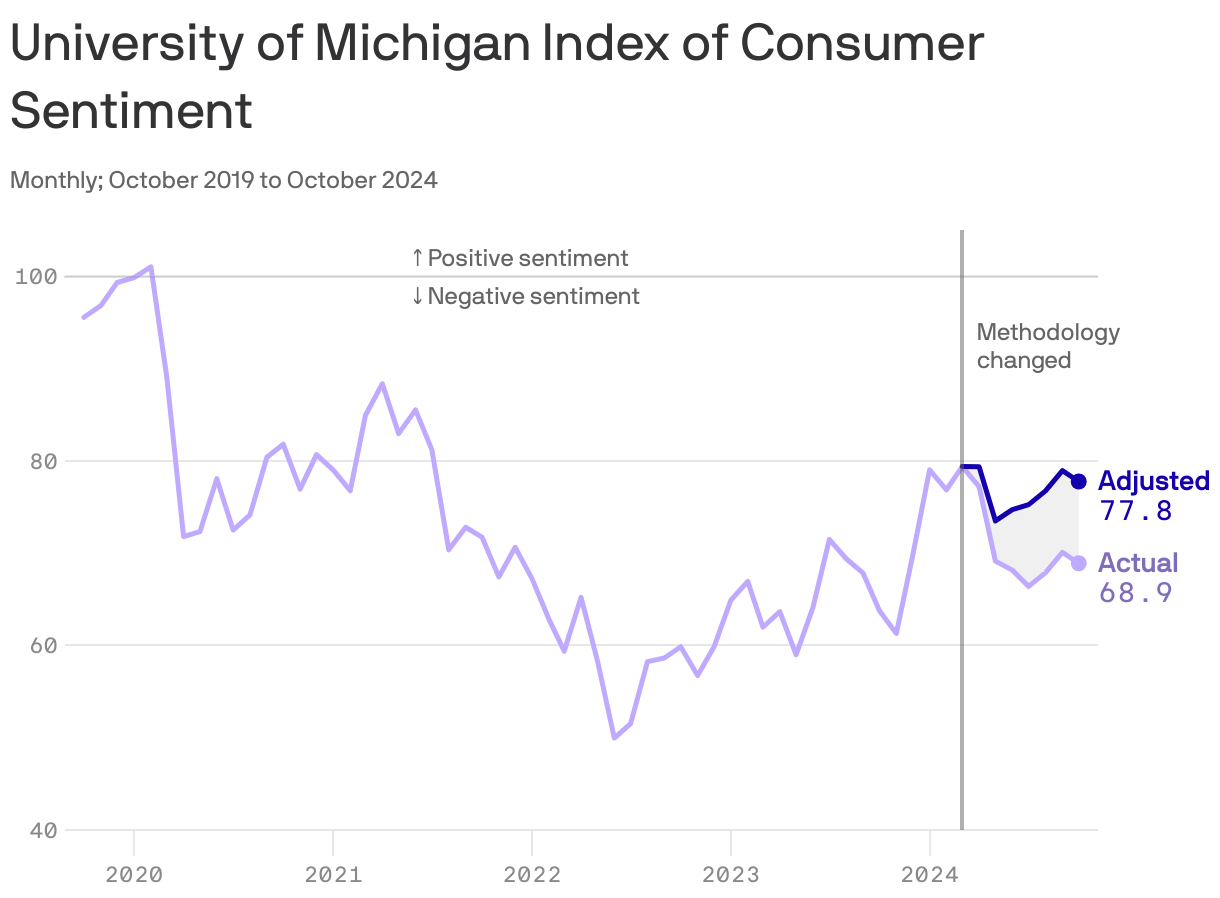
The Index of Consumer Sentiment has been meaningfully lower since the spring because of a change in survey methodology, finds a new analysis.
Why it matters: One of the most closely watched measures of consumer sentiment — aka the vibes — would seem a little less terrible if not for this change.
- That's a big deal in an election year that hinges on voters' perceptions of the economy.
Catch up fast: In April, the University of Michigan began moving from surveying respondents by phone to an online method. By July, it was fully online.
- "After this change, there was a bit of a drop in University of Michigan sentiment, something that we didn't see in other consumer attitude surveys," says Ernie Tedeschi, director of economics at the Yale Budget Lab.
- He wrote the analysis with Ryan Cummings, an economist at the Stanford Institute for Economic Policy Research.
By the numbers: The switch led to a nearly 9-point decline in sentiment, even after adjusting for differences in the demographics of phone and online respondents.
- They recommend that Michigan adjust its measures to account for this, but the school doesn't plan on it.
Zoom in: The university's analysis produced similar findings: a 6.6-point difference.
- "We wanted to be as transparent as possible," says Michigan's survey director Joanne Hsu. The university has no objection if users want to make their own adjustments, she says. They don't feel it's necessary.
Between the lines: In an election year, making further adjustments to how the index is measured in order to account for the online shift could've driven a lot of attention and controversy — especially since that could be viewed as favoring one side.
- It's possible that Michigan didn't want to step into that thicket. Hsu declined to comment.
The big picture: Before the pandemic, consumer sentiment roughly tracked economic indicators like the unemployment rate, GDP and inflation.
- That link is broken now.
The new analysis of Michigan data doesn't much change that broader story, both Hsu and Tedeschi point out.
- Even with their adjustment, Michigan's sentiment index is tracking lower than you'd expect given current economic conditions.
3. Online polling's negative tilt
Axios Markets
