
Axios Markets

November 14, 2023
π Hi and welcome back! We're just out here living our normal lives, like the future Mrs. Bezos.
Situational awareness: UAW president Shawn Fain will tell a Senate committee this morning about the auto union's next push. "We are organizing like hell to help thousands of autoworkers in this country, primarily in the South, to win their union," per prepared testimony.
Today's newsletter is 1,089 words, 4.5 minutes.
1 big thing: Basel Endgame vs. Republicans
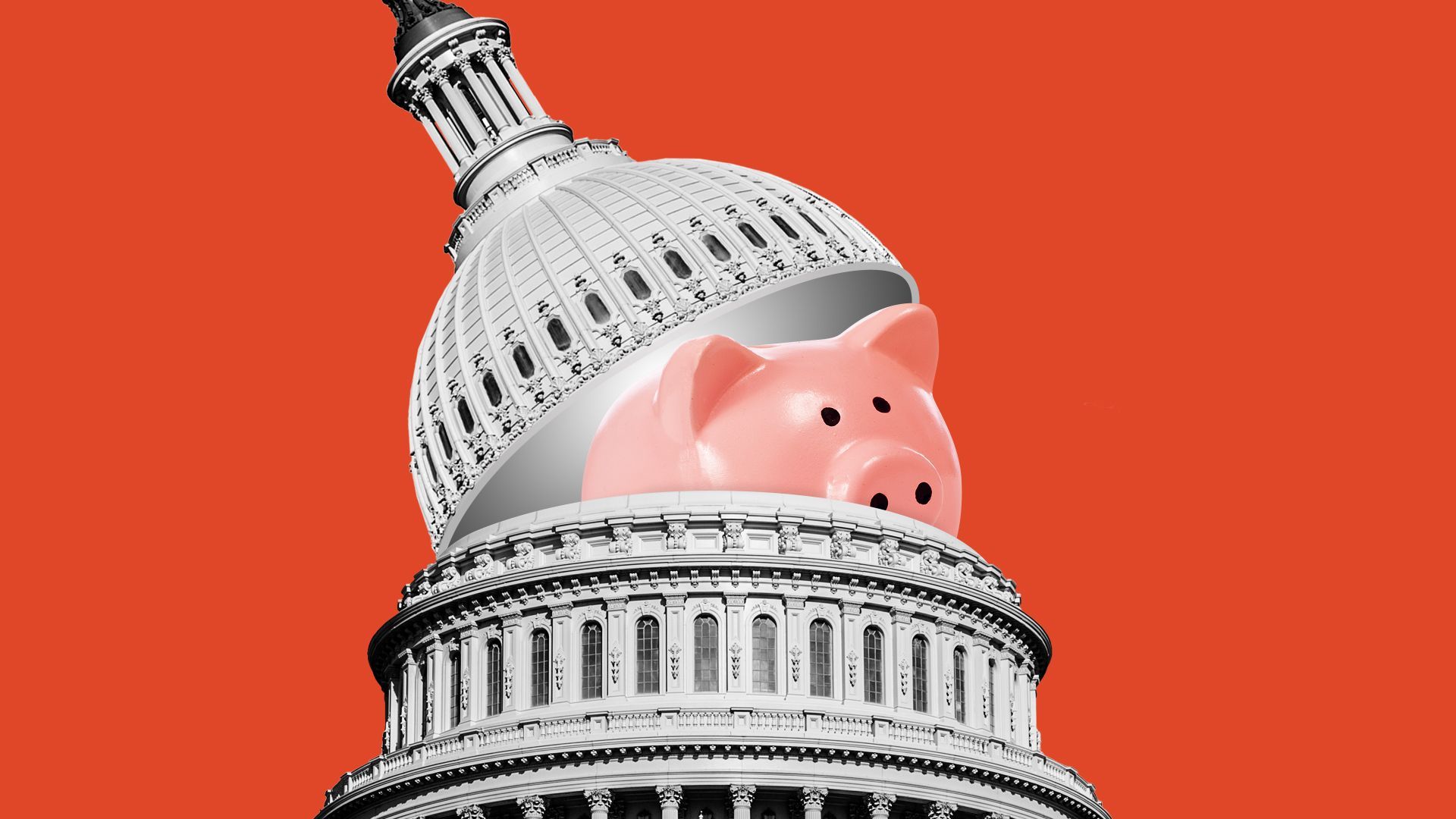
Illustration: Natalie Peeples/Axios
As top bank regulators prepare to testify in front of Senate and House committees today and tomorrow, they're going to face sustained opposition from Republicans who want to kill their plan to increase bank capital requirements, Axios' Felix Salmon writes.
Why it matters: The nitty-gritty of bank regulation has historically been dominated by technocrats rather than by elected politicians. This time seems like it might be different.
The big picture: The last big change to global bank regulation, Basel III, took place in the aftermath of the global financial crisis of 2008-09.
- Given the degree to which the crisis was caused by excess leverage and risk-taking at financial institutions, not to mention the billions that governments spent bailing out banks, there was little political appetite to oppose tougher bank regulation.
- Domestic political attention was also focused on the Dodd-Frank regulatory reforms, which required congressional approval, rather than on meetings 4,000 miles away in Basel, Switzerland.
Where it stands: The latest effort to derisk the banking system, dubbed Basel Endgame, has become much more politicized in the U.S.
- In September, all of the Republicans on the House Financial Services Committee sent a letter to the Fed urging that its Endgame proposals be withdrawn.
- On Sunday, nearly all of the Republicans in the Senate followed suit with a letter making almost identical demands.
What's new: The Republican letter leans strongly into a new talking point from the banking lobby, that the rules would hurt everyday Americans.
- "As proposed, Basel III will restrict billions of dollars in capital from those who need it most, resulting in costlier and more limited access to credit for millions of Americans," says the letter.
- A new ad campaign from the Financial Services Forum, and a lobbying effort from Center Forward, are making similar points.
Between the lines: Very broadly speaking, the Fed's plans both in Basel III and in Basel Endgame have been to raise the amount of capital ("equity") that banks have to hold in general and that too-big-to-fail banks have to hold in particular. The logic is that raising bank capital requirements is the easiest and most effective way to make banks safer.
- The greater banks' equity, the lower their profits become as a percentage of that equity. That's discomfiting for bank shareholders, who care very much about return on equity.
- Bank executives are answerable to their shareholders β and are often large shareholders themselves. The bank lobby therefore can be counted on to oppose any capital increase anywhere.
Be smart: The standard playbook when opposing an increase in capital requirements is to say that such requirements would make banks less competitive and credit more expensive. Sometimes, that's even true.
The bottom line: Republicans are now happy to align themselves with the banking lobby. That's a big change from where things stood in 2009.
2. π£οΈ Quoted: Why the banks were OK
"The U.S. Congress allocated trillions of dollars to support the banks and borrowers, and that's why the banks came out [of the pandemic] OK β because all of their borrowers were taken care of by the taxpayers. It's not because the banks had enough capital to withstand the losses themselves."β Minneapolis Fed president Neel Kashkari, speaking on the proposed Basel Endgame capital rules for banks, in an interview with Axios
3. Catch up quick
π Musk, Citi's Fraser among CEOs wooing China's Xi at APEC. (Bloomberg)
π Home Depot beats Q3 expectations but warns of declining sales. (MarketWatch)
π’οΈ Almost no Russian oil is sold below the $60 cap. (FT)
4. Bonus bummer on Wall Street


Bonuses for 2023 are expected to be down or flat across much of the finance industry compared with last year, according to projections released this morning, Emily writes.
Why it matters: It's the second year of declining bonuses on Wall Street, though this year's projections look far less catastrophic than 2022's.
- Though the much-anticipated recession hasn't yet materialized,Β the projections reflect a fairly meh year on Wall Street. Finance professionals struggled to adjust to the higher rate environment and, if you'll recall, dealt with a mini-banking crisis.
Zoom in: Overall, investment banker bonuses are projected to fall by as much by as much as 25%, according to Johnson Associates, a compensation consulting firm.
- Retail and commercial regional bank bonuses could see a 10%-20% decline.
- Other sectors were more mixed. Hedge fund bonuses could see anywhere from a 5% decline to a 5% increase; while private equity bonuses are projected to be flat.
- Wealth management was a bright spot.
- Last year, Wall Street bonuses saw their biggest drop since the Great Recession, according to state government data.
The bottom line: "Most Wall Street professionals will have to wait another year for a rebound in year-end bonuses," said Alan Johnson, the firm's managing director, in a statement.
5. Another big union has union troubles

Illustration: Shoshana Gordon/Axios
Labor unrest is so intense this year that even labor unions are facing internal staff rebellions, Emily writes.
Driving the news: The 48 employees who make up the field staff of the National Education Association, the teachers' union, voted unanimously on Monday to authorize a strike.
State of play: The NEA is the largest union in the country, representing about 3 million education professionals from pre-school to graduate school β has been without a contract since May 2023.
- The vote by the Association of Field Service Employees is the latest sign of the strong labor resurgence.
- The AFL-CIO is facing similar issues with the union that represents its staff, as we reported last month.
Where it stands: Unless the NEA and its staffers reach a deal this week, a two-day strike would begin Friday at midnight with a picket line in Atlanta at an NEA conference.
Zoom out: It's a busy time generally for the NEA βΒ there's an ongoing teachers' strike in Portland, Oregon, that staff members are working on. They're also working in Florida to fend off efforts to curb union power in the state.
What they're saying: The union is asking for raises to catch up with inflation over the past few years and says that the NEA hasn't made bargaining a priority.
- Staff is asking for the same kinds of benefits that they're going out and fighting for every day, LaToya Johnson, the staff union's bargaining chair, tells Axios.
- "The NEA is going to have to step up and honor the values of the organization," she says.
- "NEA has engaged in negotiations in good faith," a spokesperson said in an emailed statement. "[A]nd continues to apply a solutions-based approach to resolve the outstanding issues in a manner that addresses articulated priorities of AFSE while also balancing the strategic priorities of NEA and its members."
π Looking for a lunchtime plan tomorrow? Join Axios' Javier E. David and Nathan Bomey tomorrow at 12:30pm ET for a virtual event looking at the impact of AI tools on business. Register to attend virtually.
Was this email forwarded to you? Subscribe here.
Axios Markets is edited by Kate Marino and copy edited by Mickey Meece.
Sign up for Axios Markets

Stay on top of the latest market trends and economic insights