
Axios Markets

May 09, 2023
📕 🚀 Hello hello! It's Tuesday. Big day for Axios' chief markets wizard, Felix Salmon. His new book, The Phoenix Economy, is out today with a look at how the world has changed post-COVID. It's a rare optimistic take. Check it out.
Meantime, we've got all matter of news to dive into. Let's go!
Today's newsletter is 941 words, 4 minutes.
1 big thing: The Fed’s watching commercial real estate

Illustration: Brendan Lynch/Axios
Trouble in the commercial real estate sector — including office buildings across the country that stand largely unoccupied — is a possible risk to the U.S. financial system, Axios' Courtenay Brown writes.
- That's one takeaway from a new report by the Federal Reserve that offers a twice-yearly assessment of what the central bank sees as its biggest concerns.
Why it matters: A huge shift in where white-collar staff decides to work is rippling through the commercial real estate market, with warnings that sharp drops in property valuations will follow as office space demand slumps.
- That could spell trouble for the already battered financial sector, with uncertainty about the ultimate effect on the economy.
What they're saying: "[T]he magnitude of a correction in property values could be sizable and therefore lead to credit losses" for holders of commercial real estate debt, officials write in the "Financial Stability Report," released yesterday.
- The Fed also said that the sharp jump in borrowing costs over the past year increases the risk that commercial mortgage borrowers won't be able to refinance their loans as they come due.
The intrigue: Worries about the sector prompted officials to more closely monitor the performance of commercial real estate loans, a disclosure made public in the report — which, unlike the last report, features a special section on commercial real estate-related risks.
- The Fed's bank supervisors — those charged with day-to-day oversight of lenders — also have "expanded examination procedures" for banks with "significant" exposure to commercial real estate.
Details: Mortgages for non-farm, non-residential commercial real estate — which includes offices — are a small slice of total assets held by banks, according to the Fed. But those mortgages represent one-fifth of total assets for the smallest banks (with some of those firms, of course, having more exposure than others).
What to watch: The Fed's quarterly survey of loan officers, released yesterday, suggests that banks are more wary than they have been in years about extending credit for commercial real estate projects — a shift that has accelerated since early 2022.
- Loan standards are now nearly the tightest since at least the 2008 global financial crisis — outmatched only during the onset of the pandemic.
- Demand for these loans, meanwhile, has collapsed: the share of banks reporting stronger demand fell to the lowest on record.
The bottom line: In a survey that accompanied the Fed's stability report, commercial real estate was mentioned by some market participants as a "possible trigger for systemic risk" — making the list of top-cited concerns, alongside inflation, banking sector stress and the debt limit.
3. Key measure of bank stress eases


Bank borrowing from the Fed's discount window — a key measure of stress in the system — plunged last week, Matt writes.
Why it matters: It's a sign that the worst of the panic that started with Silicon Valley Bank's collapse in March may be in the past.
State of play: Borrowings from the discount window — where banks can get emergency cash in exchange for handing the Fed collateral like U.S. government bonds — plunged to $5.3 billion in the first week of May, from nearly $74 billion the previous week.
- Discount window borrowing had jumped to $153 billion in March, after the implosion of SVB.
Between the lines: The big drop in discount borrowing suggests that First Republic — which was taken over by the FDIC and sold for parts last week — was the central borrower from the Fed.
The bottom line: Despite recent gyrations in regional bank stocks, the Fed data should be a relief, since it doesn't show cash-strapped banks rushing to the Fed for help.
4. Charted: Tighter


Banks toughened standards on business loans in the first quarter, after Silicon Valley Bank's March collapse sparked the still-burbling bank panic, according to the Fed's loan officer survey out yesterday, Matt writes.
Why it matters: Remarkably tough business lending standards are often associated with economic downturns, as the chart above shows.
Yes, but: The change wasn’t particularly extreme last quarter — a sign that the jitters in the banking system don't seem to be getting much worse. Bankers had already been raising restrictions on business lending steadily over the last year.
- What they're saying: "The results were remarkably uneventful in the context of the prevailing regional banking angst," wrote Ian Lyngen, a bond market analyst with BMO in New York.
Go deeper: Banks continued to tighten loan standards as banking turmoil got underway
5. Powell's popularity depends on the president
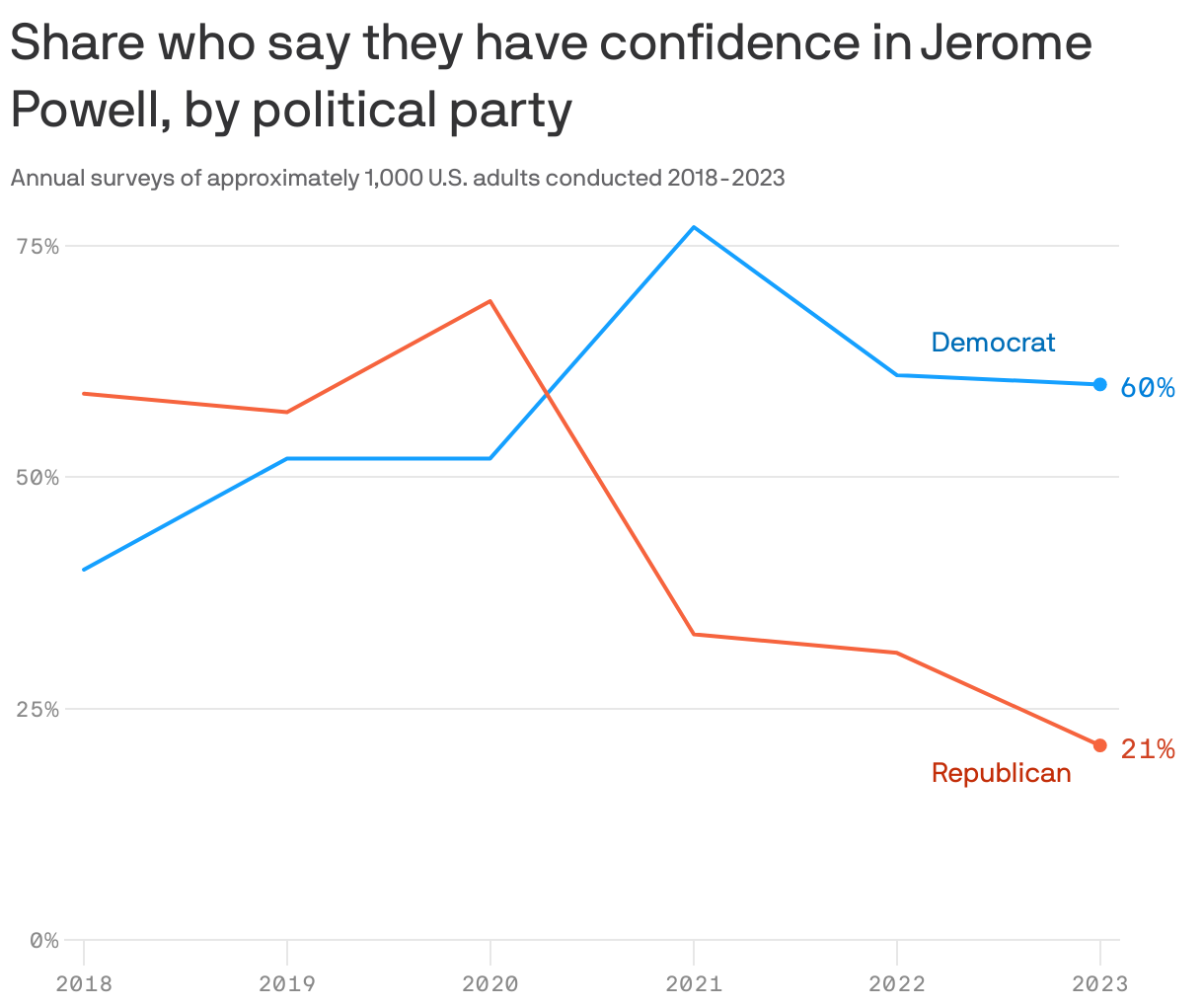
How confident are Americans in Federal Reserve chair Jerome Powell? That appears to depend on who's sitting in the White House, Emily writes.
Driving the news: Confidence in Powell declined this year from 2022 amid stubborn inflation and a banking crisis — but under the hood, partisanship plays a big role, according to a new survey from Gallup out Tuesday morning.
Zoom in: Since Powell was nominated by Republican President Donald Trump, and renominated by Democratic President Joe Biden, you've got the conditions for essentially a natural experiment on how partisanship colors Americans' views on the economy.
- From 2018 to 2020, when Trump was president, 62% of Republicans on average were confident Powell would do the right thing for the economy. Now, that number is 21%.
- Democrats' confidence in Powell went from 48%, on average, under Trump, to 60% in this most recent Gallup survey conducted in April.
The bottom line: "It's the politics, stupid," seems to have replaced the old James Carville line, at least for now.
Was this forwarded to you? Subscribe here.
Axios Markets was edited by Kate Marino and copy edited by Mickey Meece.
Sign up for Axios Markets

Stay on top of the latest market trends and economic insights