Axios Markets

June 08, 2023

1 big thing: 💴 Japan's stock market is a thing again


Japanese stocks are leaving other major markets in the dust this year, Matt writes.
Why it matters: This isn't just a markets story.
- The return of Japan to a leadership position among global markets — after literally decades of being viewed as a dead end for capital — is another reflection of how COVID, Ukraine, and the growing China-U.S. split are reshaping the world economy.
The latest: The Nikkei has notched a 14% gain so far this quarter, clambering to its highest closing level in nearly 33 years on Tuesday. The Japanese benchmark is up 22% this year, trouncing the performance of other large markets — as the chart below shows.
What's happening: Japanese stocks are getting a boost from a few separate but related shifts that add up to a transformative moment for the world's third-largest economy.
1.) After the better part of four decades, Japan has inflation again.
- The country's economy had been stuck in a low-growth, deflationary environment since it suffered a massive real estate and banking crisis in the late 1980s. Japanese companies have pricing power again, helping push 2022 corporate profits to record highs.
2.) With that profitability, policymakers see a chance to push through long-sought reforms to the country's sleepy corporate giants.
- For instance, this year the Tokyo Stock Exchange has begun quietly pressuring some companies — those trading below their price-to-book value — to boost cash return to shareholders, or potentially face delisting. Buyback announcements, once modest in Japan, have soared.
3.) The market's rise also mirrors growing tension between the U.S. and China — respectively, Japan's most important ally, and its massive neighbor — especially after Russia's invasion of Ukraine returned the issue of territorial conquest to the global stage.
- Companies in geopolitically sensitive sectors like defense and semiconductors have been major drivers of the rally this year — just look at Mitsubishi Heavy Industries and Tokyo Electron.
4.) Foreign investors are also starting to pile in, analysts say. Notably, this includes Warren Buffett, whose Berkshire Hathaway has boosted its key Japanese holdings recently.
- And Goldman Sachs analysts wrote in a June 2 note: "We recently had an extensive set of investor conversations in the US and Canada. Overall, the mood on China was as or more bearish as we have encountered over many years of such interactions. In contrast, interest in Japan was much higher than we typically find, especially regarding the theme of corporate change.”
Yes, but: Japan has had prior rallies that caught the market's attention — only to peter out.
- For instance, in 2013 the political ascension of Prime Minister Shinzo Abe and his economic revitalization program — known as Abenomics — generated a sizable market boost.
The bottom line: But if the shifts in the global economy — including the return of inflation and growing tensions with China — and its own corporate sector prove durable, then Japan's next decade could look very different from its last.
2. 🇯🇵 Charted: Leading the pack


3. Catch up quick
4. 🇨🇳 China's exports disappoint again


China's sluggish reopening woes continue, as its export sector struggles, Matt writes.
Why it matters: The world's second-largest economy is struggling to shake off the lingering effects of the pandemic and the harsh lockdowns it imposed in response.
- In part, that's because China is returning to a very different world economy than the one that existed before COVID and the war in Ukraine.
- Both events prompted countries worldwide to reassess trade relationships and the risks of relying on rivals for core products.
State of play: That's a problem for China, where domestic activity has been persistently weak. Industrial production, retail sales and capital investment were all softer than expected in April.
- New numbers Wednesday showed the economy isn't getting much help from exports, a traditional source of strength for the manufacturing giant. Exports declined 7.5% in May, compared with May 2022.
Between the lines: The export figures reflect the ongoing strains between China and its major trading partners in the West.
- China's exports to the U.S. were down 18% compared to May 2022.
- Exports to Europe fell 26.6%.
- On the other hand, exports to Russia — which has become economically reliant on China since its invasion of Ukraine prompted the West to sanction much of its economy — more than doubled.
5. 💸 Parity in 2056
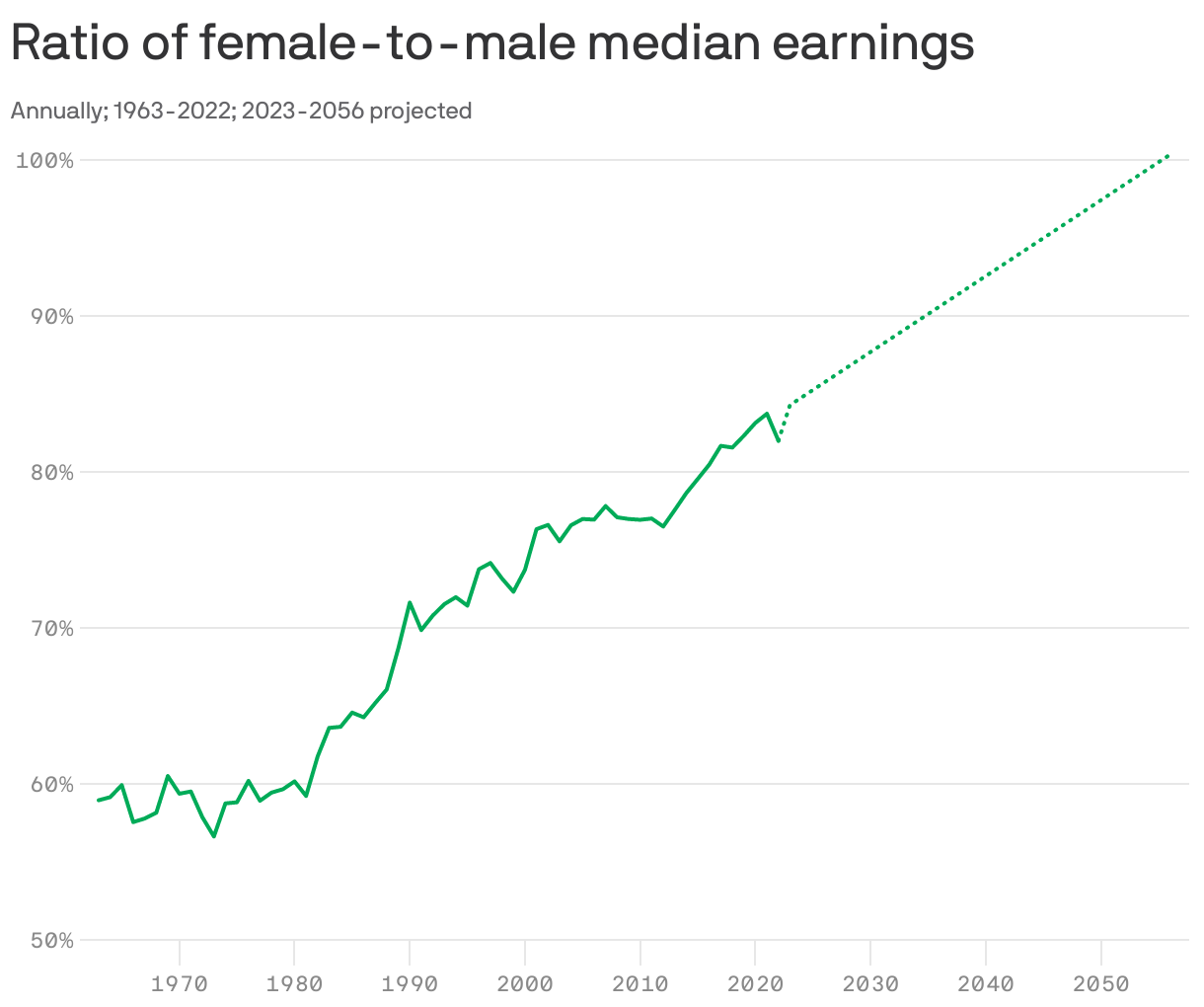
Saturday marks the 60th anniversary of the Equal Pay Act, which prohibits employers from paying women less than men for the same work, Emily writes.
Why it matters: Since the law passed, the wage gap between men and women has narrowed substantially — but not all the way.
By the numbers: In 1963, the typical woman working full-time, year-round earned 59 cents for every dollar earned by a male counterpart. In 2022, that number was 82 cents, per government data. (For women of color, the gap is wider.)
- At the rate we're going, women, working full-time year-round wouldn't achieve pay parity with men until 2056, per calculations from the progressive Center for American Progress out this morning.
- And the projection is rosy. It would be unlikely for the trend to continue at that pace without major structural changes, said Sara Estep, the associate director of CAP's Women's Initiative and the report's co-author.
State of play: A woman working full-time, year-round earned $9,954 less than her male counterpart in 2021, per CAP's analysis of the most recent available census data.
- Cumulatively, since 1967 when the data first became available, women have missed out on $61 trillion in pay because of the differential.
The big picture: Before you send me hate mail explaining that the pay gap is a myth, understand that women still earn less than men for a host of reasons, some outside the scope of that original law.
- A few factors: Women are overrepresented in lower-paying occupations and underrepresented in the highest, best-paying echelons of companies.
- They are also more likely to take time out of the labor force or work part-time to care for children or take less demanding jobs. All moves that lower their pay — sometimes for a lifetime.
The bottom line: In addition to all that, there is still some unexplained portion of the wage gap that economists attribute to wage discrimination.
Axios Markets

Stay on top of the latest market trends and economic insights