Axios Markets

May 13, 2026

👋 Hi! Stock futures are rising this morning, after markets tumbled on that scorching hot inflation report yesterday. Another inflation report, the Producer Price Index, is due out at 8:30am and could signal more increases on the way.
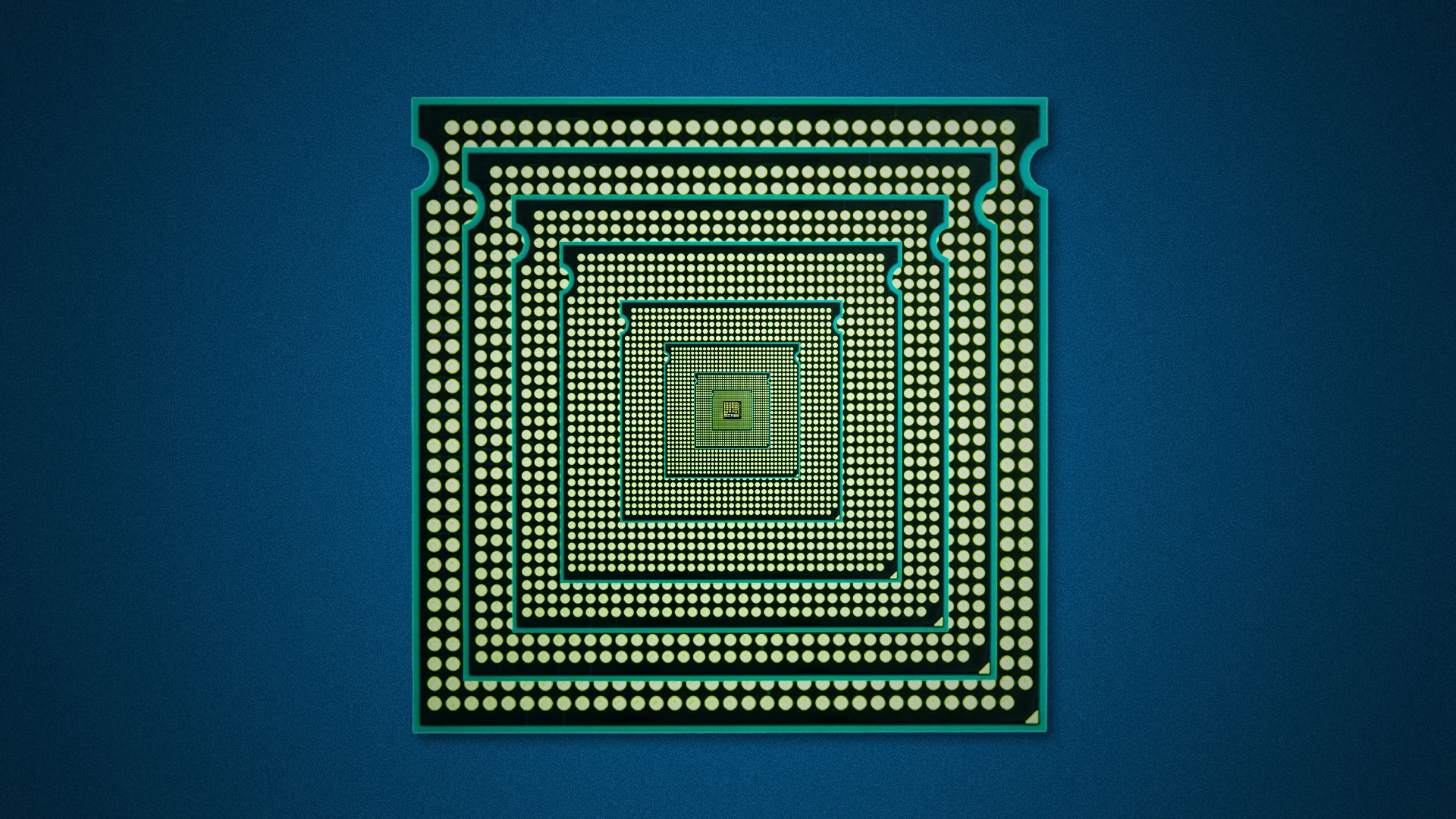
🗓️ Today, I'm obsessing over chips. No, not the delicious kind. The nerdy tech kind. The stock market is increasingly all about semiconductors, aka chips, and so is the geopolitical landscape.
Let's get into it! In 927 words, a 3.5-minute read.
1 big thing: Everything is chips now
We focus a lot on oil these days, but semiconductors, or chips, are again turning out to be the It Girl of the global economy.
Why it matters: Chips are essential to the AI build-out, and that's driving a huge burst of demand, creating supply shortages, pushing up prices and creating an investment frenzy.
- It also puts chips at the center of geopolitics.
The latest: Nvidia CEO Jensen Huang boarded Air Force One last night, joining the delegation to China, during a refueling stop in Anchorage.
- A source tells Axios' Mike Allen that President Trump rang Huang and invited him after media reports that the chip mogul wasn't part of the big delegation of U.S. CEOs joining the summit in Beijing.
Zoom in: The stock market is now largely a story about chips. Since the launch of ChatGPT in 2022, the PHLX semiconductor index, which tracks 30 of the largest companies in the industry, has grown to account for 16% of the S&P 500's market cap, up from 4%, Bloomberg's John Authers noted earlier this week.
- Chip stocks, which had been powering a rally since March, dragged the market lower yesterday as the PHLX index fell 3%.
The big picture: It's hard to overemphasize how weird the chip market is at the moment. Outside of the pandemic, when supply chain issues drove up costs, typically the price of computing power has trended down.
- Now, the frenzied demand for "compute" to power AI has driven up prices throughout the chip supply chain: from the fanciest logic chips to memory chips that store data to older ones that power infrastructure like cars or industrial machinery.
- "The part no one really bet on for 2025 and 2026 was the acute shortages," says Kelly Littlepage, founder of OneChronos, a company that designs new kinds of markets for investing. "Even older chips are now appreciating in value as an asset."
What to watch: Increasingly, companies are looking for ways to hedge the cost of compute.
- Littlepage's firm, which already offers so-called "smart markets" in which institutional investors trade complex stock and FX instruments, is developing one for compute, with input from Paul Milgrom, who won a Nobel Prize in 2020 for his work on auction theory.
Driving the news: It's not alone. Yesterday, CME Group said that it is launching a new futures market to trade compute.
- "As the backbone of the digital economy, compute is the new oil of the 21st century," CME CEO Terry Duffy said in a statement.
Friction point: Geopolitics hangs over all of this. Trump's meeting with Chinese leader Xi Jinping this week swings a spotlight on the global trade in chips.
- The U.S. dominates in advanced AI compute that sits at the top of the stack. But China owns the bottom — it has the critical minerals, and the more basic foundational chips.
- In other words, they need each other. The prospect of either economy achieving "industrial sovereignty" isn't likely anytime soon.
Between the lines: In the middle sits Taiwan. Most of the world's most advanced chips are manufactured on the island, as Treasury Secretary Scott Bessent said at Davos this year.
- "If that island were blockaded, if that capacity were destroyed, it would be an economic apocalypse."
The bottom line: Chips are kind of a big deal.
2. 1 to remember: The hottest ETF yet


Speaking of chip stocks — behold the newest play in the market: the Roundhill Memory ETF, ticker symbol DRAM.
- It's a basket of global memory chip companies, including SK Hynix and Micron Technology, that just launched last month.
Why it matters: DRAM appears to have had one of the best launches ever — reaching $6.5 billion under management in just 36 days on the market, per Bloomberg Intelligence ETF analyst Eric Balchunas.
- That's faster than any other exchange-traded fund — including the Bitcoin ETF, whose ticker is IBIT, which took 43 days after its launch in 2024.
What they're saying: "I'm stunned, frankly," Balchunas posted. "Regardless of what happens from here, this was one of the most heads up, best timed ETF launches I've ever seen."
- The ETF is rapidly becoming "the poster child for the ongoing semiconductor frenzy ... especially among retail investors," the data and research firm Vanda wrote in a note Monday.
Zoom in: Retail investors moved fast into DRAM — $200 million in net buying in just 27 trading days, Vanda reported.
- It took 29 days to get to $200 million for IBIT.
Zoom out: The memory chip market has historically been cyclical, driven by boom and bust cycles, Dave Mazza, the CEO of Roundhill told CNBC Monday. Companies typically signed short-term contracts to secure chip supply.
- But the market has evolved. Data centers are increasingly buying memory chips — and signing longer-term contracts with suppliers.
The bottom line: 15 years ago, Marc Andreesen famously wrote that "software is eating the world."
- Now, Mazza said, it's semiconductors' turn.
Send me tips and story ideas: [email protected] or reply to this email.
Thanks to Jeffrey Cane for editing and Carlin Becker for copy editing this edition.
Tell your friends to sign up here. You can also hit me up on X.com or Bluesky at EmilyRPeck.
Sign up for Axios Markets