Axios Markets

October 06, 2023
Phew. We made it to Friday. Seems like yesterday it was only Thursday. Heading into the weekend, Emily is betting that Grazer runs away with the Fat Bear crown β readΒ more from Axios' Ivana Saric.
- Calendar note: We'll be off on Monday in observance of Indigenous Peoples Day β and back in your inbox on Tuesday.
Today's newsletter is 1,129 words, 4.5 minutes.
1 big thing: Reshaping the food ecosystem
Illustration: Sarah Grillo/Axios
As Ozempic and similar weight loss drugs become more popular, Americans might start buying less food, particularly high-calorie snacks and fast food, Emily writes.
Why it matters: That could radically reshape the food industry, and investors and food industry executives are starting to pay attention.
- Ozempic is approved by the FDA to treat diabetes but is also prescribed for off-label use by doctors for obesity.
Driving the news: Earlier this week, Walmart's U.S. CEO told Bloomberg that customers taking Ozempic buy less food. (Walmart mined its own pharmacy and grocery data to pinpoint customer buying patterns, per Bloomberg.)
- "We definitely do see a slight change compared to the total population, we do see a slight pullback," John Furner said. "Just less units, slightly less calories." But he added that it's still early days for Ozempic.
- The drug itself has boosted sales of other items at Walmart β folks on the drug "tend to spend more with us overall," another company exec said this summer.
- Meanwhile: Steve Cahillane, CEO of snack maker Kellanova, told CNBC this week that his company β a Kellogg spinoff that makes Pringles and Cheez-It β is watching the Ozempic trends. "But it's just far too early to forecast this is a headwind."
The big picture: It's early, yes, but investors are paying close attention. In an 82-page note this summer, a team of 17 Morgan Stanley analysts, strategists and associates laid out how obesity medicine could dampen demand for food and reshape the "food ecosystem."
- The firm projects that over the next 10 years, 7% of the U.S. population β 24 million people β could be taking these drugs.
- Folks on the drug will likely consume 20% fewer calories, they say.
- In 2035 that would represent 1.3% of overall calories consumed. Analysts also modeled out a bullish scenario where calorie consumption falls by 1.7% and a bearish one at 0.9%.
Increased use of these weight-loss drugs could hurt demand for high-calorie, high-fat and sugary foods β at home or at fast-food outlets.
- Products made by Pepsi and McDonald's β and even Altria, as some users say Ozempic curves cravings for cigarettes β could take a hit, according to a note from Barclays this week cited by Bloomberg.
The upshot: Americans' consumption of soda, baked goods and salty snacks might be around 3% lower, the Morgan Stanley analysts write.
Reality check: It's compelling to think Ozempic will change the food economy, but "right now these drugs are still being understood," Peter Bonis, chief medical officer at Wolters Kluwer Health, tells Axios. There are questions about how users will do on them long-term β or how long they'll even stay on the medication.
- Plus, he points out, that the food industry is adaptable and is used to changing tastes.
- Companies can shift product mixes and packaging sizes to preserve profitability, food company executives told the WSJ.
Editor's note: This story has been updated to clarify that Ozempic is only approved for treatment of diabetes.
Bonus chart: How weight loss leads to big gains


Novo Nordisk, the Danish pharmaceutical company that makes Ozempic and Wegovy, has seen its stock soar thanks to the new popularity of these drugs.
- "Novo Nordisk's gain may be Kellogg's loss," as Axios' Felix Salmon wrote earlier this week.
Another winner: Patients who lose weight. "We have an obesity problem in the United States that leads to all sorts of untoward health effects," said Bonis from Wolters Kluwer.
- If we're able to address that problem, he emphasized, it's a "good thing."
2. Catch up quick
π° Exxon closing in on a deal to buy Pioneer Natural Resources for $60 billion that would reshape the oil industry. (WSJ)
β¨ Biden makes plans to meet Chinese leader Xi Jinping in San Francisco next month. (Washington Post)
3. The trade deficit is shrinking

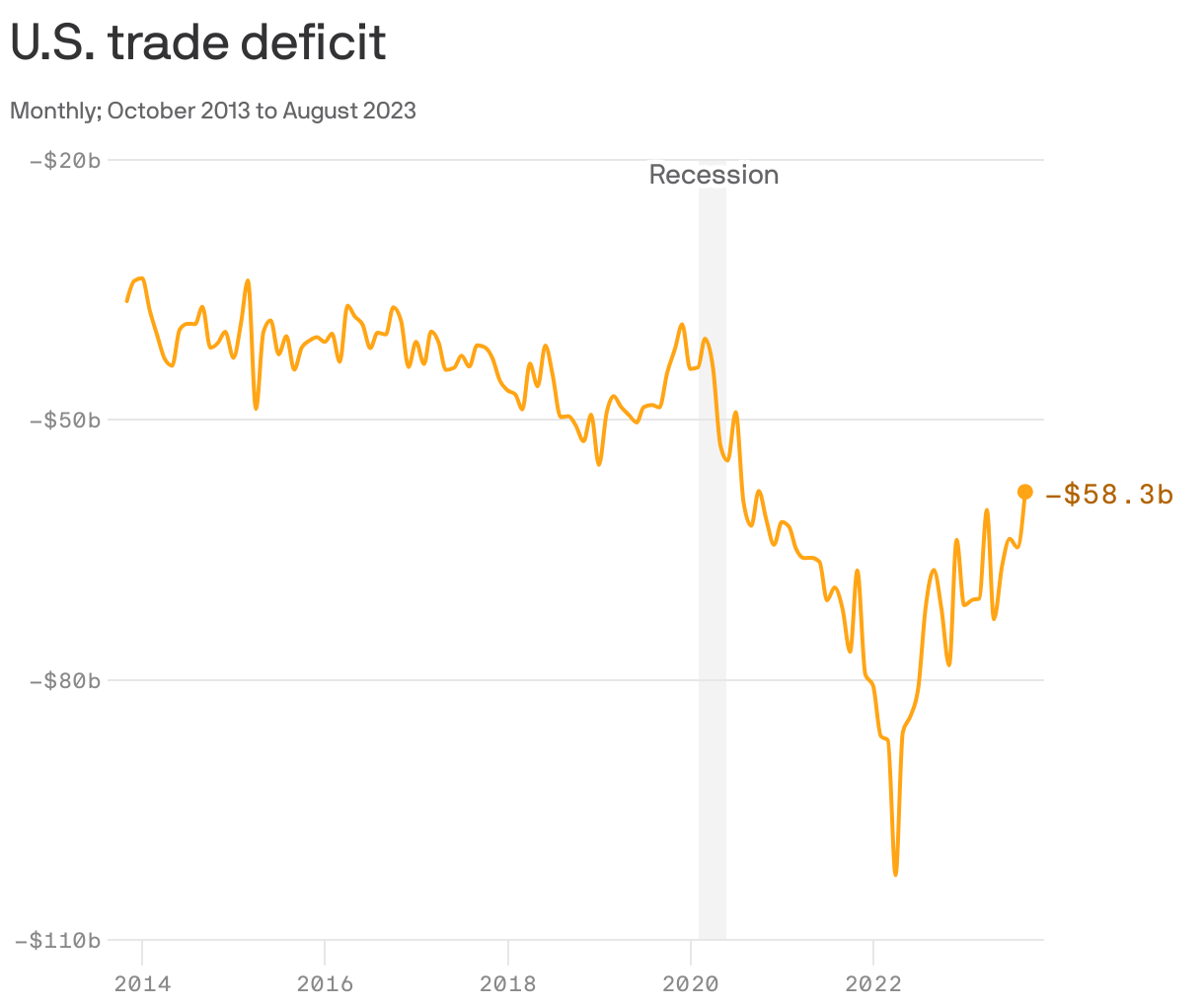
The U.S. trade deficit narrowed in August to the smallest in three years, Matt writes.
Why it matters: The deficit is going down because of a sharp downturn in imports of consumer and investment goods, which could be a sign of weakening demand in the U.S.
- On the other hand, the downturn in goods purchases may merely be a return to normal after the binge that came during and after the COVID crisis.
By the numbers: The trade deficit declined by roughly 16%, to $58.3 billion, in August, compared to the same month last year.
- U.S. exports rose, driven by rising crude oil sales. And imports fell, thanks to declines in cellphones, semiconductors and electrical equipment.
Be smart: The trade deficit is a measure of the gap between what the U.S. buys from foreign nations and what it sells overseas.
- Rising imports typically reflect increasing consumption, a key sign of economic health in the consumption-driven U.S.
- But deficits actually reduce gross domestic product, given the way the measure is calculated.
- So, the smaller deficit β while it actually might be a sign of weakening demand in the U.S. β actually could mean a better-than-expected GDP number for the third quarter.
The big picture: The large trade deficits that emerged in the 1980s, and grew with the rise of China as an exporting powerhouse, are associated with large job losses in some industries β especially in electorally powerful industrial Midwestern states.
The bottom line: Month-to-month swings are less important but the narrowing of the deficit in August could set the stage for a stronger Q3 GDP report than many expected.
- Goldman Sachs economists raised their estimate for Q3 GDP to 3.7% after the release of the numbers yesterday.
4. Message received
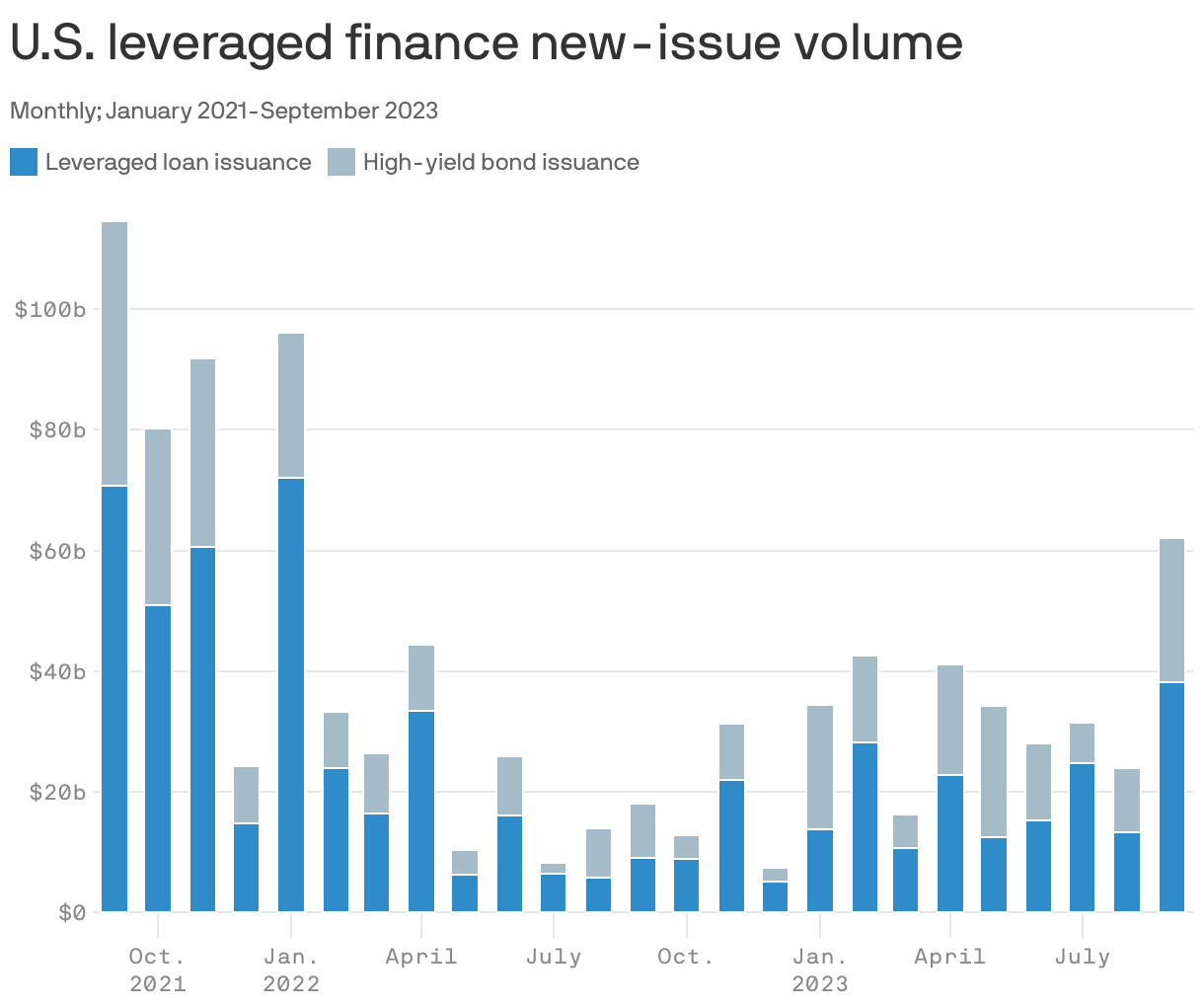
High-yield rated companies, or those with lower credit ratings, borrowed more in the capital markets in September than they have in any single month since January 2022 β before the Fed started raising rates, Axios' Kate Marino writes.
- Why it matters: The "higher for longer" message has been received. As benchmark rates soared last month, corporate treasurers and deal-makers scrambled to lock in new debt before it got even more expensive.
How it works: When lower-rated companies want to fund M&A, refinance their debt, or bankroll a project, they often tap investment banks to raise bonds or loans for them.
- Borrowing nearly ground to a halt last year as rates started climbing β but now, companies are less inclined to wait for that future moment when rates go back down.
5. π¬ Quoted: The market hiked
"The bond market has tightened quite considerably, about 36 basis points, since [the FOMC] met in September. Well, that is equivalent to about a rate hike, right? So then the need to do tightening, additionally, is not there.β Mary Daly, San Francisco Fed president, speaking yesterday at The Economic Club of New York
Why it matters: As of the Fed's September meeting, it was still an open question as to whether the policy-setting committee would hike rates one more time this year.
- But as Daly implies, the market may have already effectively done that itself.
The intrigue: The inverted yield curve over the last year has blunted the impact of the Fed's rate hiking campaign, as our colleague Neil Irwin wrote yesterday.
- But with the 10-year yield soaring, that may be set to change.
Was this email forwarded to you? Subscribe here.
Today's Axios Markets was edited by Kate Marino and copy edited by Mickey Meece.
Sign up for Axios Markets

Stay on top of the latest market trends and economic insights